
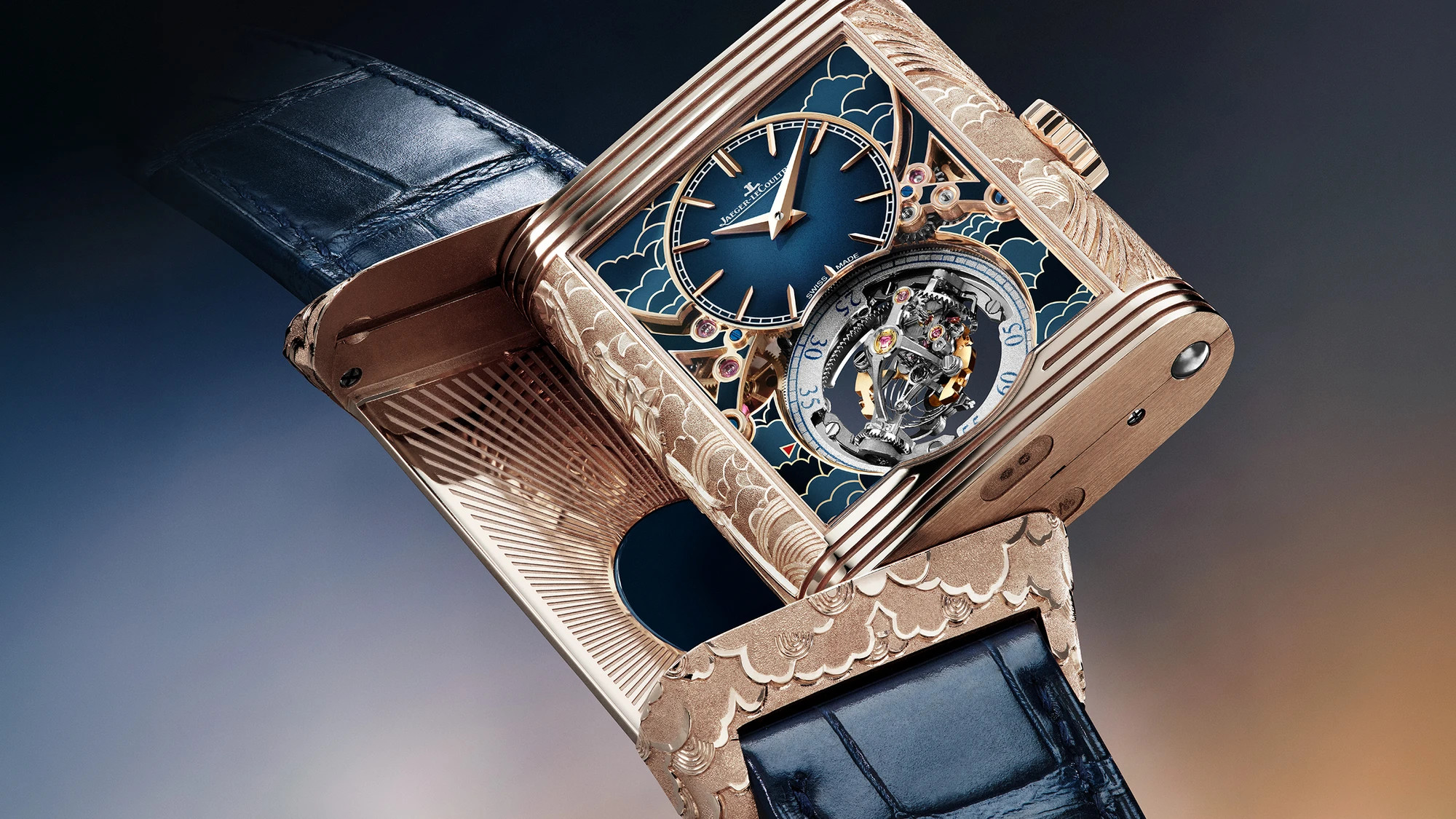
The work begins with a single block of 18K pink gold. It ends 180 hours later, with the form of a winged horse wrapped seamlessly around the case of a new Jaeger-LeCoultre Reverso. This is not a simple surface treatment. It is a sculpture, executed on a miniature scale, where relief engraving creates shadows that give the impression of volume and movement.
The watch is the Reverso Hybris Artistica Calibre 179 Pegasus, a limited edition of five pieces. The choice of Pegasus, the flying horse of Greek mythology, is deliberate. It connects the watch back to the Reverso’s origins on the polo fields, linking the discipline of sport with the freedom of myth. The engraving itself is so complete it almost hides the join between the upper and lower parts of the case, creating a continuous canvas.
Technique Becomes Imagination
The cloud motif from the case engraving is carried over to the front dial. Here, two plates are set at different levels. More than 50 hollows are carved into their surfaces and hand-filled with layers of blue lacquer in varying shades, creating a depth that complements the tourbillon aperture. Between these plates, open-worked bridges, also lacquered in dark blue, give a glimpse of the Calibre 179 movement within.
Flipping the case reveals the Duoface movement’s second time zone display. The reverse dial is fully skeletonised, its hours-minutes ring and support bridges traced in blue lacquer. This finishing contrasts with the warm 18K pink gold of the movement components. The skeletonisation is amplified by extensive hand-bevelling, a process that takes approximately 14 hours for the Gyrotourbillon cage alone and another eight hours for a single signature bridge on the reverse side.