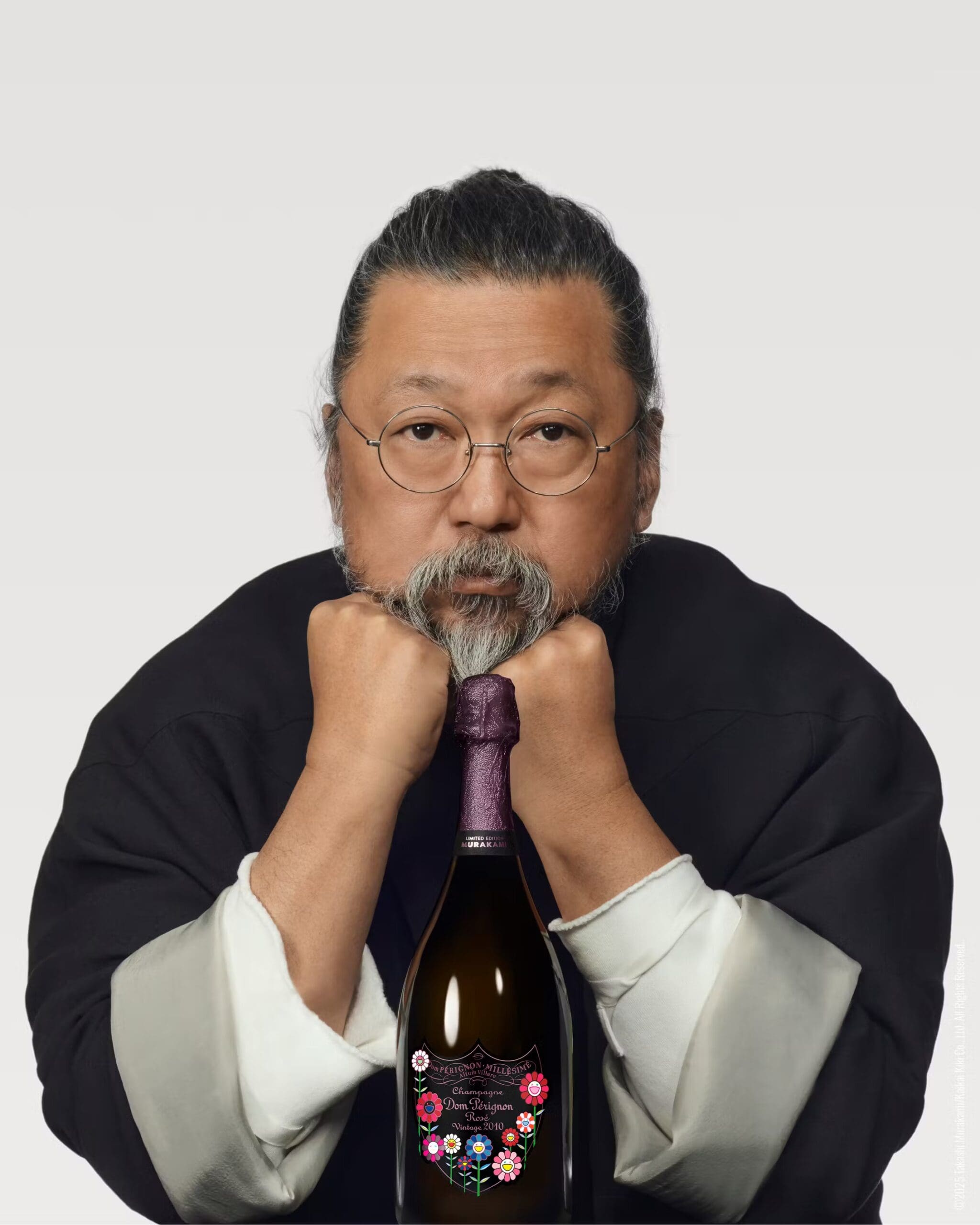
Takashi Murakami is one of seven creative talents enlisted for the Maison’s new chapter, Creation is an Eternal Journey. The brief is simple enough on paper. Murakami’s smiling flowers meet Dom Pérignon’s severe elegance. The result is less a stunt and more a study in contrast.
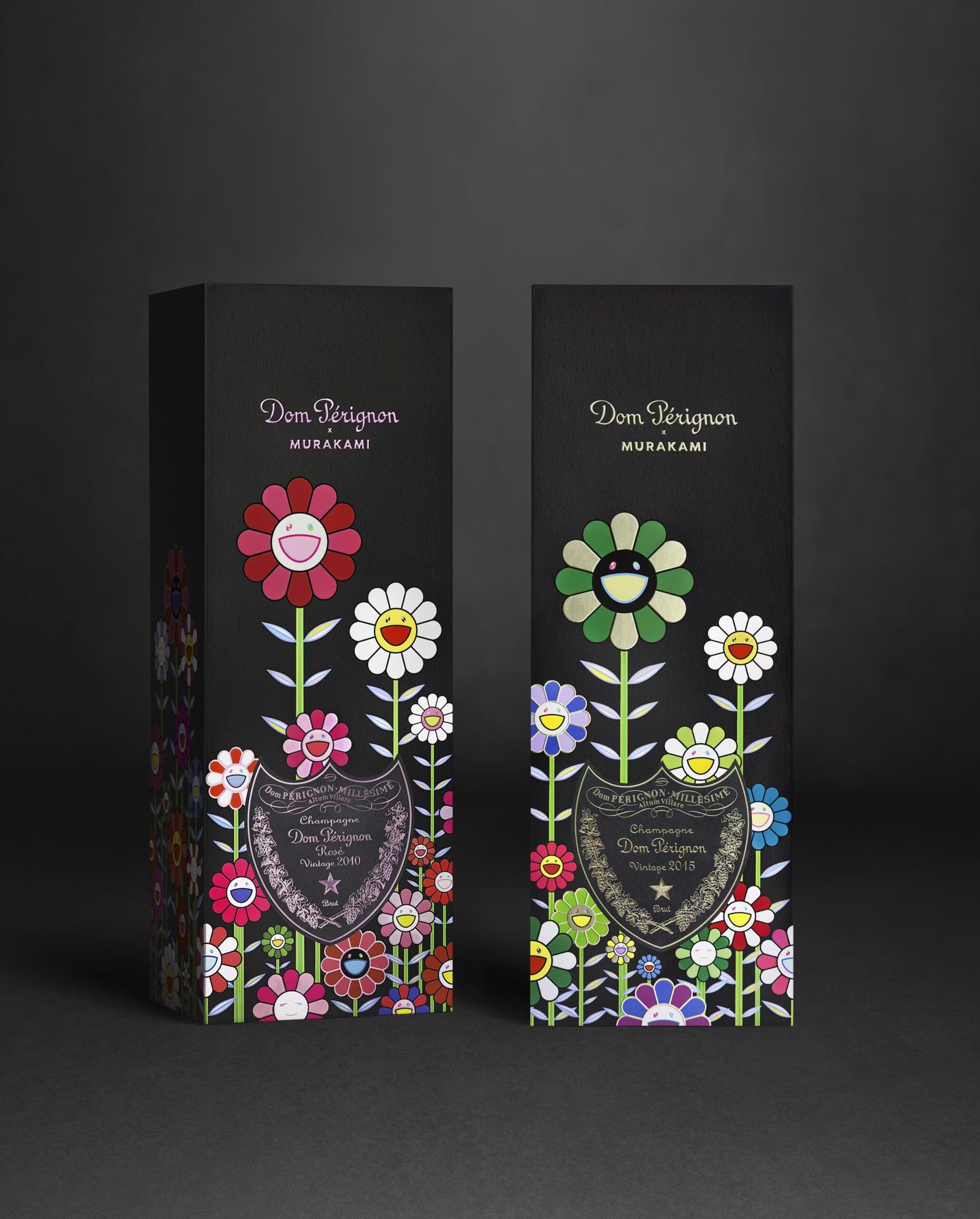
The designs are exactly what you imagine when Superflat meets the Maison’s most austere silhouette. A dark, almost satin bottle and coffret punctuated by saturated blooms that read from across the room, like colored glass under low light. The Maison’s shield sits centered and calm while Murakami’s kawaii flowers orbit as bright satellites. It is the tension that carries the object. Minimalism holds its ground. Pop art provides the spark.

Murakami has said he wanted to express time travel, to make a label that still reads in a century when everyone involved is gone. That ambition feels aligned with Dom Pérignon’s habit of patience. The Maison rewards slowness, and the idea of watching a label scuff and soften while the wine inside evolves gives the piece a quiet resonance. The visual is cheerful. The subtext is about time.
On the table, this edition behaves like good design should. You notice the weight of the coffret lid, the soft friction of matte against palm, the sudden snap of chroma when the bottle meets candlelight. Pull the cork and the pop is the same as ever, but now the conversation shifts. It becomes about the role of contemporary art at dinner, about whether flowers on a label are frivolous or a gift to the room. It is a talking point that does not demand center stage once the glasses are poured.

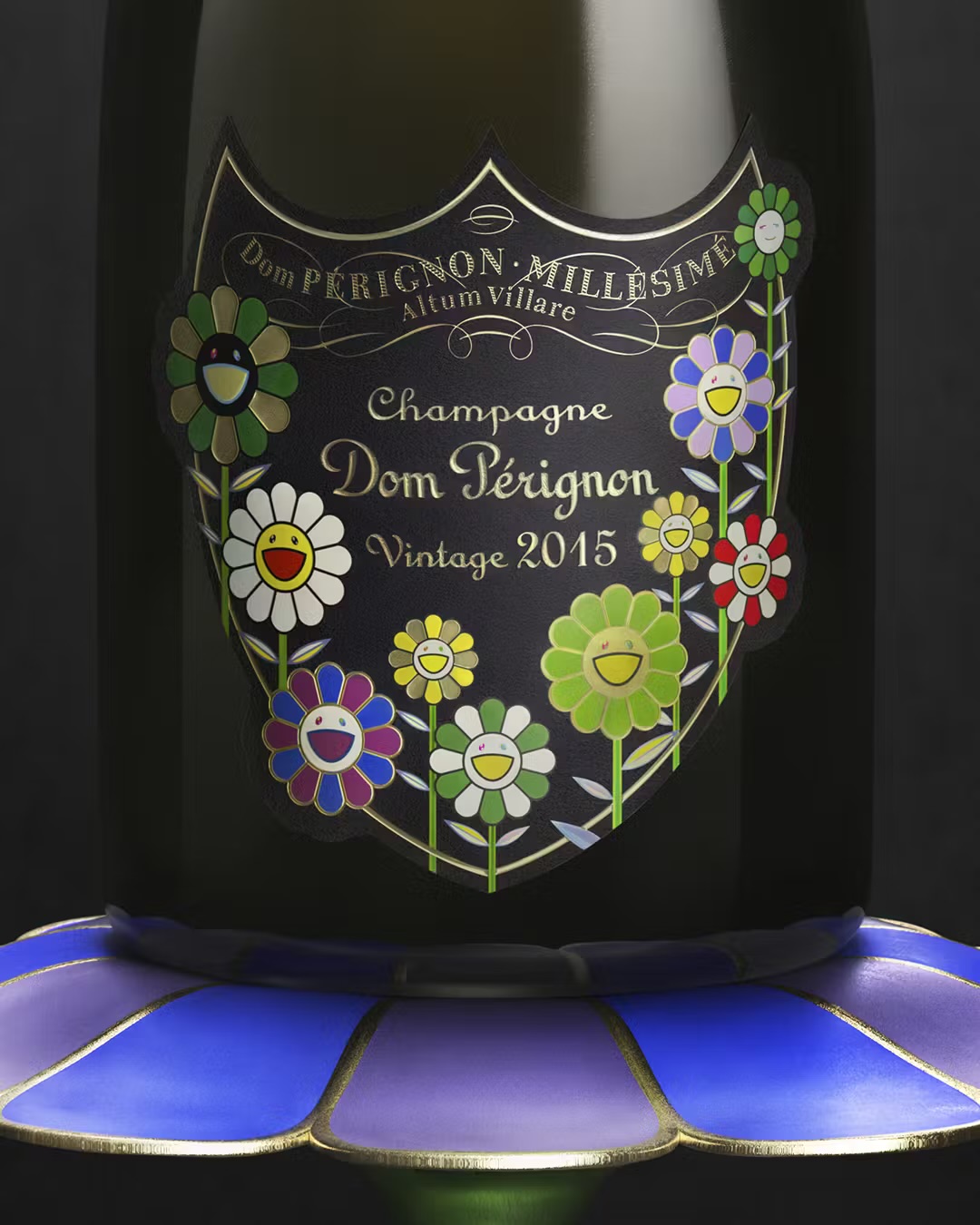
The wines themselves are established quantities within Dom Pérignon’s canon. Vintage 2015 and Rosé 2010 carry the house’s name and therefore its standards. The release does not disclose allocations or pricing, which is worth noting for anyone eyeing these as future trophies. This is where the modern gentleman needs a rule of thumb. If you buy it, open it. If you love the label, keep the empty as a small artifact of the present.
Context matters. Dom Pérignon has long dialogued with culture. Andy Warhol, Jeff Koons, Karl Lagerfeld, Lenny Kravitz, and now Murakami. The pattern is not random. The Maison often stands in for ceremony. Inviting artists into that space reframes what ceremony looks like for our time. Murakami’s language is playful and polarizing. Some will call it cutesy. Others will recognize the rigor beneath the smile. Here, the palette is disciplined, the flowers are restrained by the darkness of the bottle, and the overall effect respects the house’s classical core.
In the broader luxury landscape, artist editions usually split into two camps. Objects that exist to be flipped, and objects that improve the rituals they touch. This one leans toward the latter. The packaging is memorable, but not louder than the wine. That is the correct balance. It also serves as a reminder that LVMH’s cultural projects are strongest when they set the scene rather than steal it.
For collectors, this will sit comfortably beside previous Dom Pérignon art editions. For hosts, it is a way to add a contemporary note to a traditional meal without turning the table into a stage. For the skeptics, the collaboration confirms that the Maison can accommodate new imagery without losing posture.
The closing thought is simple. Murakami’s flowers will age. The bottle will scuff. The wine will tell its own story. If the goal was to plant a pop emblem in the Maison’s dark glass and let time do the rest, this is a credible start. Not loud. Not precious. Just a clear sign of where high culture and high craft meet now.
Read more about culture here.