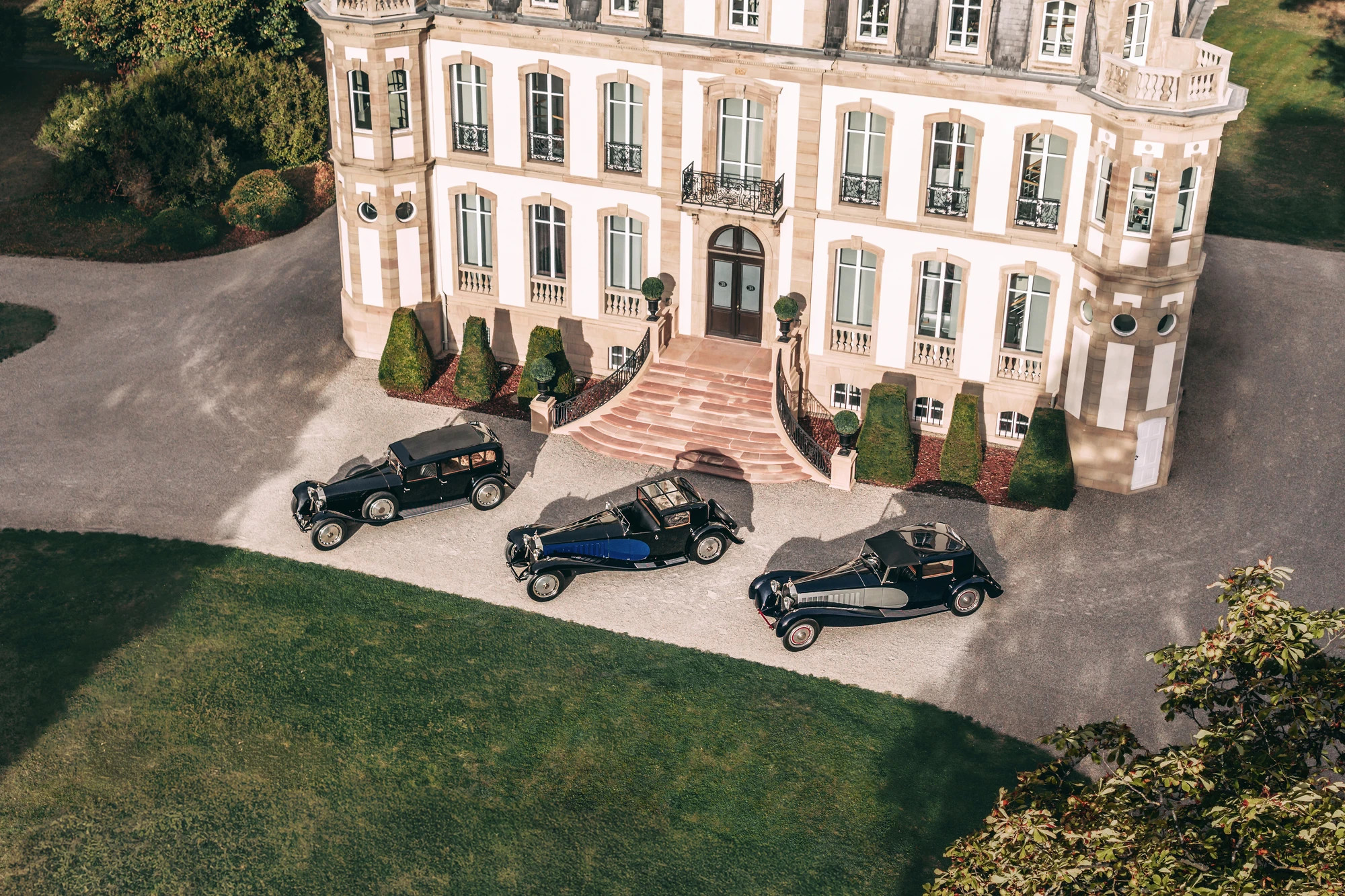
Bugatti measured the Type 41 Royale at more than six meters from bumper to bumper, setting the wheels roughly 4.3 meters apart. When the machine surfaced in British motoring circles in June 1926, observers referred to the immense prototype simply as The Golden Bugatti. That presence arrived with purpose. Ettore Bugatti wanted to construct an automobile for emperors and monarchs, working with proportions that ignored standard manufacturing boundaries entirely.
Only six examples ever left the workshop. The original prototype carried an engine displacing approximately 14.7 liters before production settled on a definitive 12.8-liter straight-eight. Producing around 300 horsepower, the aviation-derived block moved roughly 3.5 tons of metal, leather, and wood up to a maximum speed of 200 km/h. Engineering on that scale required dry-sump lubrication and intricate valve gear to function with mechanical authority.
The Bugatti Approach to Singular Engineering
The mechanical chassis served as a foundation for independent European coachbuilders, including Kellner, Weymann, Park Ward, Binder, and Weinberger. The Coupé Napoléon remains the clearest study of how that balance worked. Originally fitted with a fixed-head Weymann body, the car suffered extensive damage in a crash during the early 1930s. Jean Bugatti stepped in to reshape the damaged chassis, establishing an enclosed passenger salon beneath a glazed roof while the driver sat exposed ahead.
Personal patronage shaped every single body. Armand Esders, a Parisian textile industrialist who became the first private client to secure a chassis, commissioned a roadster body directly through Jean Bugatti. Esders informed the factory that his driving took place exclusively under natural daylight, prompting the design team to eliminate headlights entirely. Henri Binder later acquired the chassis and rebodied the mechanical base into an armor-plated Coupé de Ville, which is preserved today by the Autostadt.
Ettore Bugatti approached instrument placement with equal precision. In 1932, he commissioned Breguet to produce a series of nine mechanical chronographs designed for the center of the Royale steering wheels. Engraved with the words Spécial pour Bugatti, each dial integrated an eight-day power reserve and a tachometer alongside elapsed time counters. That horological union accompanied tactile details like whalebone control knobs, polished walnut rims, and the standing elephant mascot cast by Rembrandt Bugatti.