
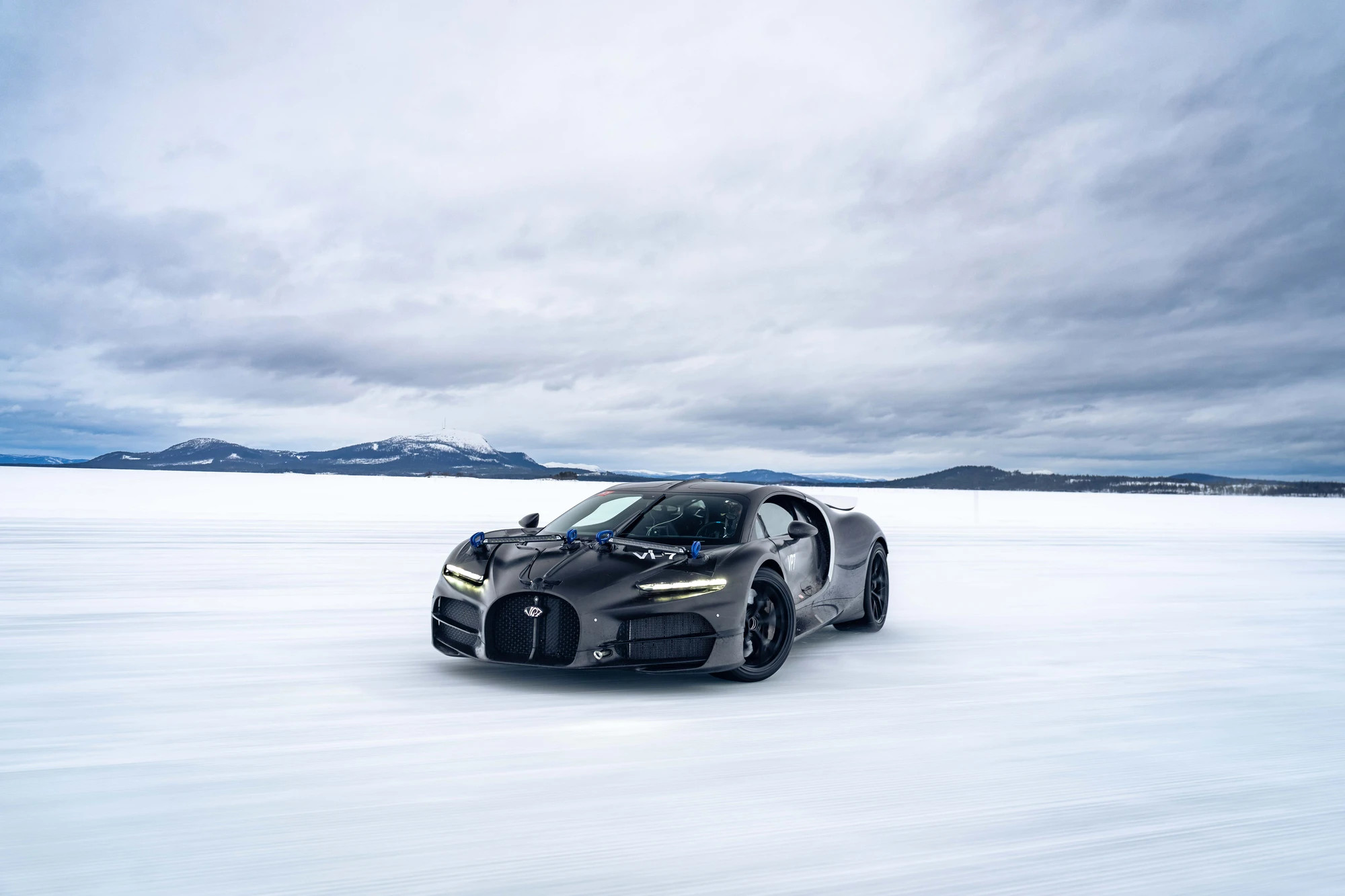
In Arjeplog, Sweden, the temperature drops to -30°C. The ground is a shifting mix of polished ice, packed snow, slush, and asphalt. This is the environment where the new Bugatti Tourbillon has come for four weeks of winter validation, a process designed to prove its systems at the very edge of engineering possibility.
The car itself is built on an all-new platform, with a naturally aspirated V16 engine and three electric motors producing a combined 1,800 HP. The central task in Sweden is to ensure that immense output remains accessible and faithful to the driver’s inputs, even when grip is at its most fragile.
A team of 20 people supports the program, with a core group of six working in two shifts to capture data. With a narrowing window for true winter conditions, they extend their work into night sessions. “We are maximizing our potential and basically using the best out of what we can from what the weather allows us,” the team explained.
Mastering the Surfaces
The work focuses on what engineers call low-MU conditions, where the coefficient of grip is dramatically reduced. Here, the team refines the integration of all-wheel-drive torque distribution, traction control, and the electronic stability control. A key area of assessment is the brake-by-wire system, which must seamlessly manage the relationship between regenerative braking from the electric motors and the hydraulic foundation brakes.
One of the most demanding tests is the MU-jump. The prototype begins braking on dry or heated asphalt before transitioning onto polished ice, forcing the ABS and ESC systems to recognize and respond to the sudden loss of adhesion. “What we look for in the system is its ability to fight and master various kinds of conditions,” a test-driver noted.