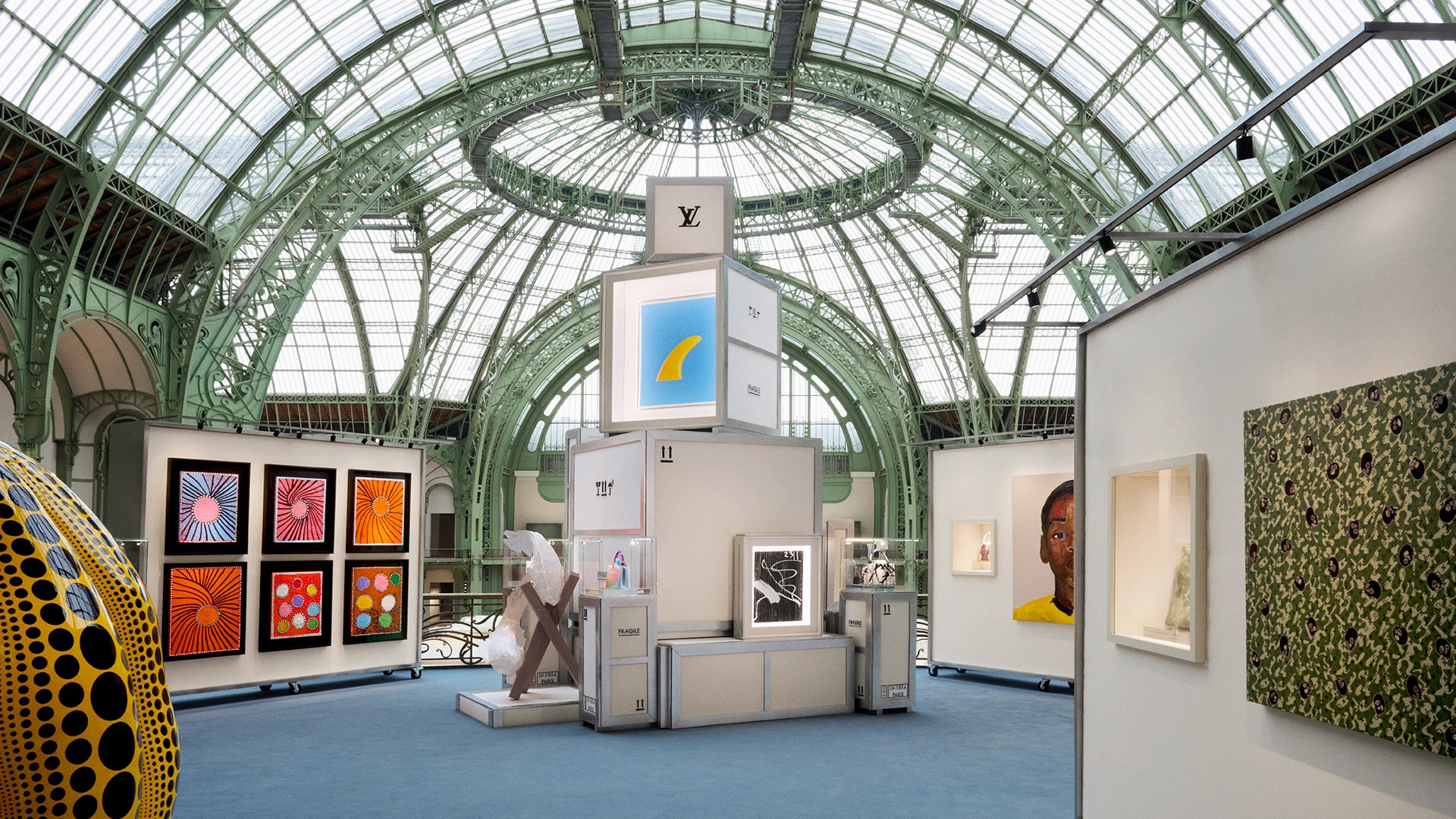
Capucines leather greeted visitors inside the Grand Palais from the interior of raw shipping crates. The installation marked seven years of Louis Vuitton’s Artycapucines initiative during Art Basel Paris 2026, where the house participated as an associate partner. Fourteen artists formed the core of the retrospective, which opened to the public on October 23. Every creation on display documented a direct dialogue between individual studio practices and the technical capabilities of leather artisans. The Grand Palais gave the collection an imposing cultural setting, framing these specialized bags as genuine artifacts of modern material culture.
Display plinths across the exhibition hall used brushed aluminum and natural cotton canvas. These utilitarian materials evoked the physical mechanics of moving fine art across oceans and continents. The design referenced the earliest trunks built by Louis Vuitton, objects conceived specifically to protect delicate possessions in transit. Packing crates and preservation cases became the visual language of the gallery, reminding viewers that utility sits at the base of every luxury object.
Organizers positioned each finished bag directly beside the original painting or sculpture that sparked its creation. That physical pairing established the Capucines as a serious object of inquiry. Visitors could trace how a brushstroke or carved surface traveled from an artist’s private studio into a structured leather silhouette. Seeing the source artwork next to the leather goods highlighted the technical translation achieved by the artisans.
The Capucines as an Architectural Object
Since 2019, the Capucines handbag has served as a consistent foundation for external collaborators. The design carries clean vertical lines, an arched top handle, and distinctive hardware that define its physical identity. Those firm proportions provide the stability needed to host radical visual ideas. The geometric discipline of the bag allows diverse creators to test their visual theories without compromising the handbag's essential form.
Artisans pushed leather far beyond conventional leathercraft to realize these projects. They integrated detailed embroidery, complex assemblage, and sculptural molding directly into the hides. Every edition required new mechanical calculations, expanding what the workshop bench could produce. The resulting pieces turned functional hides into surfaces capable of holding complex dimensional compositions.
Color and textural experimentation transformed the skin of each bag into an active surface. Heavy relief work sat alongside delicate needlework across the gallery space. The fourteen artists brought distinct graphic vocabularies to the table, and the craftspeople adapted traditional tools to meet those demands. Hand stitching supported intricate structural layers, demonstrating how classical leatherworking adapts to modern conceptual demands.