
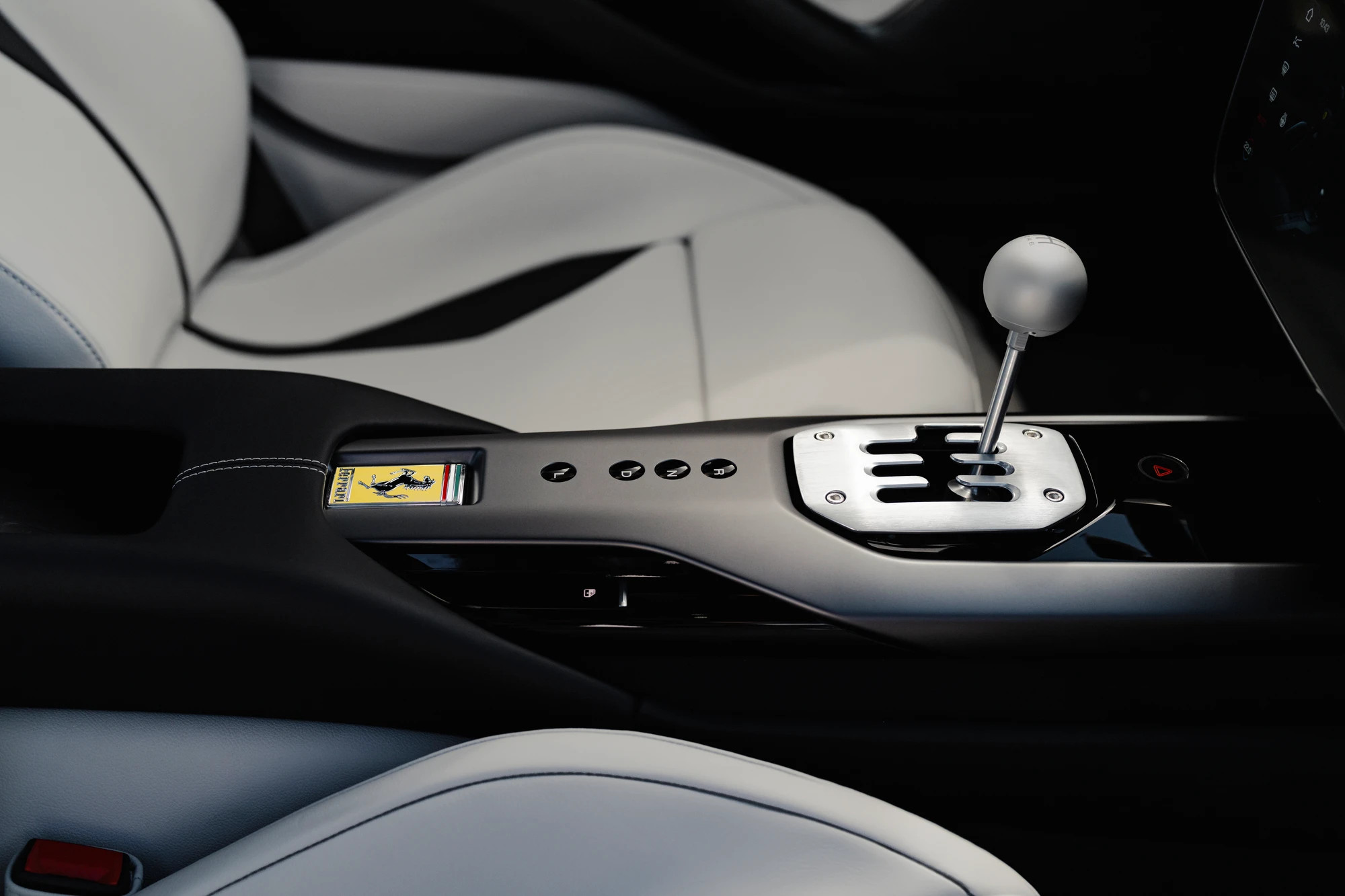
The kinematic mechanism generates clicks. It creates load variations, sending feedback through the gear lever to the driver. If the clutch pedal is not depressed, the system can mechanically inhibit the gear change. This is the core of the new Ferrari 12Cilindri Manuale, a car that reintroduces a three-pedal layout by translating physical movement into an electronic signal.
Unveiled in Maranello, this limited-edition series of the Ferrari 12Cilindri is built around a system named Manuale By-Wire. It pairs the car's naturally aspirated, 9,500 rpm V12 with the company's existing 8-speed dual-clutch transmission, controlled through an entirely new manual command architecture. There is no direct mechanical linkage between the lever and the gearbox. Instead, the driver interacts with a gear lever and a clutch-by-wire pedal, both developed entirely in-house.
A Digital Reinterpretation of Analogue Feel
The system was designed to preserve the physical sensations of a traditional manual. The gear selector module, machined from solid blocks and weighing less than 3.5 kg, uses advanced kinematics and sensors to replicate the mechanical loads felt during synchronisation and engagement. Even the acoustic effects of its movements were a point of focus during development. Expertise was drawn from across the company, including the team behind the Hypersail project, which developed a similar by-wire solution for the nautical sector.
The clutch pedal operates on the same principle. A position sensor tracks the driver’s input, which is then translated into hydraulic actuation of the DCT clutch. An innovative passive mechanical system recreates the specific load-travel curve of a mechanically linked pedal. The result is behaviour consistent with a traditional gearbox. A correct shift is smooth, while a mistake can result in a jerk or a stall, preserving the satisfaction of authentic torque feedback.