
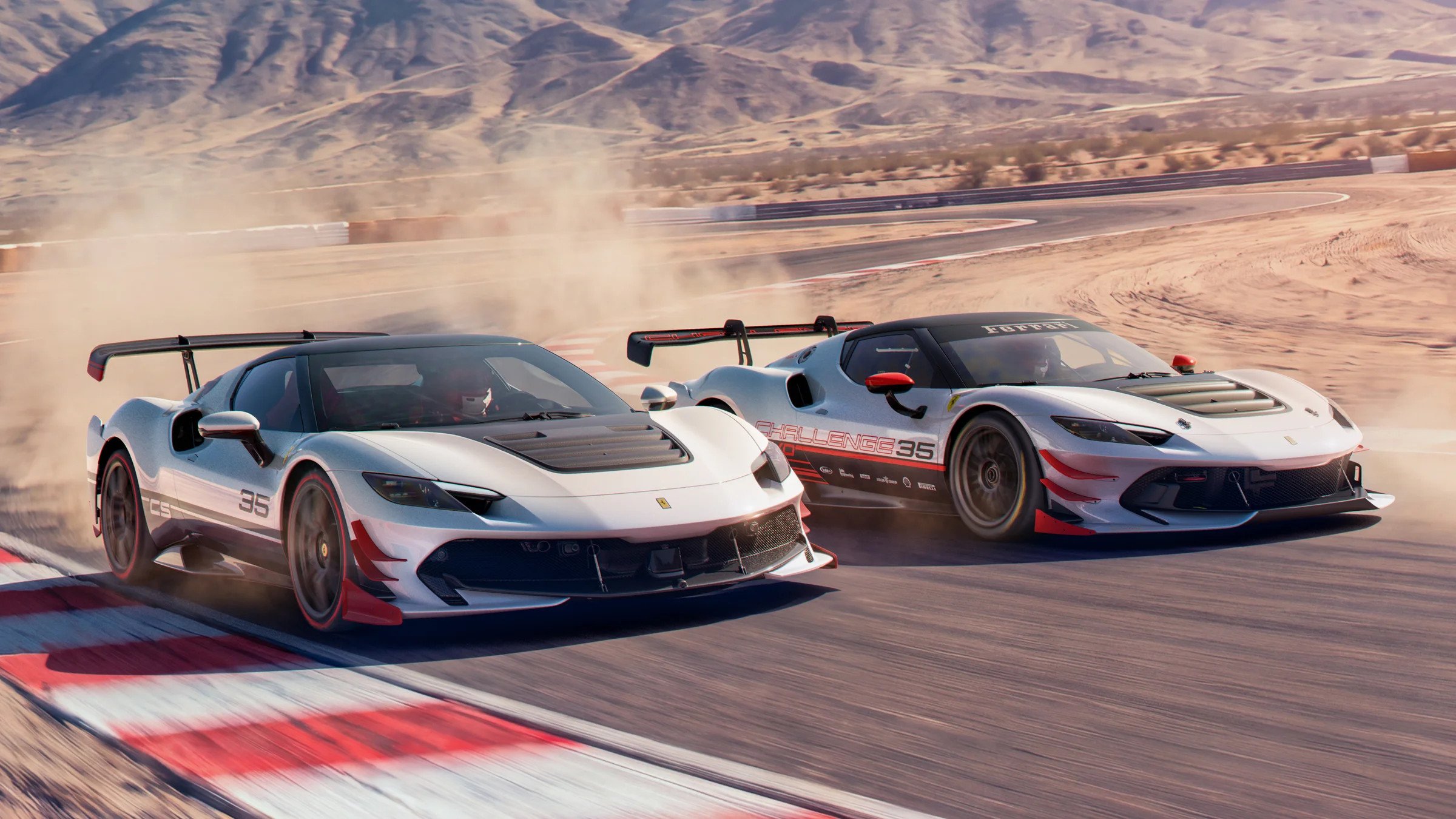
Ferrari brought two distinct machines to the tarmac at Circuit de Barcelona-Catalunya during the 2026 Finali Mondiali in Montmeló. The 296 Challenge Stradale and the 296 Challenge Evo arrived side by side, sharing an explicit technical bloodline rooted in customer racing. Both cars abandon hybrid electrification in favour of an unassisted 120-degree twin-turbo V6 engine.
Stripping the hybrid system from the powertrain removes 140 kilograms compared to the road-going 296 GTB. The 296 Challenge Stradale hits a dry weight of 1,330 kilograms. That figure yields a power-to-weight ratio of 1.98 kilograms per horsepower, matching the scale of the pure-competition 296 Challenge Evo. The engine develops 670 horsepower at 8,000 rpm in the road car, routed through an eight-speed dual-clutch transmission.
Removing the electric motors directly links the driver's throttle inputs to the rear wheels. The power delivery relies entirely on internal combustion, utilizing the 2,992 cc architecture that previously established lap records across European circuits in the 296 Speciale. The cabin and exterior packaging reflect this mechanical directness with visible technical elements.
Ferrari Aerodynamics and Mechanical Grip
Aerodynamic development generates significant vertical load across both platforms. The road-legal 296 Challenge Stradale produces 617 kilograms of downforce at 250 km/h, representing a 72 percent increase over the standard 296 GTB. This downforce relies on a fixed rear wing, front splitter, side flicks, an aero damper, vortex generators, and a fully sealed underbody.
Dynamic grip comes through dedicated chassis electronics and bespoke rubber. The Stradale uses ABS Evo across every Manettino setting, maintaining consistent intervention during aggressive trail braking. Ferrari mounts Pirelli P Zero R tyres for balanced street and circuit driving, with track-focused P Zero Trofeo RS compounds available as an optional specification.