
Ferrari Showed Two Futures In Monterey
    By Ash Mirghadiri

    Ferrari Showed Two Futures In Monterey

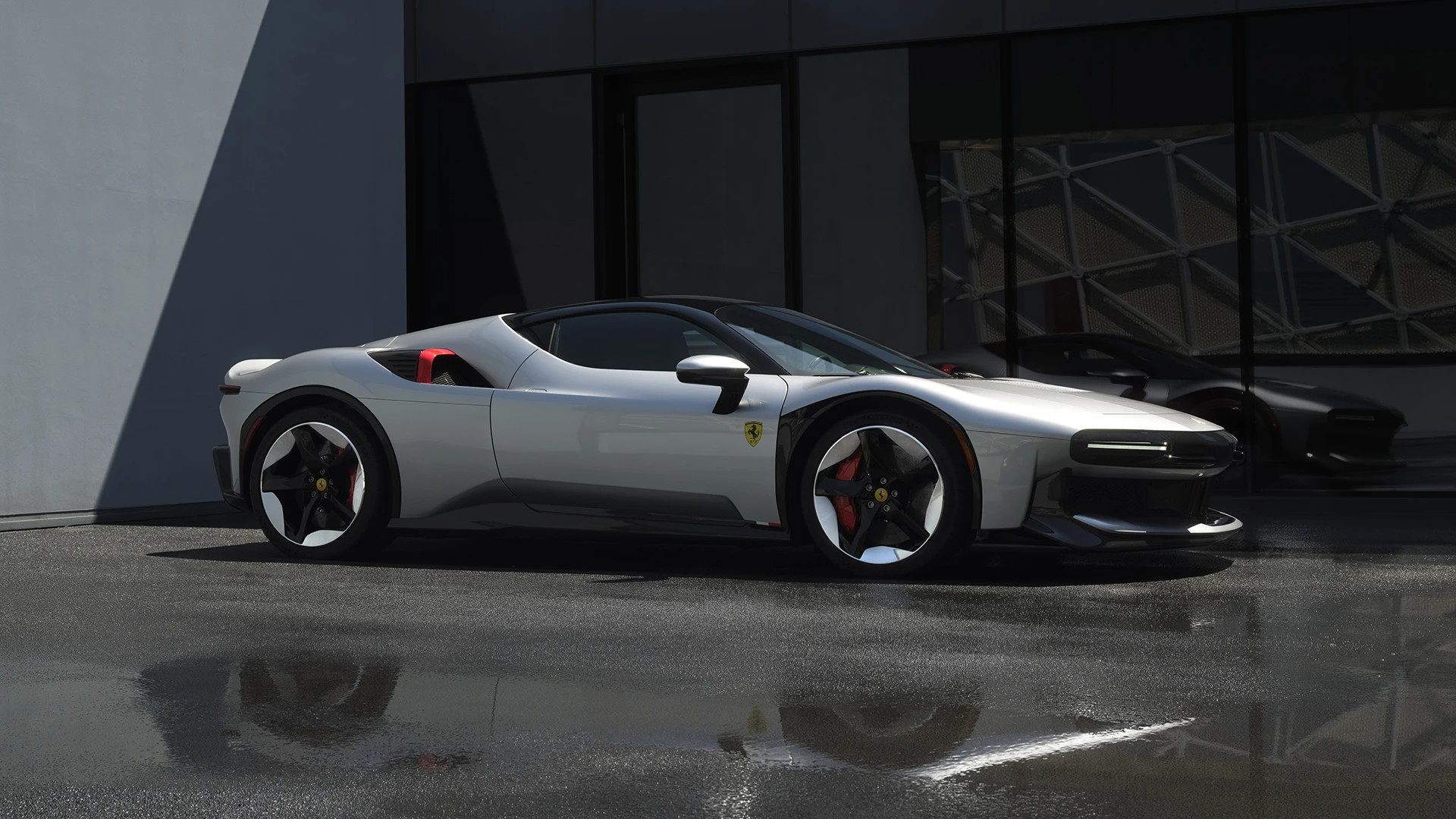
    The front of the Ferrari CZ26 is a wall.

    Not a raked nose, not a wedge, not the pointed shovel every supercar has worn since the SF90. A vertical leading edge, flat to the airstream, holding a full-width grille with the lighting hidden inside it. Ferrari calls the edge unprecedented, which is marketing language for something that is nonetheless true.

    It is also, aerodynamically, close to the worst thing you can do to a fast car. A blunt vertical face builds a wall of high pressure in front of it and drags that pressure down the length of the body. Every shape decision in the last decade of performance and electric cars has been made to avoid exactly this, which is why so many of them have converged on the same slippery form.

    So the interesting question is not whether the CZ26 looks good. It is what Ferrari had to spend to keep the face they wanted.

    What The Shape Cost

    The list is in the technical notes and it is longer than a one-off usually needs.

    The central radiator pack was reoriented and given dedicated bypass ducts. The entire underbody was redesigned, along with the vortex generator system beneath it. An air curtain system was built into the outer sections of the front bumper to manage the wake coming off the front wheels. At the rear, a large upper spoiler and a dedicated diffuser were developed to put the downforce back. Even the engine cover was redrawn with new vents to get the heat out.

    None of that is styling. That is a full aerodynamic development programme, run on a car that will be built once, in order to make a shape work that the airflow did not want.

    Which is the opposite of how most of this industry now operates. The dominant method is to let the metric choose the shape and then decorate what comes out. Ferrari picked the shape first and paid for it in engineering. Whatever you think of the result, that is a company using its competence to buy a design decision rather than to satisfy a number.

    The 1970s Reference Is Doing Real Work

    Ferrari points to Italian industrial design of the 1970s, and it would be easy to read that as a mood board.

    It isn't, quite. The 1970s Italian tradition that matters here is the one where the object shows you what it does. Where a control looks like a control, a vent looks like a vent, and the housing is the shape of the function rather than a lid placed over it. On the CZ26 the side intakes, the diffuser, the carbon elements extending the arches and the light clusters all emerge from the main surface instead of being applied to it. The car is trying to look like the sum of its jobs.

    That is a coherent position, and it is a rarer one than it sounds. Most performance cars today are covered in vents that do nothing and creases that exist to break up a surface.

    Gallery

    Two Ferraris, One Week

    The CZ26 was presented in Monterey on 13 August. In the same city, in the same week, Chassis 0 of the Luce went under the hammer at RM Sotheby's, expected to clear a million dollars for the Ferrari Foundation.

    Two cars, four days, one badge, and two completely different answers to what a Ferrari is for.

    The Luce has four motors, more than a thousand horsepower, and accelerometers on the rear axle that pick up powertrain vibration and amplify it into the cabin so the driver hears something. The CZ26 has a twin-turbo V8, three electric motors, and an underbody rebuilt from scratch to defend a flat front face.

    One car manufactures the sensation. The other engineers the cause.

    I have argued before that the industry is repeating watchmaking's mistake by competing on the metrics the new technology wins. The CZ26 is the other half of that argument, and it is the more useful half, because it is a working example of the way out. Fewer cars. More difficulty. Difficulty made visible. That is precisely the move Swiss watchmaking made when it stopped defending accuracy and started selling tourbillons, and it is the reason mechanical watches still account for 86 percent of Swiss export value while keeping worse time than a cheap quartz.

    Ferrari already runs this programme. Special Projects takes about two years per car, with the client in the room through design and verification. It is treated inside the company as an expression of client privilege, a reward for the top of the list. On the evidence of this car it is something more useful than that. It is the part of Ferrari where the constraint is taste rather than volume, and where the engineering exists to serve a decision instead of a target.

    What It Doesn't Solve

    One car does not make a strategy. Special Projects builds a handful a year against roughly thirteen thousand deliveries, and there is no version of it that scales.

    And the CZ26 is still an SF90 underneath. Extensively re-engineered, but not a new car. What is new is the skin and the aerodynamic work required to hang it there.

    There is also something slightly melancholy about it. The most interesting design decision Ferrari made this year will sit in one collection, seen in the flesh by a few hundred people, while the car everyone will actually encounter is the one that plays its engine through the cabin.

    Ferrari knows how to make an object worth arguing about. It made one this month. It just made it for a single client, in a week when it was also selling the other future for charity, four days and one auction catalogue away.

    Read more about cars here.