
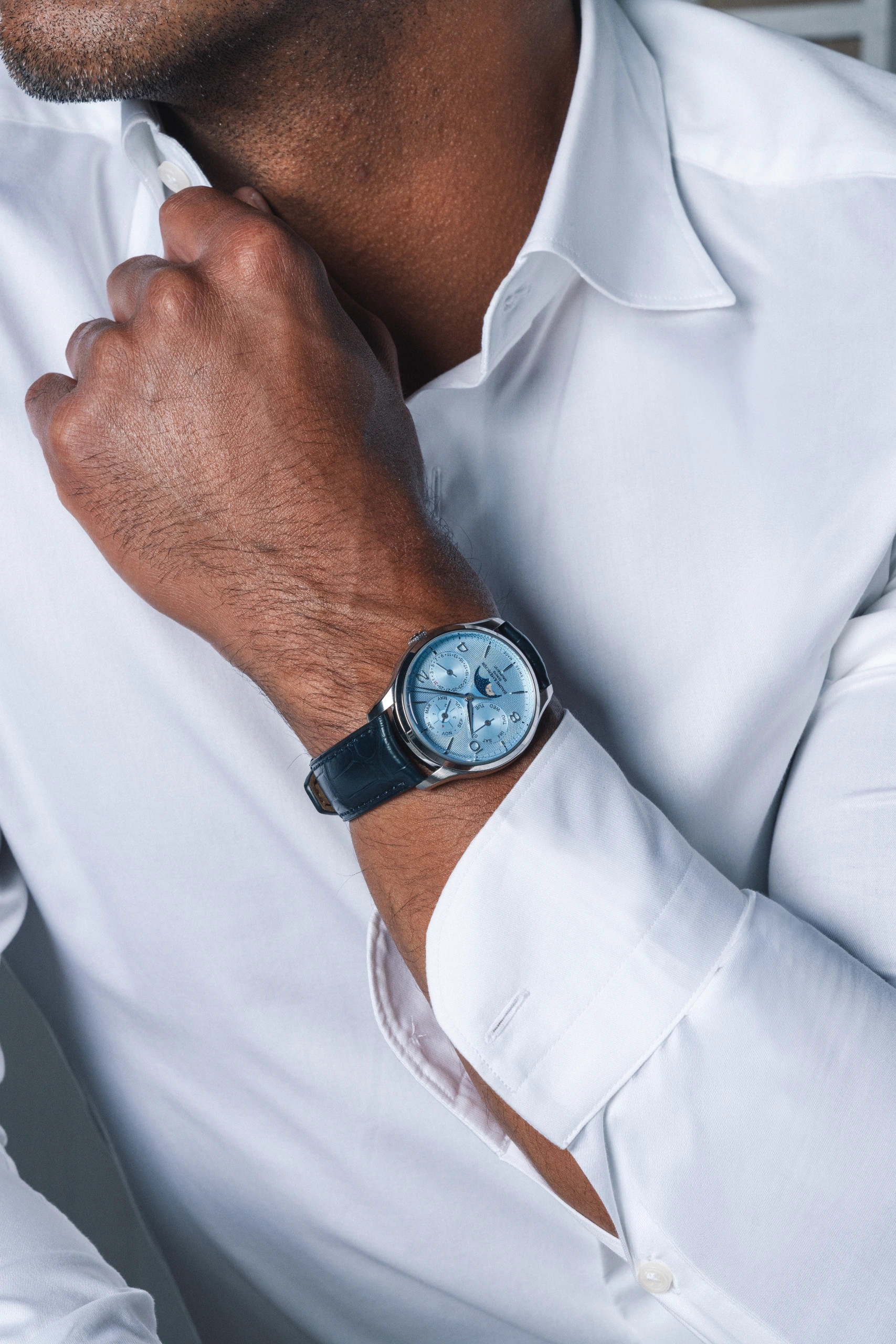
A dress watch has fewer places to hide than a sports watch. No bezel to break up the case, no bracelet geometry doing the heavy lifting, no tool function to excuse a compromise. What remains is the dial, the movement behind it, and whether the two feel like they belong to each other. Baume & Mercier has added two Cliftons that get judged on exactly those terms, and both arrive in a colour the collection has not used before.
Glacier blue is the new hue, and it is a careful one. Cold rather than navy, pale enough to read as grey in low light, and laid over a guilloché pattern so the surface never sits flat. Both references share it. Both are limited editions. The similarity ends at the complication.
Clifton 10870
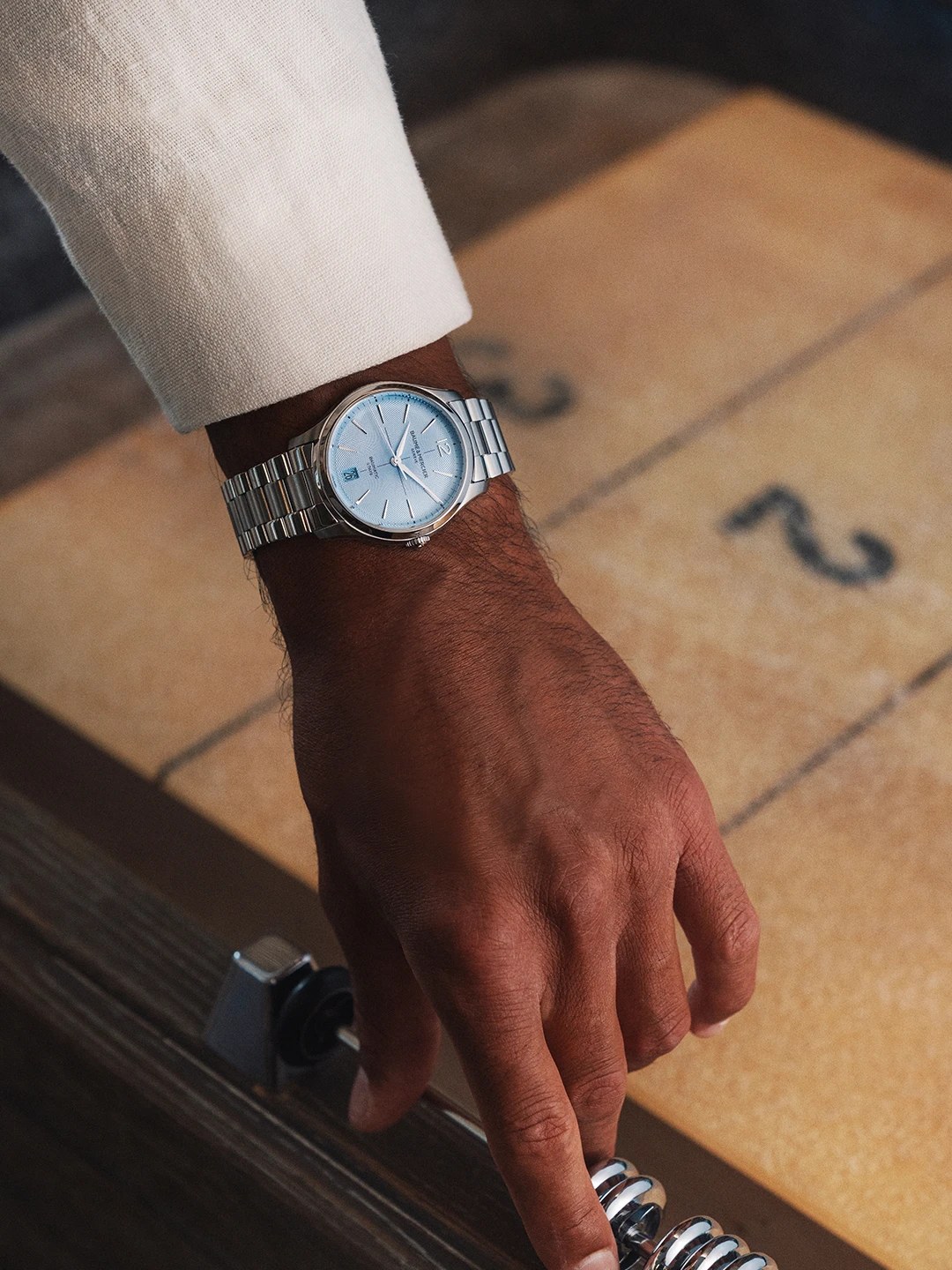
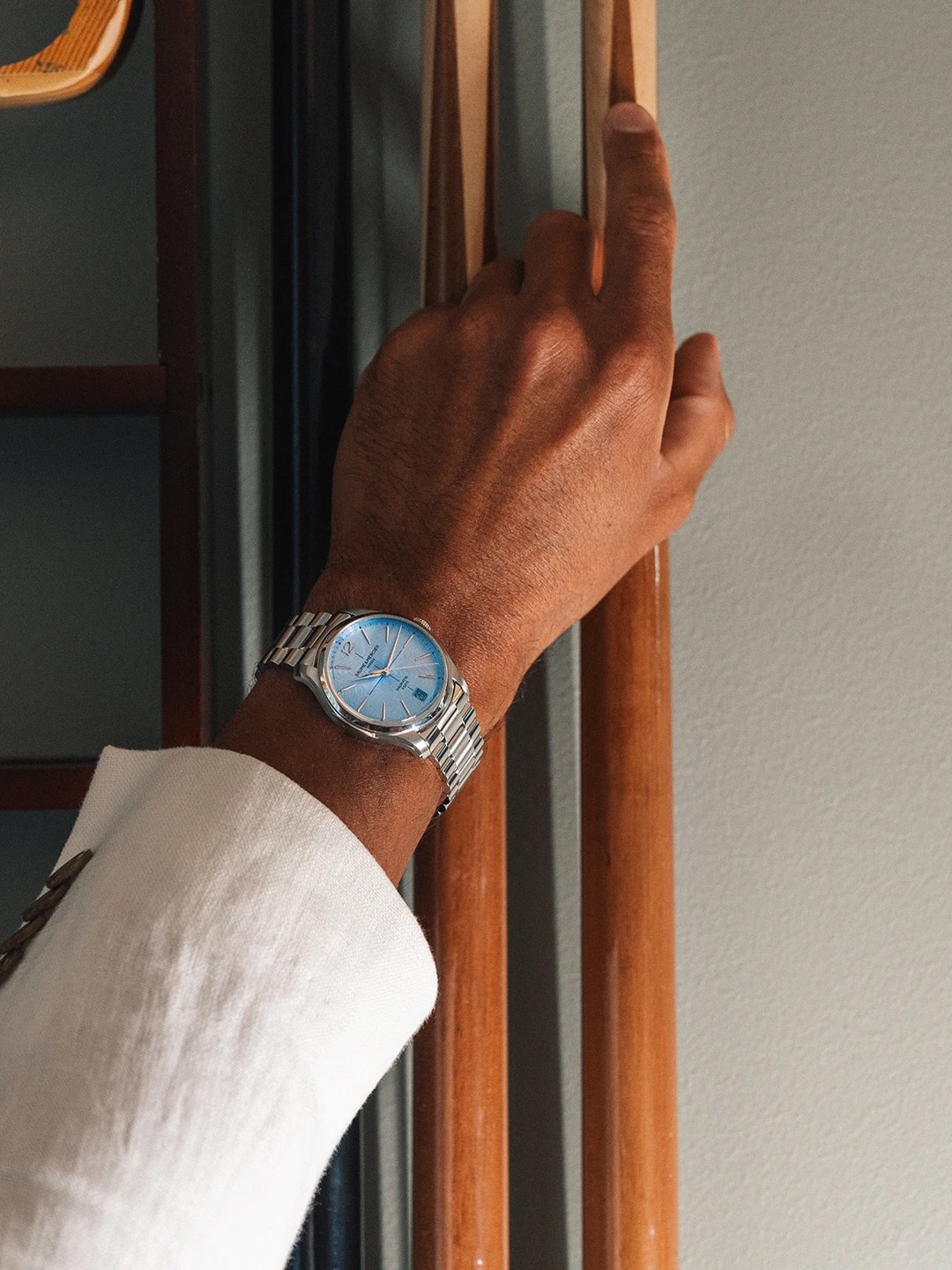
The simpler of the pair runs 39 mm with a date, powered by the Baumatic BM13-1975 A. Its dial is the clearest expression of what glacier blue is meant to do: guilloché underneath, a sunburst minute track running the outside edge, and a single Arabic numeral at 12 o'clock as the only departure from the rhodium-plated trapezoid indexes. Those indexes are faceted rather than flat, which is the detail that makes the dial move. Turn the wrist and each one lights separately. Alpha hands sit above them, a shape the collection has leaned on for years and one that suits a dial with this much surface interest, because the hands stay legible without adding their own noise.
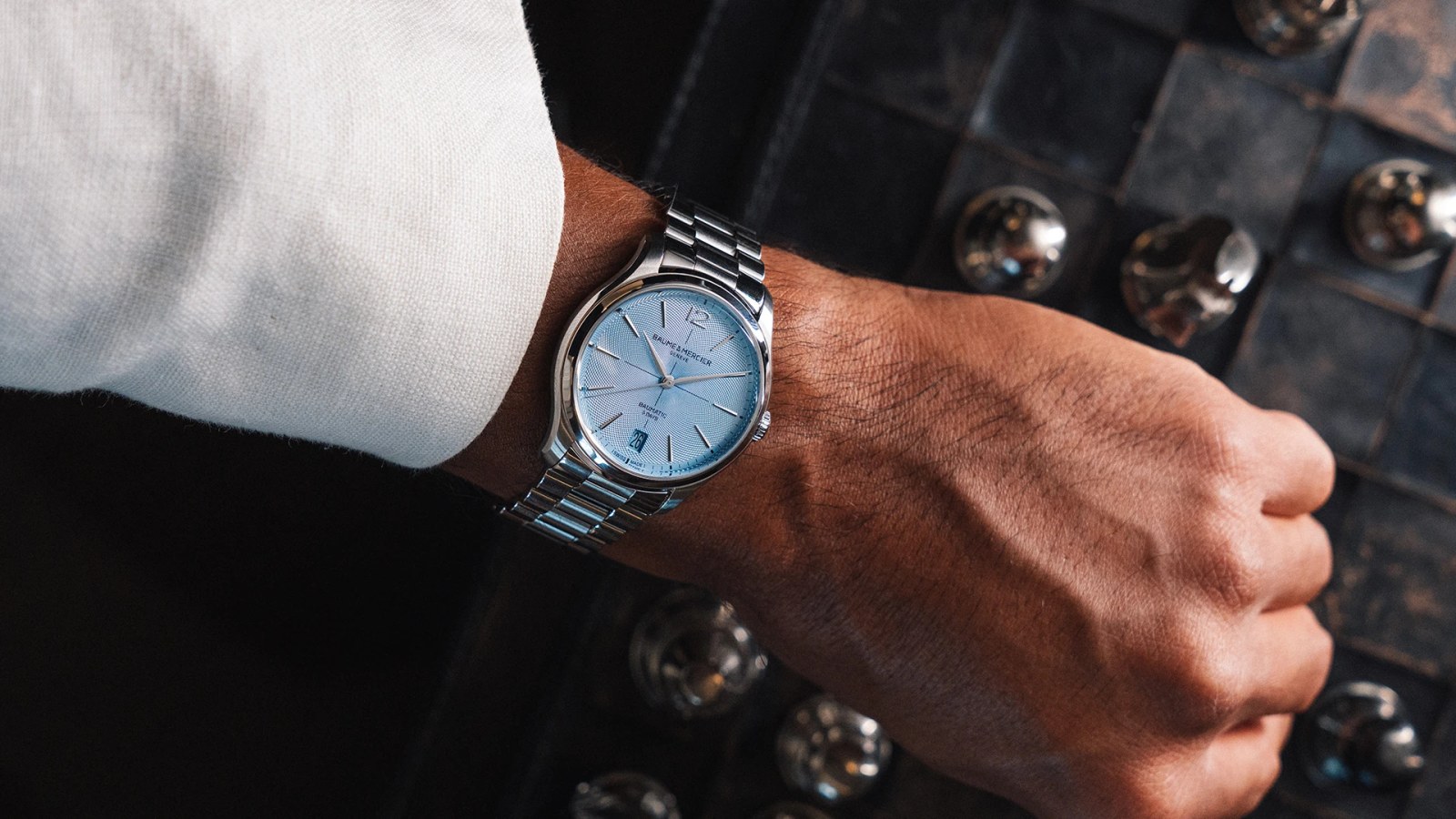
The three-row bracelet is satin-polished steel and comes off without tools. On a 39 mm dress watch, that flexibility matters more than it does on a sports piece. This is a watch that will spend most of its life under a cuff and some of it out in the open, and the ability to move between steel and leather in a minute is the difference between one watch and two.
Clifton 10872
The second is the more ambitious proposition. A perpetual calendar in 40 mm, running the Baumatic BM13-1975 AC2, with the calendar laid across sunburst counters rather than squeezed into a corner of the dial. Arabic numerals mark 2, 4, 8 and 10 o'clock, with the same faceted trapezoid indexes and alpha hands between them.
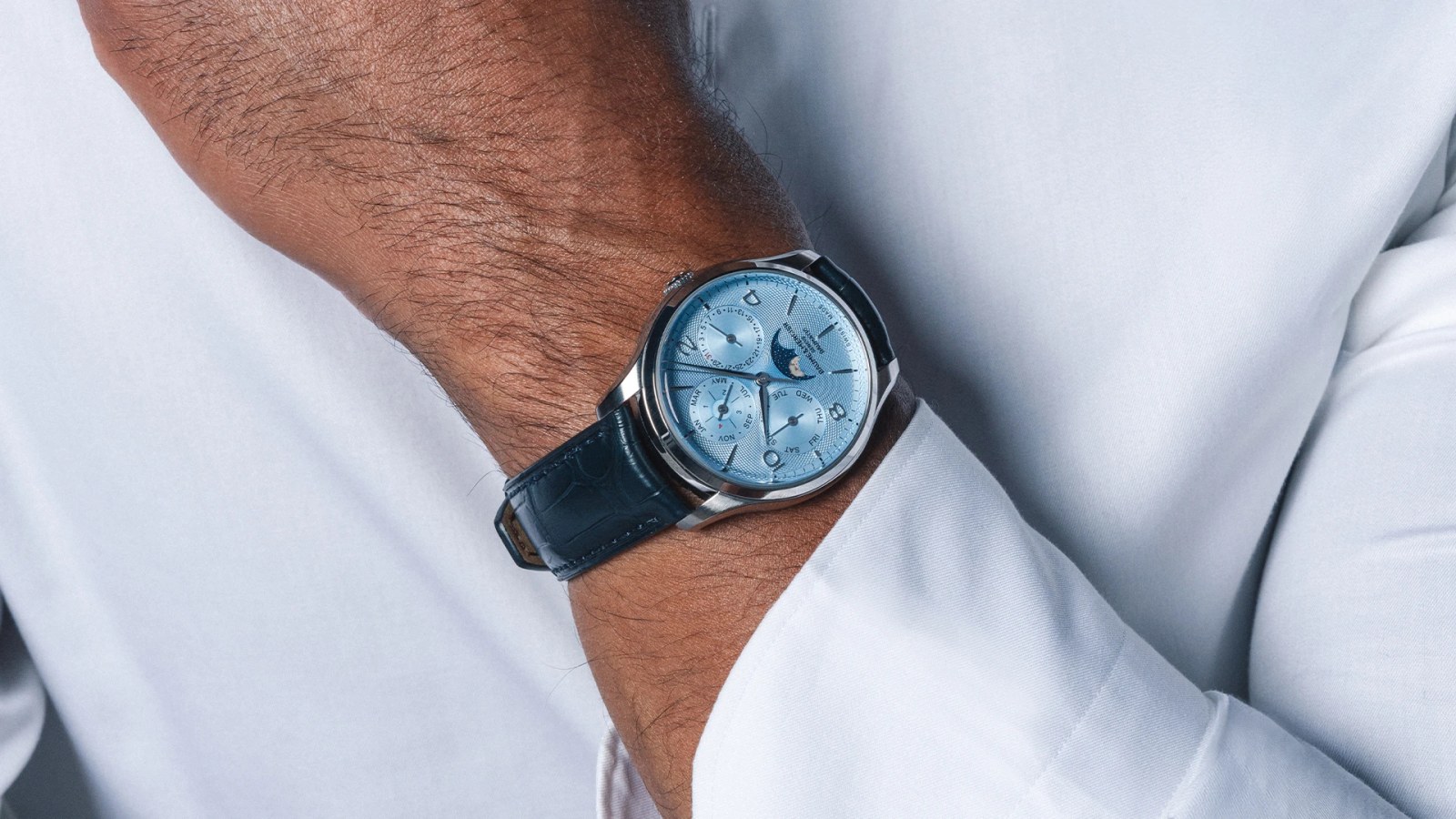
Perpetual calendars usually fight their own dials. Four indications, a moon, a minute track and two hands is a lot to organise in 40 mm, and most attempts either crowd the centre or push the counters so far out that the balance goes. The layout here works because the counters are sunburst, so they separate from the guilloché field by texture rather than by a printed border. You read the difference before you read the information.
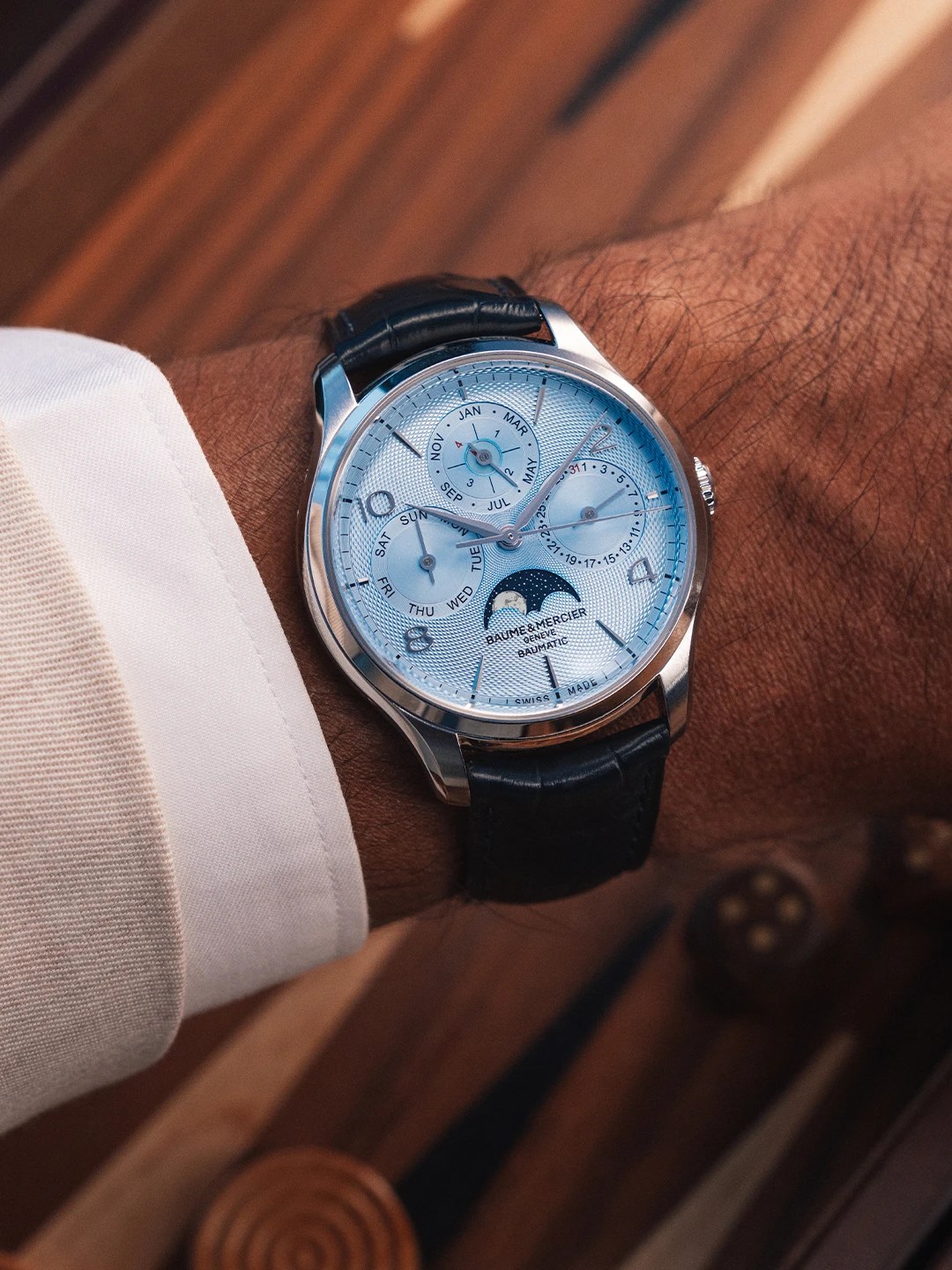
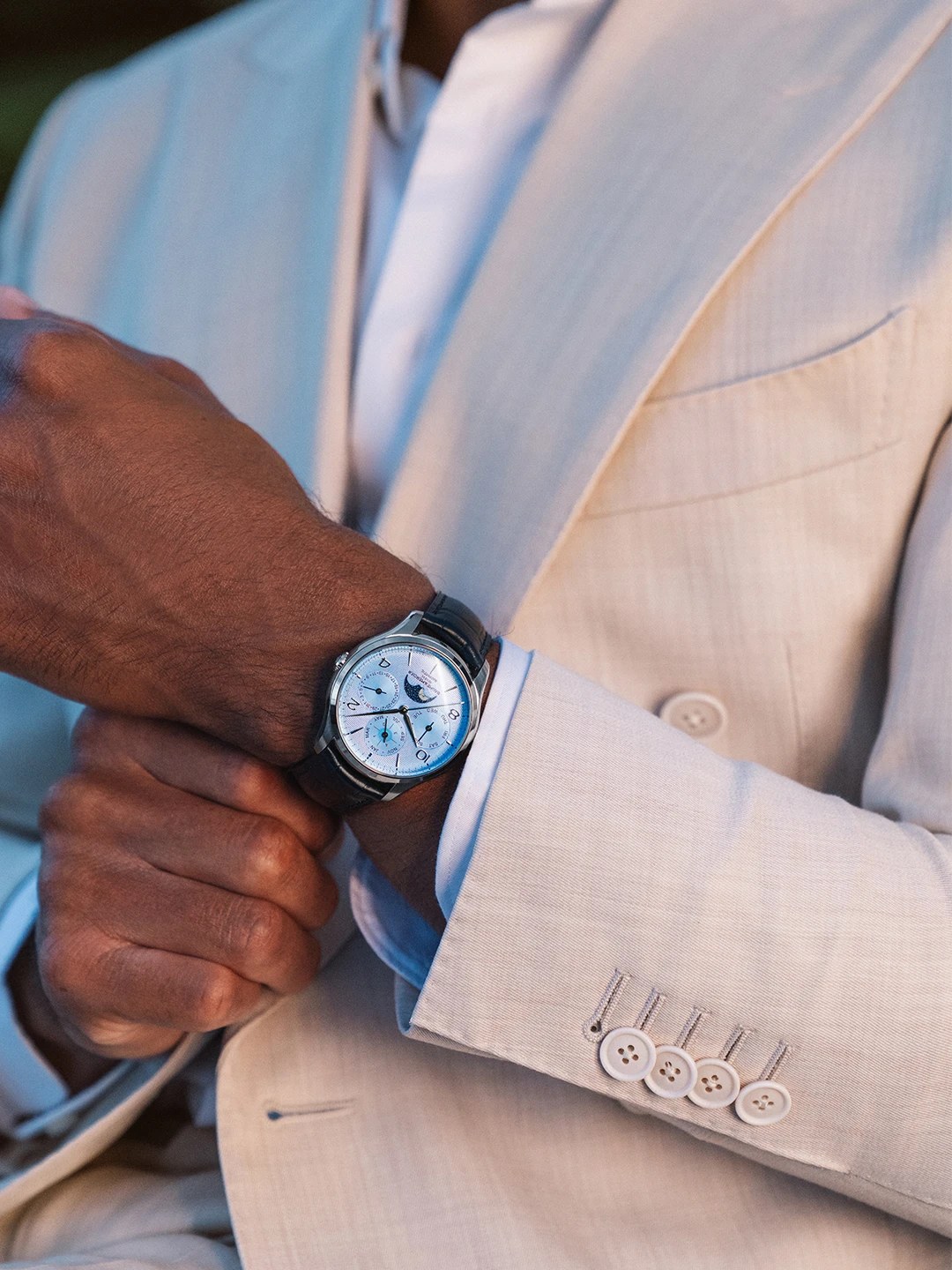
The strap is blue alligator, tool-free like the other. It is also the one decision worth questioning. The 39 mm three-hander gets a steel bracelet as standard; the perpetual, which is the more serious watch of the two and the one likelier to be worn every day of a five-day working week, arrives on leather alone. A steel option would suit how a perpetual actually gets used.
The movement is the argument
Both watches run the Baumatic, and the case for these Cliftons rests there more than anywhere else. Baume & Mercier introduced the calibre in 2018, and its headline figure has not aged: 120 hours of power reserve, five full days from a fully wound movement. The brand rates it to 1,500 gauss, well above the standard threshold for an antimagnetic watch.
Five days reads like a specification on the 10870 and like a genuine function on the 10872. Anyone who has owned a perpetual calendar knows the real cost of the complication is not the setting, it is the restarting. Leave it in a drawer over a long weekend and you are working through months and leap years to get it right again. A movement that survives Friday evening to Monday morning without help removes that entirely, which is a more useful thing to engineer than another tenth of a second of accuracy.
Finishing on the Baumatic has always sat above what the collection's positioning would suggest. Circular graining, textured mainplate, decorated rotor. Visible through a sapphire back on a watch that is not asking to be a showpiece.
Where they land
These are not loud watches, and they are not trying to be. The Clifton has always been the part of the range that looks backwards for its proportions and forwards for its mechanics, and the glacier-blue pair holds that line. One is the watch you wear every day and never think about. The other is the one you set once and then leave alone for years.
Both made in limited numbers, which is the only part of the story that will decide itself.