
Inside La Maviglia, Puglia's 202-Hectare Golf Estate
    By Ash Mirghadiri

    Inside La Maviglia, Puglia's 202-Hectare Golf Estate

    Seventy suites, thirty-five villas and a 5,000-square-metre medical spa, laid out across an olive estate on the Ionian coast and organised around eighteen holes.

    Construction is underway at La Maviglia, a 202-hectare resort outside Maruggio in the province of Taranto, with opening scheduled for 2027. The completed estate will hold 70 suites, 35 villas, a 20-room golfers' lodge, four restaurants, a wellness and medical spa of 5,000 square metres, and a private beach club. An 18-hole championship course occupies 75 of those hectares and sets the position of everything else.

    The property belongs to Ultimate Collection Ltd, a Swiss company registered in Kilchberg. Nicola Cortese is credited as founder and leads the project. He has said the site took longer to find than the resort has taken to plan, and that its quiet and its size were what convinced him. The masterplan bears that out. Where the oldest olive trees, the dry-stone walls and the macchia scrub already stand, the new building goes around them.

    Where It Sits

    The estate lies under a kilometre from the Gulf of Taranto, on the Ionian coast, near a protected stretch of shoreline at Monaco Mirante. The land falls inside the Primitivo growing zone, with Manduria and its vineyards immediately inland. Scheduled flights reach Bari and Brindisi. Taranto-Grottaglie, roughly 40 kilometres north, takes private and cargo traffic.

    The Course

    Städler & Reinmuth Golfdesign have laid out a par 72 over 75 hectares. Giles Wardle is designing the irrigation. Agronomy is by Turfgrass, whose client list includes Adare Manor, host venue for the 2027 Ryder Cup. Players get a driving range playable from both sides and a separate area for the short game.

    Three excavated lakes bring water into play at several points, with at least one green sited on a lake edge. Olive and fig trees over a century old have been left standing and the routing passes around them. Trulli, the round stone huts found throughout the region, sit within the property and have been kept as playing features. One hole runs past an 18th-century neoclassical triumphal arch with the Ionian visible behind it. The developer has named several holes as signature holes and states an ambition to host tournaments.

    Gallery

    The Clubhouse, The Suites, The Villas

    Masseria Maviglia, a fortified 16th-century farmhouse, is being restored and lightly extended to serve as the clubhouse. It will take a restaurant, a bar and lounge, members-only facilities, shops, and event space indoors and out. The gatehouse and the ground-floor arcade are being kept as found.

    Accommodation in the hotel is suites only, from 60-square-metre junior suites up to three-bedroom presidential suites of 400 square metres. All 70 open onto outdoor space of their own, and twelve come with a pool. Four food outlets are planned: fine dining, a pool restaurant, a breakfast and bar complex, and a restaurant serving the spa.

    The 35 villas run from two to six en-suite bedrooms and 120 to 650 square metres, each with a pool and a gated garden on a plot between 1,000 and 5,000 square metres. Four clusters take their names from what surrounds them: Uliveto among the olives, Macchia in the scrub, Trullo beside the stone huts, Primitivo in the vines. Several are built around trulli already on the site. Oppenheim Architecture is responsible for the interiors, working in plaster, local limestone and timber, with openings framed on the olive trees. Enea Landscape Architecture is handling the grounds. Visualisations are by Harris & Kalinka.

    The Spa And The Working Estate

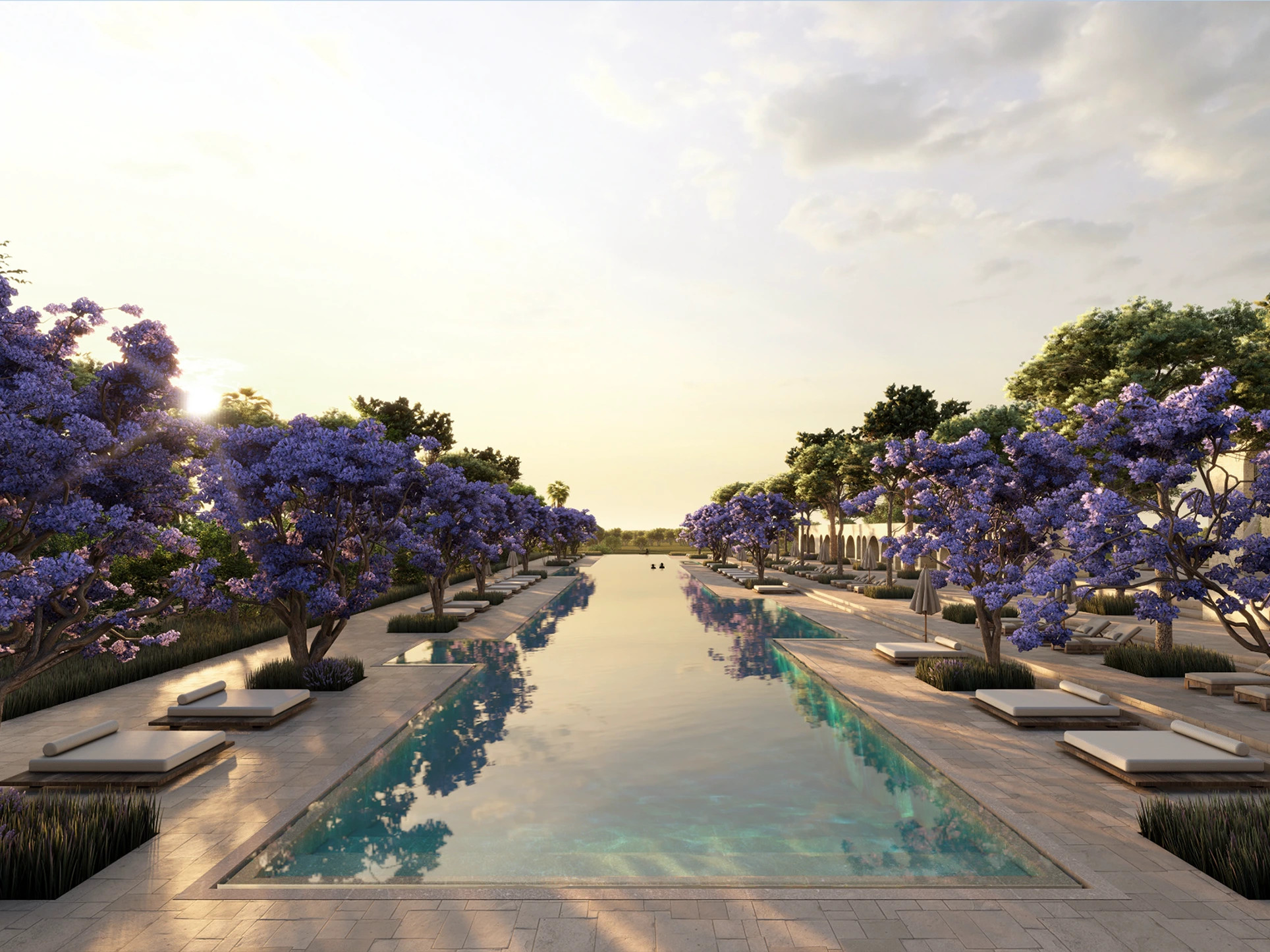
    The spa runs to 5,000 square metres. Inside are rooms for consultation and treatment, changing and wet facilities, quiet rooms, sports facilities, and a lap pool set outdoors under cover.

    The site plan puts golf on three sides of the accommodation, so suites and villas face fairway. The buildings that run the estate sit at the northern and western edges: maintenance and logistics, a farmhouse, a solar array, a helipad. One security lodge controls the main entrance.

    The developer commits to generating power on site, farming vegetables organically, making wine and pressing olive oil. The vineyards and olive groves were productive land before the course was routed through them.

    Read more about travel here.