
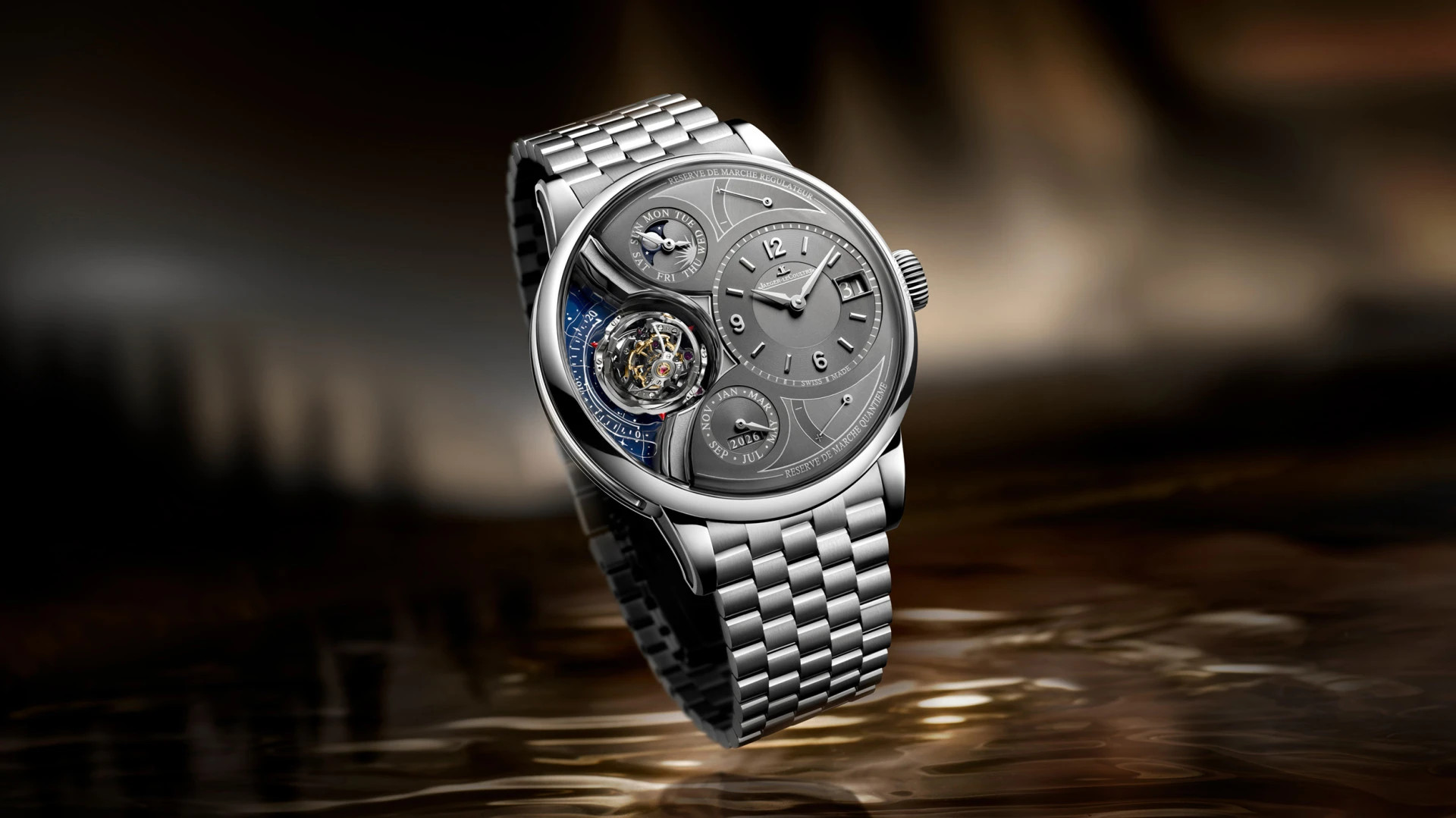
On the left side of the dial, a small mechanical city performs its rotation. A sapphire crystal window in the side of the case offers another view. This is the Heliotourbillon, a triple-axis construction that spins like a top over a deep blue lacquer background representing a starry sky. As it turns, small red triangles on its third cage mark 20-second intervals against a sapphire arc. It is the most visible part of the new Duometre Heliotourbillon Perpetual from Jaeger-LeCoultre.
First created in 2024, the timepiece is now reinterpreted in a limited run of 20 numbered pieces. The 44 mm case is crafted from platinum, a contemporary form inspired by the savonette pocket watches the manufacture made in the 19th century. Its construction is complex, comprising 40 separate parts with lugs that are screwed on rather than integrated. This allows for a mix of polished, brushed, and micro-blasted surfaces that catch light with each movement of the wrist.
A new platinum 950 bracelet was created for this model. The five-row construction features individually domed links, with alternating brushed and polished finishes that echo the case. The cool, silvery tone of the metal carries over to an all-grey dial with opaline, brushed, and azuré surfaces. The layout is symmetrical, forming a triangle. Its apex is the grande date display at 3 o’clock, while the base is formed by the moon-phase and day displays in the upper sector, and the month and year below.
A Solution to a Fundamental Problem
The Duometre concept itself was patented in 2007 to solve one of watchmaking’s core challenges. The steady flow of power from a barrel to the escapement is essential for precision. Adding complications draws from that power, interrupting the flow and affecting accuracy. Jaeger-LeCoultre’s solution was to house two barrels and two separate gear trains within a single calibre, linked to a single regulating organ. One gear train powers the time, the other drives all the functions. This separation is the foundational principle of the Duometre.
That engineering clarity allows for the complexity of Calibre 388. The movement integrates a perpetual calendar, a Grande Date, and a moon-phase indication accurate to 122 years. Unusually, the hours and minutes can be set backwards or forwards without compromising or damaging the perpetual calendar mechanism. It is a feature that addresses a common point of fragility in high-complication watchmaking.