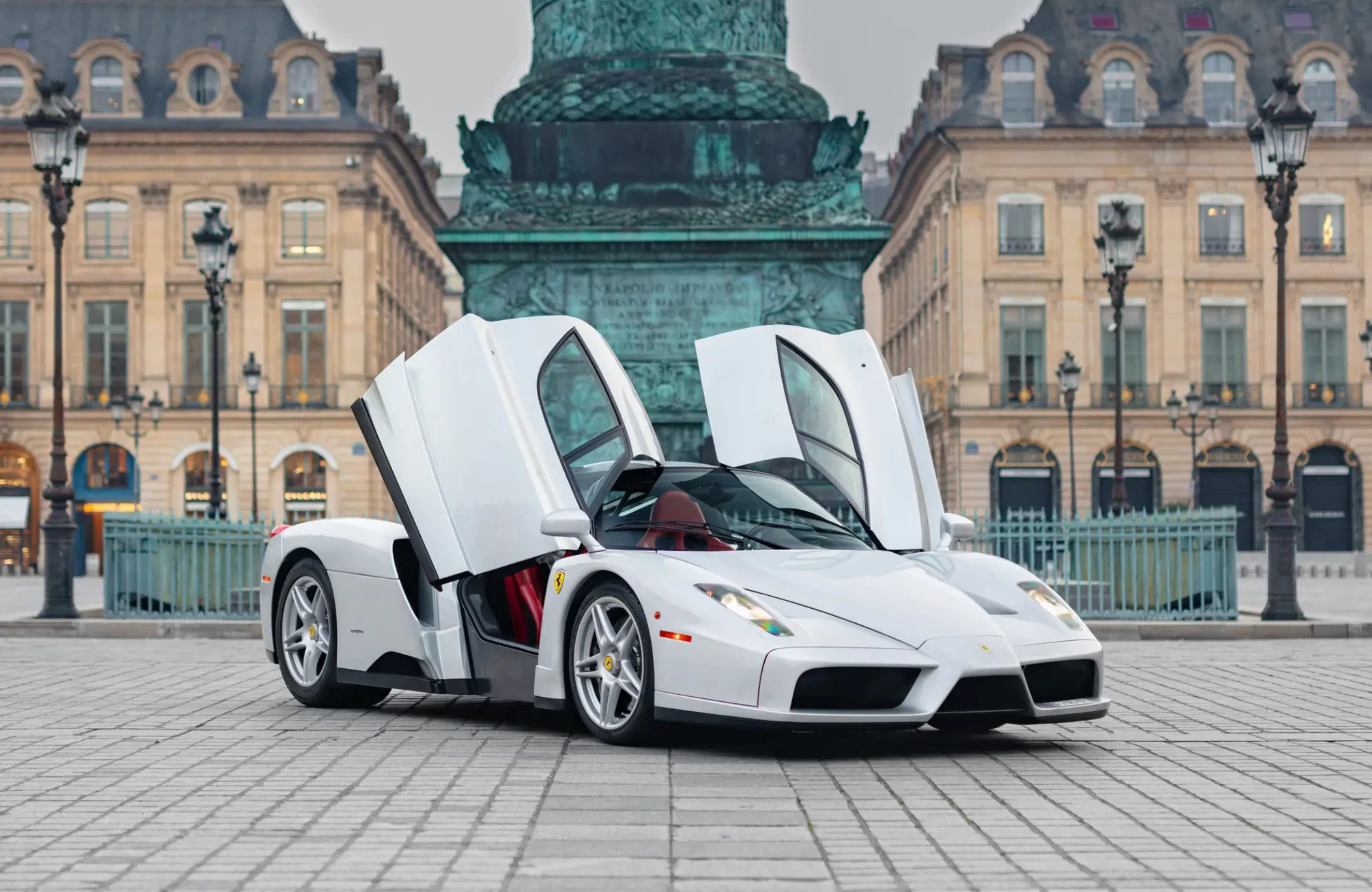
There are nine of them. Nine Enzos finished in Argento Nürburgring by the Maranello factory, out of a total production run that never reached four hundred cars. Of those nine, only five received a Rosso leather interior. And of those five, exactly one was delivered to the United Kingdom.
That car is now heading to Monaco.
The Enzo arrived at a particular moment in automotive history, one where Ferrari felt the full weight of its own mythology. The F40 and F50 had already done what seemed impossible. The Enzo had to do it again, differently, and in front of a watching world. It did so by looking inward, pulling directly from the Formula 1 programme and asking what a road car might become if the engineers were given permission to be honest.
The result was a machine that dispensed with a fixed rear wing, relying instead on the aerodynamics beneath and behind the body, with an automatic spoiler deploying only at higher speeds when the car demanded it. A naturally aspirated V-12 displacing just under six litres, producing 660 horsepower at a time when that number carried genuine consequence. Carbon-ceramic brakes from Brembo before they were commonplace. Pushrod suspension borrowed from circuits where finishing mattered more than comfort.
What makes chassis 37754 worth pausing over is not its performance. Every Enzo performs. What distinguishes this car is the quiet confidence of its specification. Argento Nürburgring is not a colour that announces itself. It reflects. It shifts with the light. Paired with the Rosso interior, the combination reads less like a factory option and more like a considered decision made by someone who understood exactly what they were asking for.