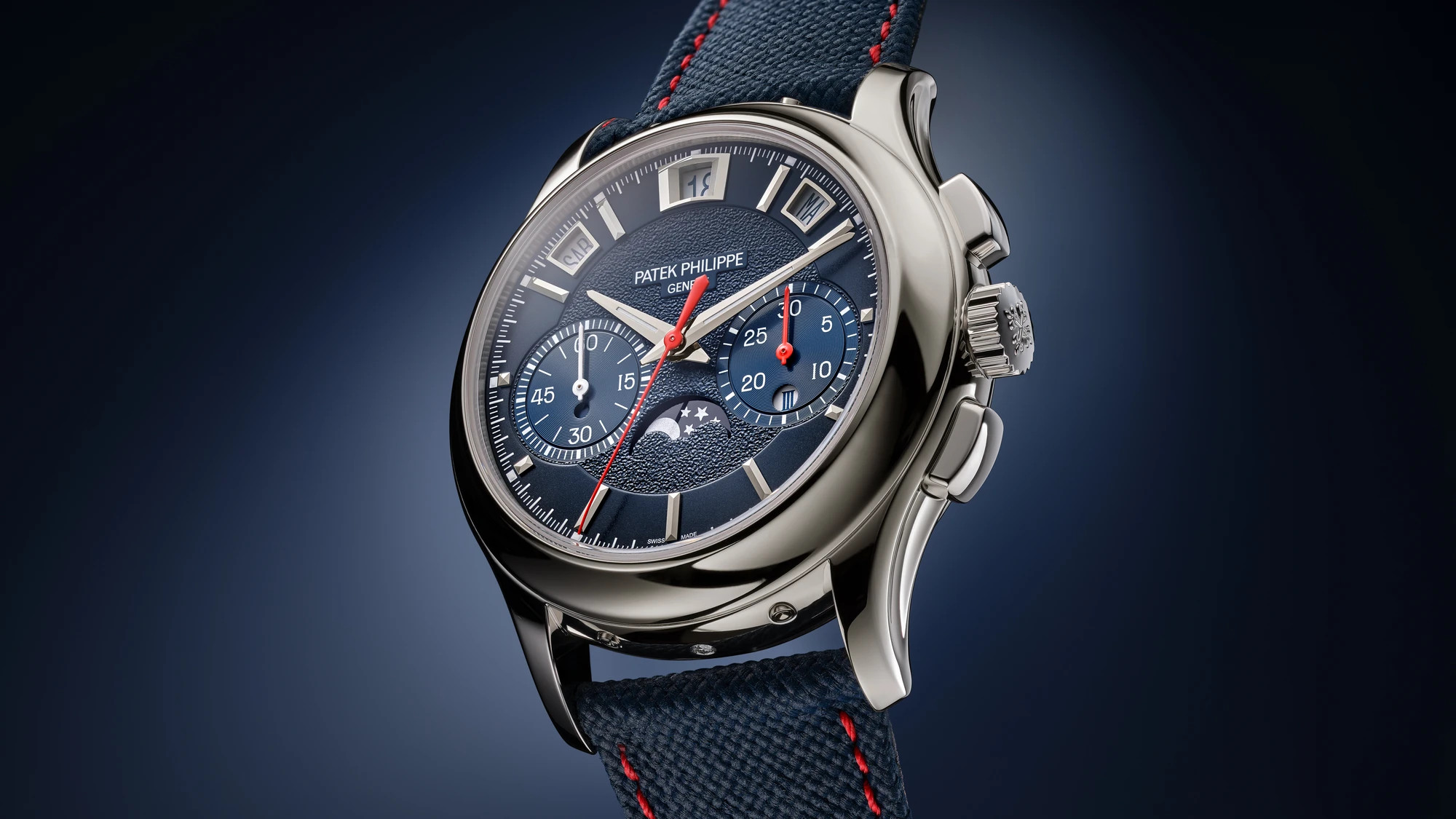
Milan gets a watch this October that could only belong to Milan. For the WATCH ART Grand Exhibition, Patek Philippe has built the Reference 5978P-010, an instantaneous perpetual calendar chronograph in platinum, limited to 120 pieces. Its calendar reads in Italian. Its strap carries the colours of the Italian flag in three small stitches. And beneath the dial sits a pairing the Manufacture has never made before.
Some history first. In 1941, the Reference 1518 became the first wristwatch to unite a perpetual calendar with a chronograph. Patek Philippe has returned to the combination ever since, and from 2011 the Reference 5270 carried it with a movement built entirely in-house. The 5978 keeps the idea and changes how the calendar behaves.
Thirty milliseconds
A conventional perpetual calendar moves gradually, its indications easing forward over the hours around midnight. Patek's instantaneous system works the other way round. It gathers energy for hours, then releases it in a fraction of a second, and day, date, month and leap year jump together in 30 milliseconds. It does this reliably even with only ten hours of power left in reserve.
Weight is the real difficulty. To keep everything legible, the indications sit on disks, and disks are far heavier than hands. Then comes February. At the end of a 31-day month the date advances one step; at the end of February in a common year it has to cover four. Too little energy and the disks stop short. Too much and they overshoot.
Patek answered with two patents, first presented in the Reference 5207 Grand Complication in 2008. A large lever of 15 parts drives the jump, while two jumper springs working in opposite directions keep the energy spent constant, whatever the distance travelled. The mechanism went on to power the Reference 5208 and the Reference 5308. Never before, though, has it been paired with the manually wound CH 29-535 chronograph.
A chronograph with breeding
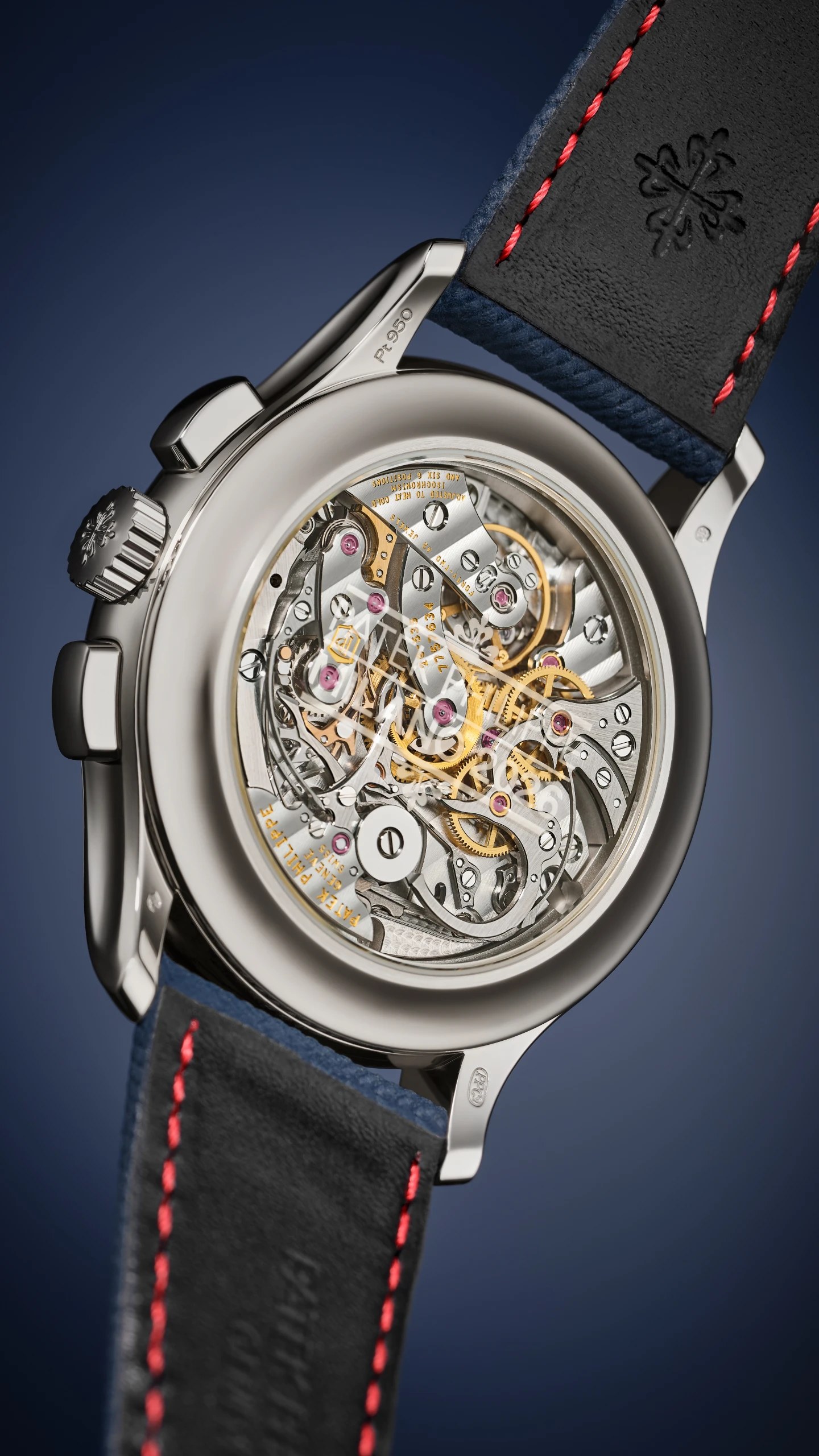
Unveiled in 2009, the CH 29-535 is the more classical half of the story, and arguably the more beautiful. Six patents refine it. A column wheel sits under a polished protective cap, in the Patek tradition, alongside a horizontal clutch whose wheels have patented tooth profiles that reduce wear and avoid point-to-point contact. Even the gear depth is set differently: rather than the usual eccentric, a large eccentric cap on the column wheel defines the clutch lever's limit, which allows a finer adjustment.
Combined with the calendar, the new caliber CH 29-535 PS QI counts 500 parts, all of it visible through a sapphire caseback engraved "Patek Philippe Milano 2026".
Navy, red and white gold
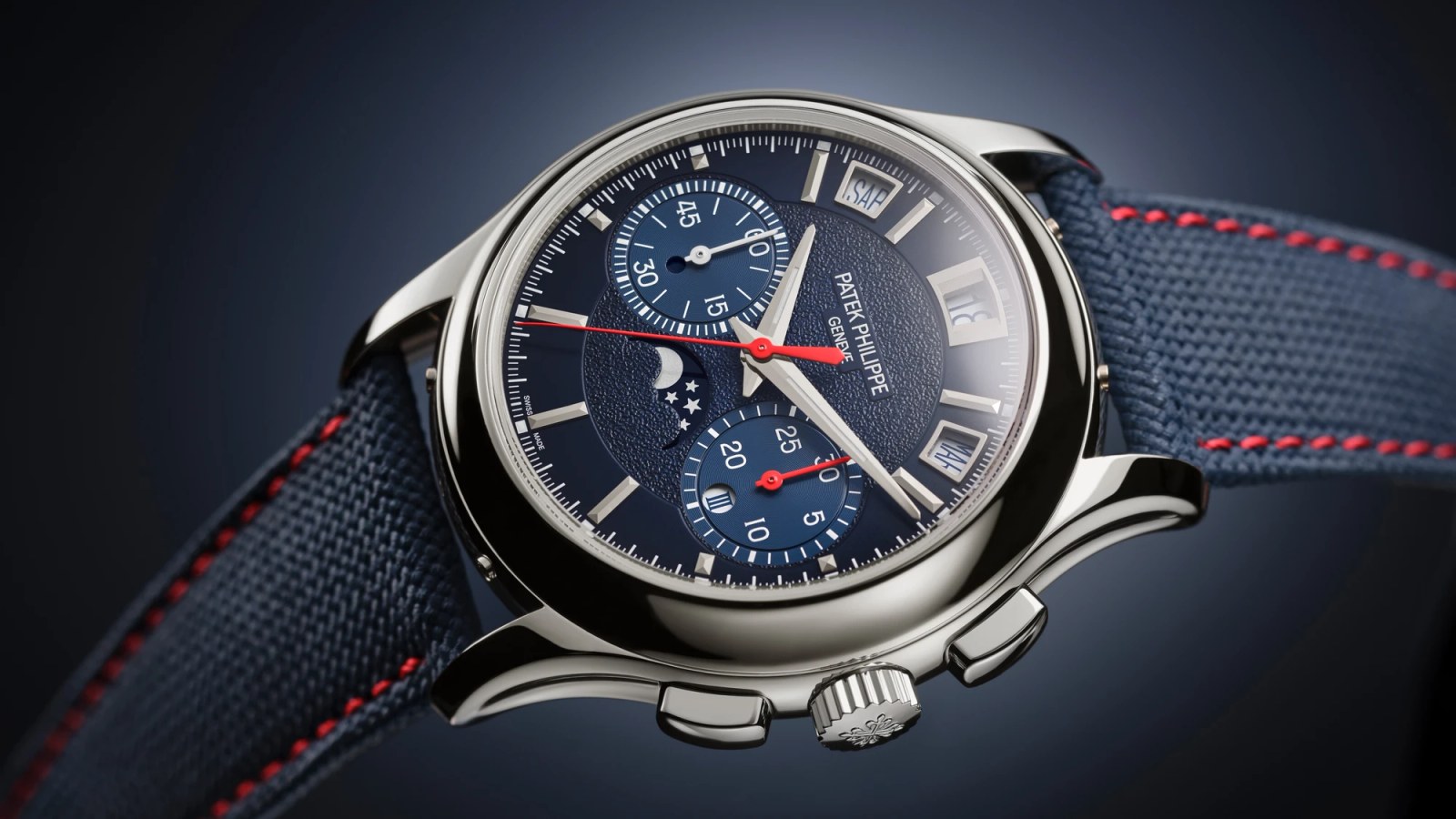
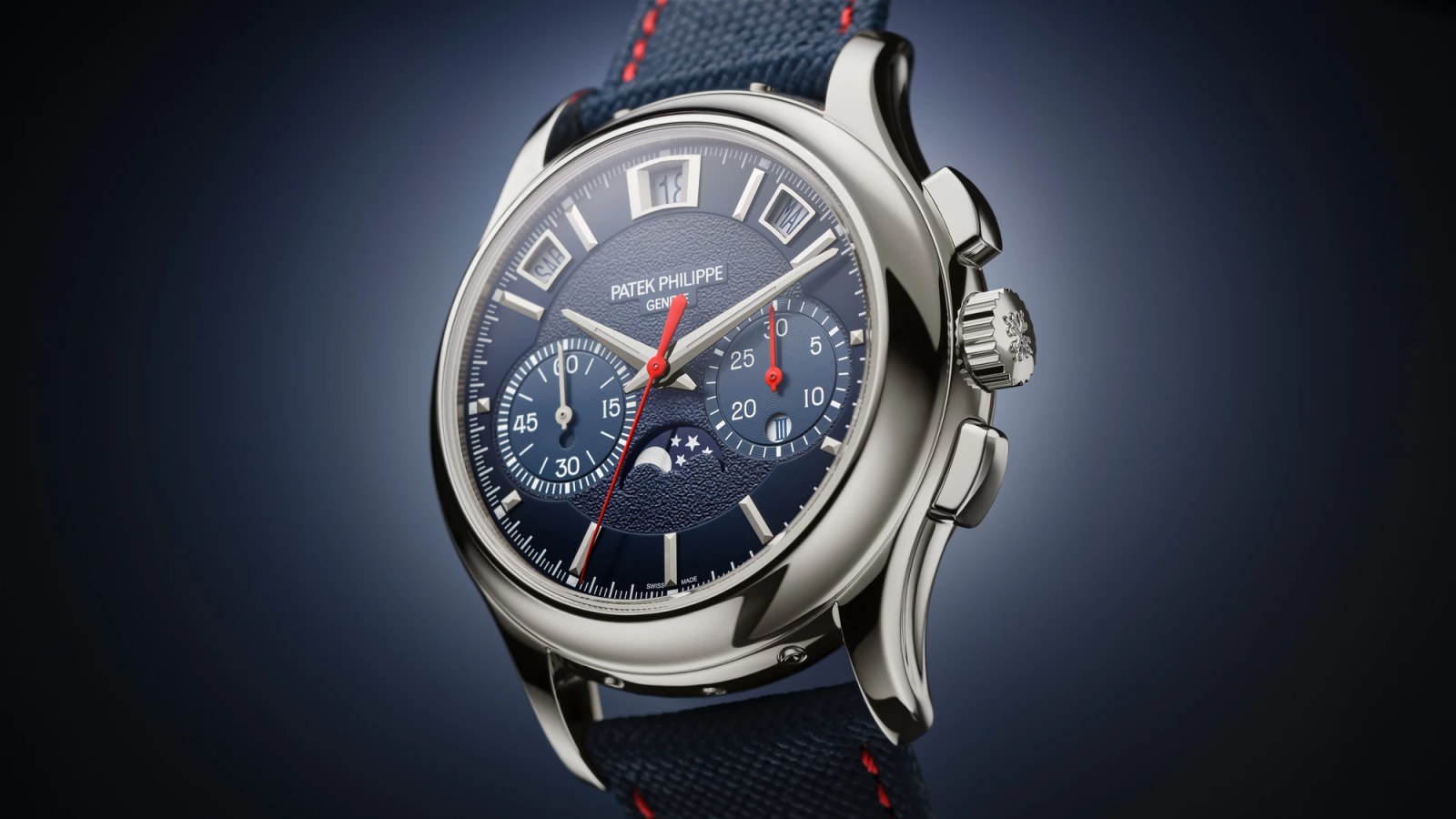
On the dial, a navy-blue sunburst darkens to black at the rim. Its centre is slightly concave and textured, and the snailed counters at 3 and 9 o'clock sit on a level of their own, so the layers do the work of separating information. Three apertures follow an arc across the top for day, date and month, each framed in white gold, with the date window cut slightly larger than its neighbours. A moon phase sits at 6 o'clock, joined by two small round windows for day and night and the leap-year cycle.
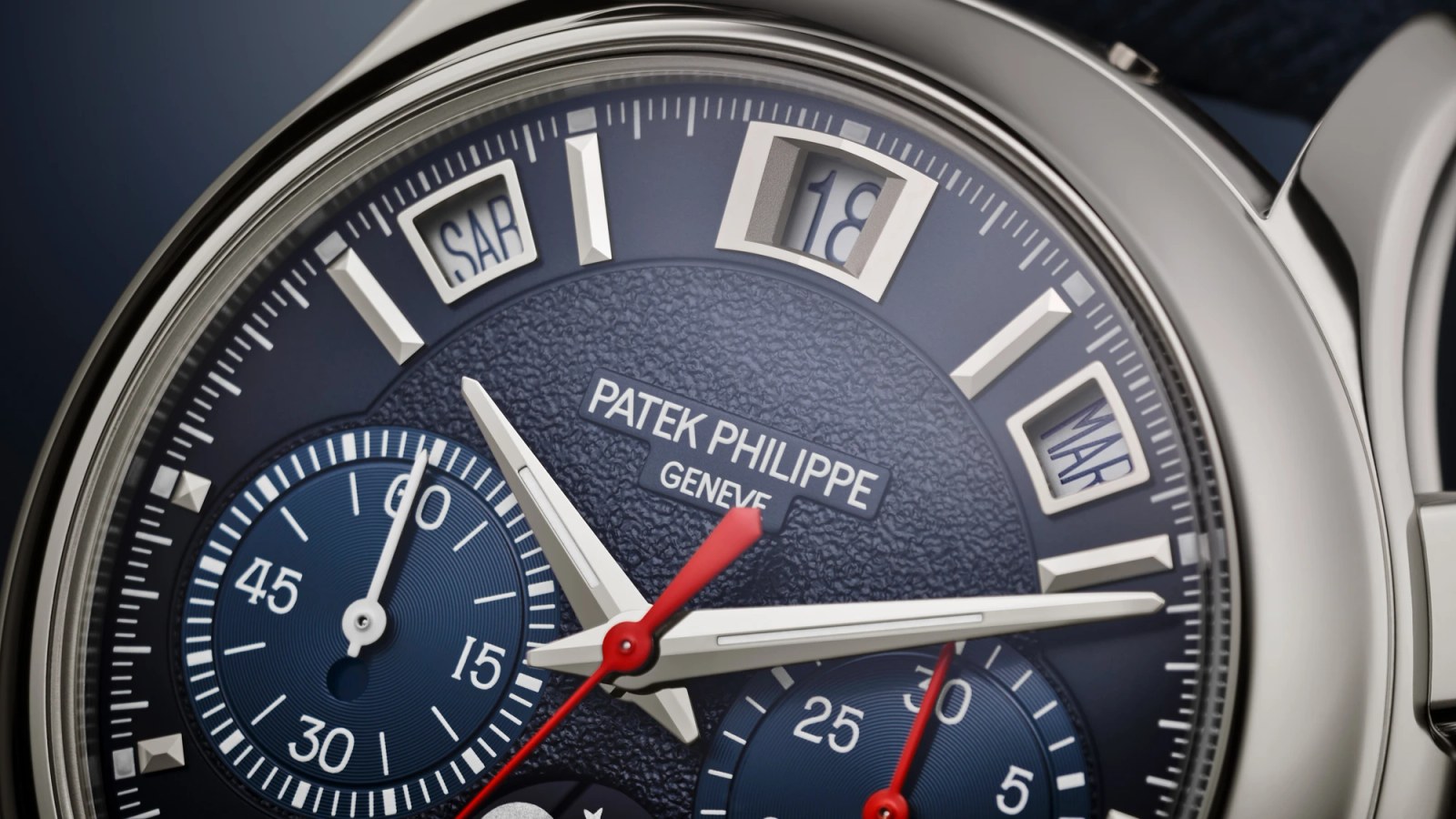
Red brings the energy. The central chronograph hand, in red-lacquered Pfinodal, and the hand of the instantaneous 30-minute counter cut across an otherwise formal face of white-gold batons and dauphine hands.
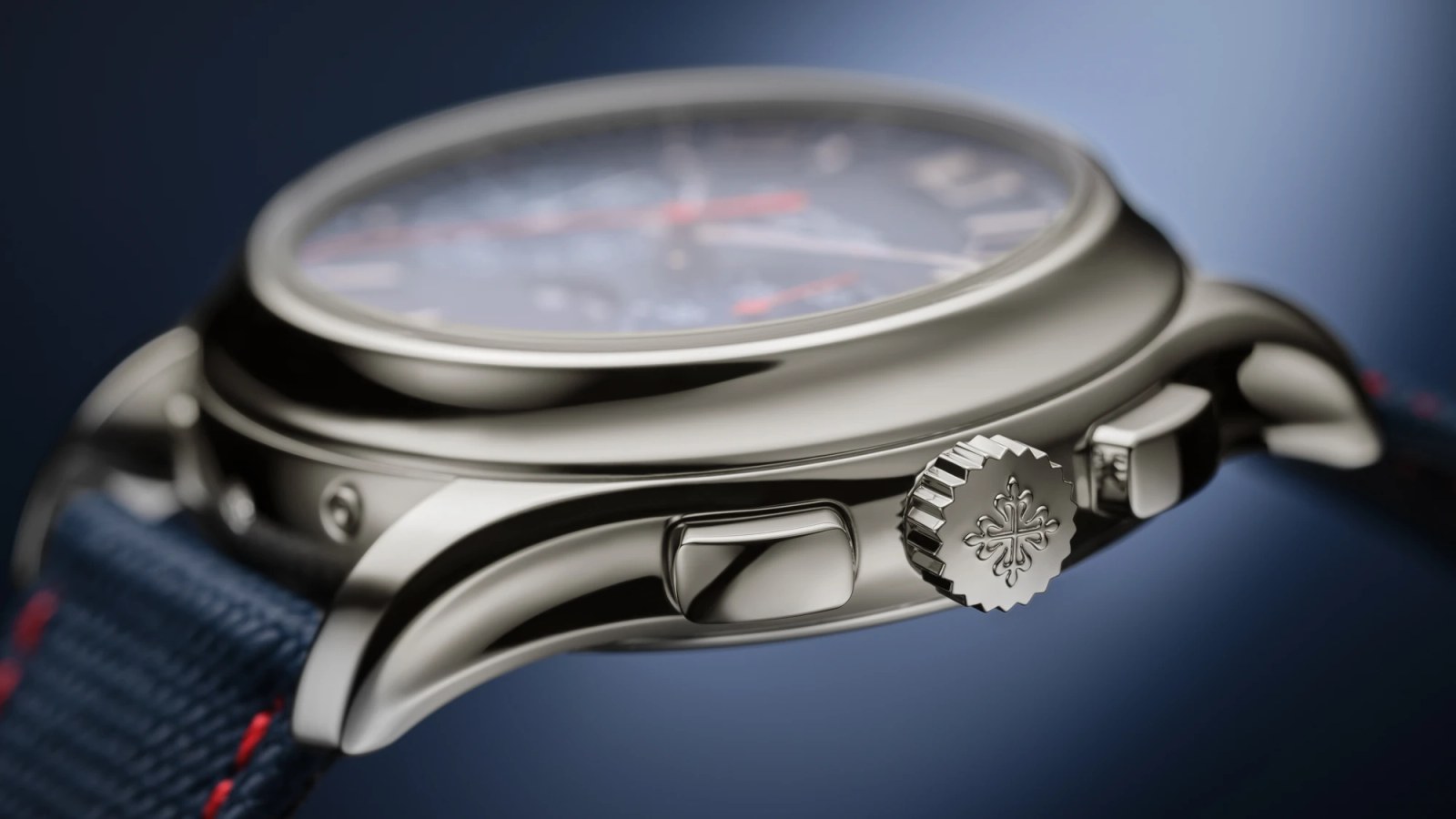
Around it all is a Calatrava case of 42 mm in hand-polished platinum, with a concave bezel, hollowed incurved lugs and rectangular pushers softened at the corners. As on every Patek Philippe platinum model, a single diamond is set at 6 o'clock.
The strap question
A composite strap on a platinum grand complication will surprise some collectors, and a few will reach for leather on day one. Patek's reasoning holds, though. This is a chronograph with a sporting temperament, and the navy composite with its fabric motif and red stitching says so plainly. Look closely and the topstitching ends in green, white and red. It is the kind of detail you notice in the second week of ownership, not the first.
Eighty-five years later
The 1518 answered whether a calendar and a chronograph could share a wrist. The 5978 asks something quieter: how quickly a calendar can change its mind. Patek's answer is thirty milliseconds, in Italian.