
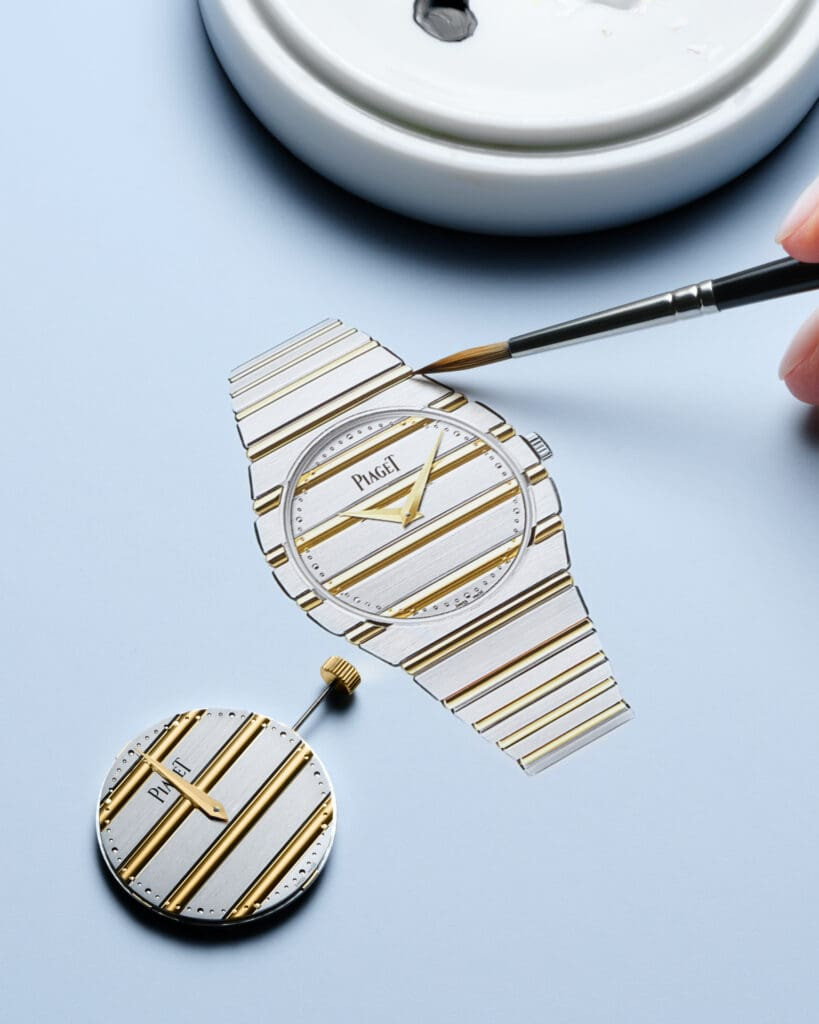
There are luxury sports watches that wear their toughness like a badge. The Piaget Polo has always worn something else: nightlife. When Yves Piaget introduced the original Polo in 1979, it wasn’t trying to compete with the era’s emerging steel icons. It was a full-gold bracelet watch built for people who treated a gala, a club and a polo match as stops on the same evening. That DNA is exactly what the Piaget Polo 79 Two-Tone (reference G0A51150) leans into, and the result is more interesting than yet another “integrated bracelet” nostalgia trip.
Design and materials: two metals, one unmistakable silhouette
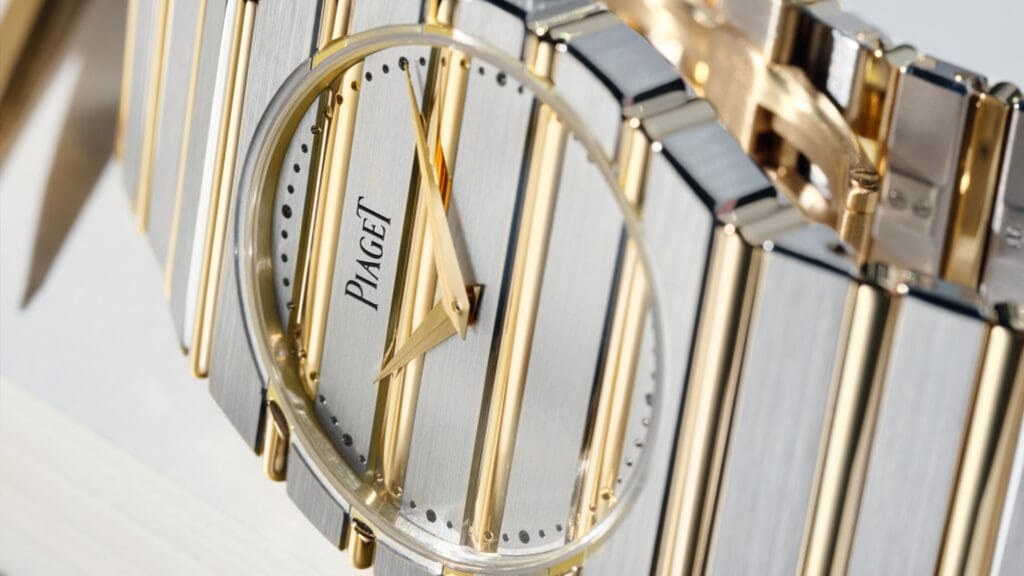
The headline is the metalwork, and Piaget is explicit about its philosophy: it “only measures time in gold.” Here, that idea becomes a deliberate optical trick. The case and integrated bracelet are rendered in brushed white gold, while the signature gadroons are picked out in polished yellow gold. From a distance, the contrast can flirt with the look of a two-tone steel watch. Up close, it reads differently, because the surfaces are doing more than shining. Brushing mutes the white gold into a soft, satin plane, and the polished yellow gold accents pop like neatly cut inlays. It is not subtle, but it is controlled.
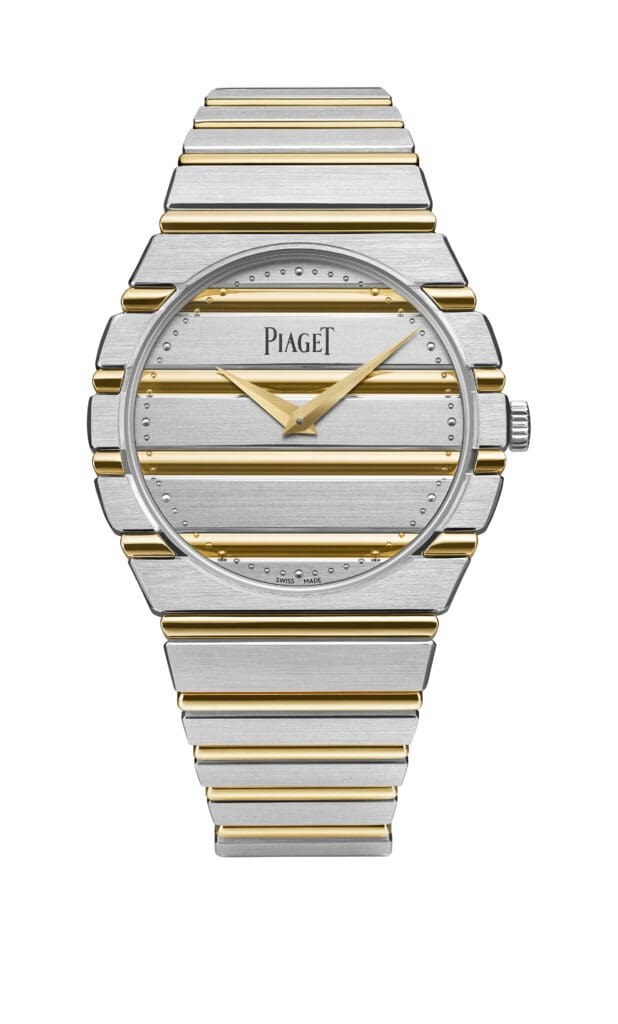
Piaget keeps the dial aligned with the bracelet’s logic. It is a solid gold dial, and the hands are in brushed yellow gold, a small detail that matters because it keeps the watch from feeling like a two-tone experiment that stops at the case. The Polo’s defining identity, the idea of “a bracelet watch and a watch bracelet,” still lives or dies on integration, and the execution here sounds appropriately cohesive.
At 38mm, the case size stays in the wearable sweet spot for a design that is more about line and proportion than about bezel presence. Combined with the fully integrated bracelet, it is clearly intended to sit close and fluid on the wrist, more cuff-like than tool-like.
Movement and technical profile: ultra-thin, micro-rotor, and very Piaget
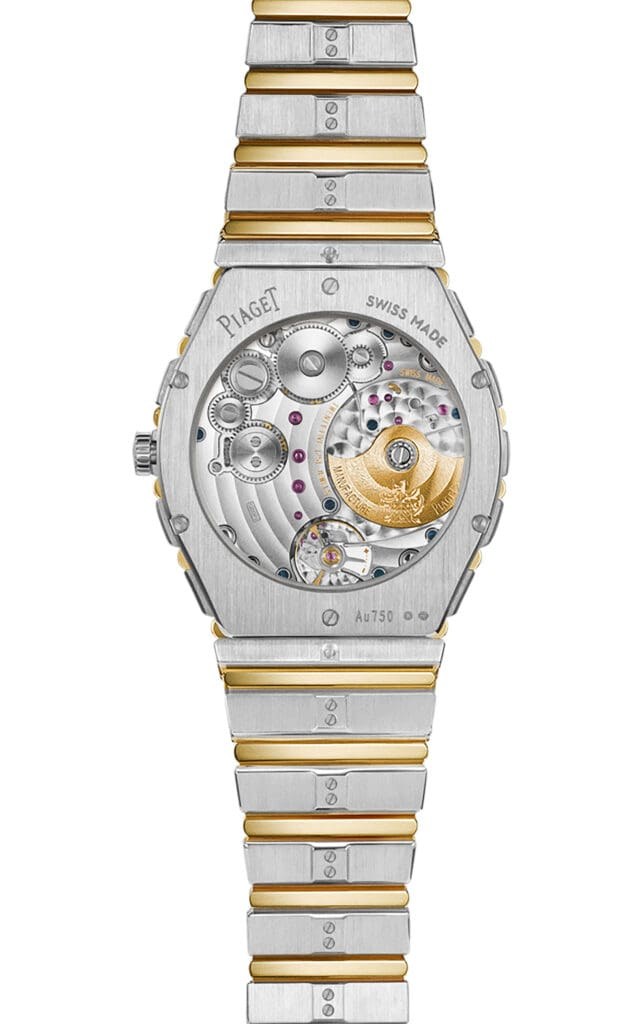
Inside is the caliber 1200P1, an ultra-thin mechanical movement with a micro-rotor measuring 2.35mm in thickness. That single number tells you why the Polo 79 can keep its sleek posture without resorting to design gimmicks. Piaget has long been associated with ultra-thin watchmaking, and using a micro-rotor here is as much about maintaining the watch’s elegant profile as it is about technical bragging rights.
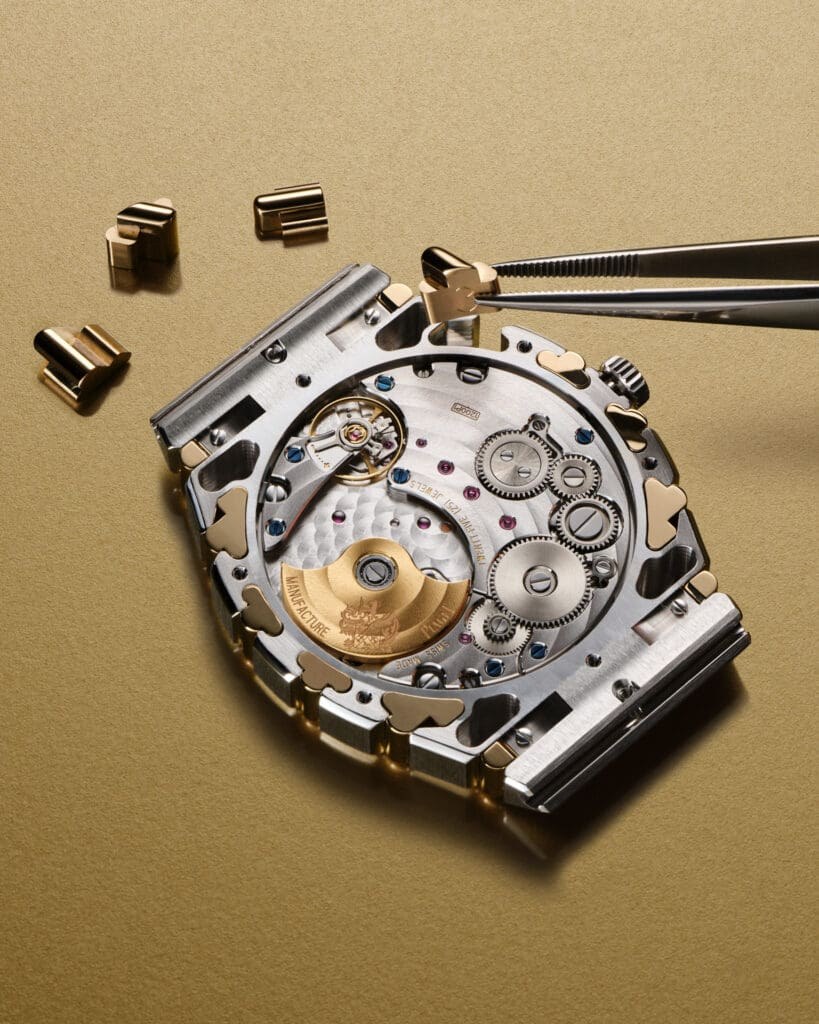
Piaget’s release positions this thinness as part of the wearing experience: a “silky” profile and comfort across different wrist sizes. In a category where many integrated-bracelet watches have become heavier, thicker, and more armor-like, that emphasis feels quietly contrarian.
Water resistance is not stated in the provided material, so it’s best treated as unknown rather than assumed.
Where it sits: heritage, anniversary energy, and a market that loves a remix
Context matters. Piaget revived the original Polo design as the Piaget Polo 79 in 2024 for the Maison’s 150th anniversary, and that comeback was validated with an “Iconic Watch” award at the GPHG in 2024. A yellow gold version led the charge, followed by a white gold iteration in 2025. The 2026 Two-Tone is positioned as a return to one of the original 1979 configurations, and Piaget notes that vintage two-tone examples are “rarely seen today.”
That scarcity, plus the current collector appetite for integrated-bracelet icons, gives the Two-Tone a plausible lane: it is familiar enough to be understood instantly, but niche enough to feel like a connoisseur’s pick rather than a default flex.
Closing thought
The Piaget Polo 79 Two-Tone (G0A51150) succeeds because it does not try to cosplay practicality. It doubles down on precious metal craft, on the tactile contrast between brushed and polished gold, and on ultra-thin elegance via the 1200P1. If you want your “sports watch” to look like it might actually play sport, look elsewhere. If you want one that looks like it owns the room, Piaget has been rehearsing that role since 1979.