
Four unique gem-set Cosmograph Daytonas, one for each season, sold individually at Phillips in London last night. No buyer's premium, no commission. All proceeds go to the Federer Foundation and Re:wild.
Four lots. Four watches that will never be made again. £37.3 million, or $49.4 million, raised in a single evening.
Aurel Bacs took the rostrum at Phillips in London for the Rolex Four Seasons sale, the auction house's first charity auction with Rolex. Phillips puts the result at the largest single consignment ever offered at a charity auction. With the buyer's premium waived, the hammer prices are the donation, split between two foundations tied to two of the brand's most recognisable Testimonees.
Roger Federer founded the Federer Foundation in 2003 to give children in Southern Africa and Switzerland the chance to learn, play and thrive, with a focus on early and foundational learning. Re:wild was launched by a team of conservation scientists together with Leonardo DiCaprio, and works with Indigenous Peoples, local communities and on-the-ground organisations to protect and restore the natural world. Rolex brought both under its Perpetual Planet Initiative for the occasion: education on one side, the planet on the other.
The initiative has had a big year. Rolex's $100 million gift supports National Geographic's Museum of Exploration, which reopened in Washington, D.C. in June, and the sale lands only days after a new season of Planet Visionaries, the brand's podcast hosted by Alex Honnold, premiered during Climate Week in New York.
One Watch, Four Readings
Every piece shares the same architecture. The case comes in a different precious metal, the dial is cut from natural stone, the hour markers and bezel carry coloured gemstones, and 54 brilliant-cut diamonds run along the lugs and crown guards. Inside sits the calibre 4131, the current Daytona movement, with roughly 72 hours of power reserve and Superlative Chronometer certification.
What changes is the season, and Rolex let the stones do the telling.
Spring arrives in 18 ct white gold with a chrysoprase dial, its counters in lepidolite. Purple sapphires set the markers and all 36 trapeze-cut stones of the bezel. It sold for £6.8 million ($9 million).

Summer is the warmest of the four, in 18 ct Everose gold. A turquoise dial meets counters in heart of ruby, framed by pink sapphires in pink gold settings and on the bezel. It became the top lot of the night at £10.3 million ($13.65 million).

Autumn turns to 18 ct yellow gold and a dial of mookaite, the earthy jasper that reads like fallen leaves. Green tourmalines form the markers and bezel. Look at the counters and you find chrysoprase again, the same green stone that carried the Spring dial, returning as the year closes. It fetched £10.2 million ($13.5 million).

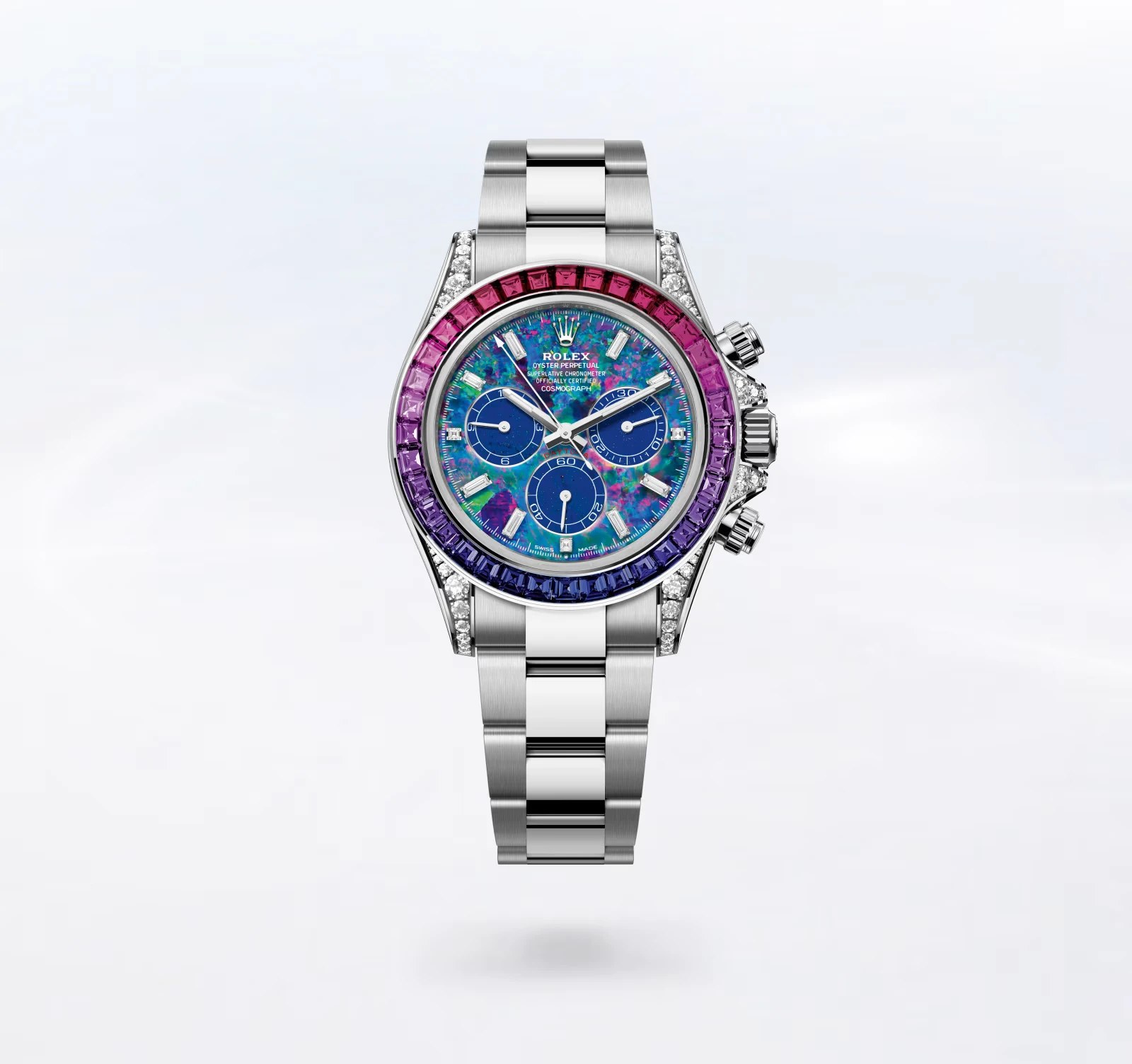
Winter is the only one in 950 platinum, and the choice feels deliberate. Blue has long belonged to platinum at Rolex, and here it comes as a blue opal dial with lapis lazuli counters. Diamonds replace coloured stones on the markers, while the sapphire bezel shifts from blue to fuchsia across its 36 stones, the cold edge of the year already leaning toward spring. It sold for £10 million ($13.2 million).
Beyond The Room
Phillips knows what a Daytona can do in a saleroom. In 2017, in New York, the house sold Paul Newman's own Daytona for $17.75 million, and the watch world has been measuring against it ever since. Last night gave it a new set of numbers to talk about.
Bacs called it a historic moment for watchmaking, and the phrase carries weight coming from the man who has sold most of the records that matter. Yet the achievement of the evening sits outside the saleroom. Four collectors now own the only examples of watches Rolex will not repeat, and the money they paid leaves the watch world entirely, headed for classrooms in Southern Africa and wild places that need defending.
It rounds off a year Rolex opened by marking a century of the Oyster case, and one in which the Daytona already had its moment at Watches and Wonders with the Rolesium reference 126502 and its white grand feu enamel dial. For a brand that rarely makes a spectacle of itself, the Four Seasons said a great deal. It showed what the Daytona can become in stone and colour, and gave that craft a purpose far larger than a wrist.