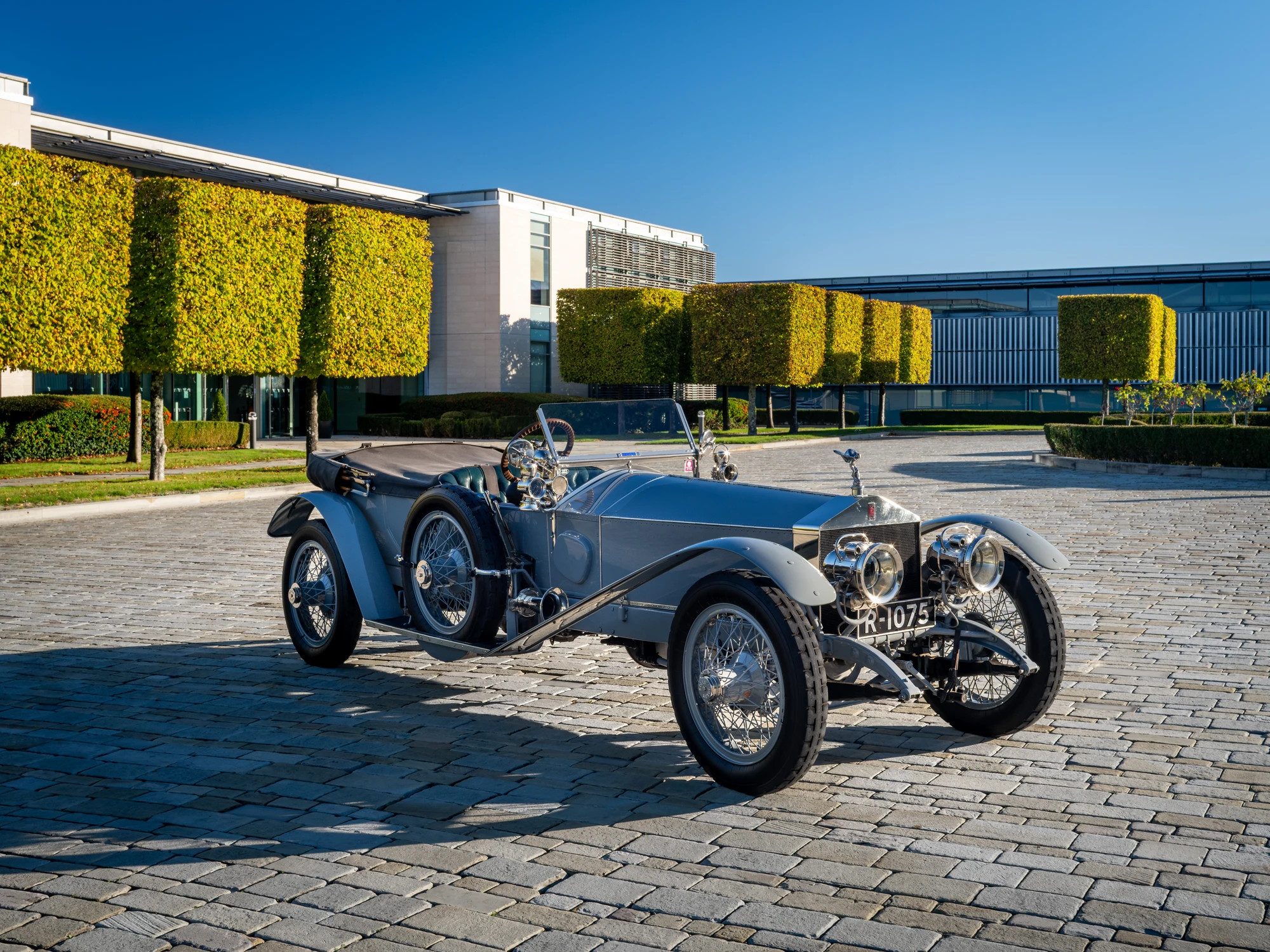
Rolls-Royce introduced the 40/50 H.P. at London's Olympia Motor Show in November 1906, establishing an operational benchmark that defined early twentieth-century motoring. Henry Royce engineered the mechanical platform to resolve the structural frailties common to pioneer automobiles. Commercial Managing Director Claude Johnson, known across the industry as CJ, recognized that commercial survival required public demonstration. He chose chassis 60551, painted it silver, installed silver-plated fittings, and christened it the Silver Ghost. Clients adopted the designation for every subsequent chassis, anchoring the identity of the marque to a single mechanical philosophy.
Royce focused his development on a smooth-running six-cylinder engine, pairing it with a versatile chassis capable of carrying varied coachwork configurations. British production ran from 1906 through 1925 at Derby, totaling 6,173 chassis. An additional 1,703 rolled out from the American assembly plant in Springfield, Massachusetts, followed by ten specialized chassis in 1927. Factory mechanics paired specific spring rates and damping arrangements directly to the weight and profile of each individual coachbuilder commission, spanning formal limousines to open tourers.
The Engineering Logic of Rolls-Royce
Competitive trials served as Johnson's primary verification method during an era when long-distance travel remained unpredictable. The model secured early titles at the Scottish Reliability Trial, the Austrian Alpine Trial, and the Spanish Grand Prix. Experimental test driver Ernest Hives demonstrated the mechanical ceiling of the platform in 1911 by entering chassis 1701 into the London-Edinburgh Trial. Mechanics deliberately sealed the gearbox in top gear for the entire journey. Chassis 1701 recorded fuel economy figures exceeding 24 mpg, reached 78.2 mph in a subsequent half-mile test, and later clocked 101.8 mph at Brooklands fitted with streamlined bodywork, marking the first Rolls-Royce to clear the 100 mph threshold.
That demonstration unit earned the nickname The Sluggard from Johnson, though its structural endurance proved repeatable across eras. Historical specialists retraced the 1,800-mile route of the 1913 Alpine Trial in 2013 with 47 original examples, including chassis 1701. In 2021, the same chassis repeated its London-Edinburgh run with the transmission once again locked in top gear, matching the exact operational conditions recorded 110 years earlier. Today, chassis 1701 sits on display inside the Goodwood manufacturing plant, representing the mechanical origin point for the brand's contemporary standards.