The Audemars Piguet x Swatch Collab Isn't What You Think
The first thing to understand about the Royal Pop is that it is not a wristwatch. In the days before the reveal, the internet had already decided what this would be. Another icon, another bioceramic case, another line around the block. After the success of the Omega and Blancpain collaborations, the formula felt inevitable. Swatch would do what it does best. Audemars Piguet would lend its most famous design. The result would be a Royal Oak for the masses.
That is not what happened.
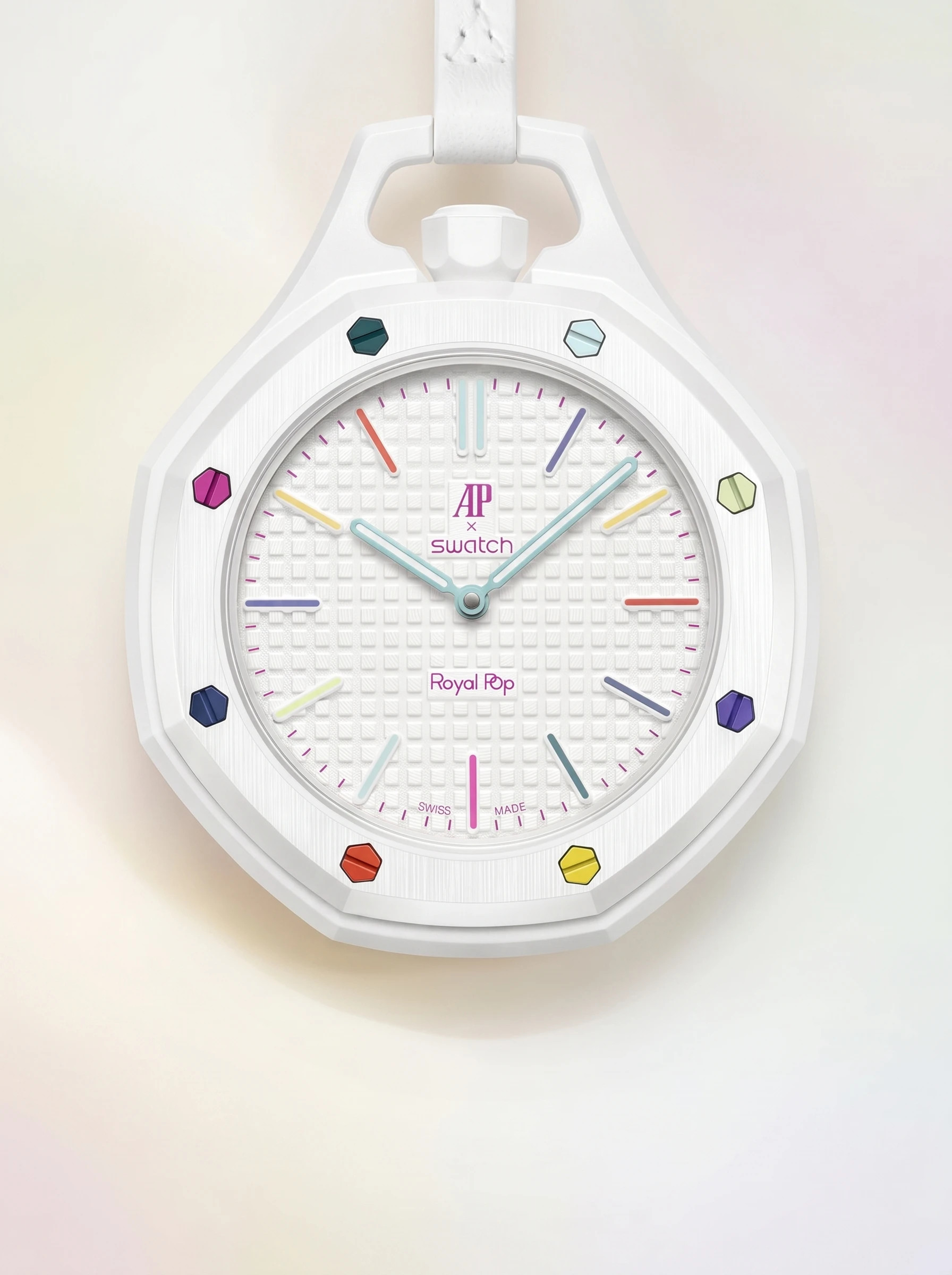
Instead, Audemars Piguet and Swatch delivered something more considered, and far more interesting. The Royal Pop is a pocket watch that refuses to stay in one place. It draws its logic not just from the octagonal bezel, but from a piece of Swatch's own catalogue, the clip-on POP series from the 1980s. The choice to sidestep the obvious, to avoid making a cheap replica of a Royal Oak wristwatch, is the whole story here. It is a gesture of restraint in a market that rewards the opposite.
A More Interesting Question
A bioceramic Royal Oak for the wrist was the obvious play. It would have moved fast and traveled further. It would also have put the original in an uncomfortable position, asked to share its silhouette with something it could not control. By pivoting to a pocket watch, the brands asked a better question. Not "how do we make this accessible," but "what else can this be?"
The answer is a 40mm bioceramic object that feels both familiar and entirely new. The Petite Tapisserie dial is there. So is the satin-finished bezel. But the thing is built to be worn around the neck, clipped to a bag, or set on a desk. The system is deliberately open: Swatch supplies the lanyard and the stand, but the wrist is left to the imagination, and to whoever wants to build for it. There is also a quiet nod to the brand's own back catalogue. Audemars Piguet has its own history with the format, including the Royal Oak Pocket Watch reference 5691, and the Royal Pop sits in that lineage rather than apart from it.
The details confirm the seriousness of the project. Sapphire crystal sits on both sides of the case, an upgrade from earlier Swatch collaborations. The Sistem51 appears here for the first time as a hand-wound calibre, with fifteen active patents and an antimagnetic Nivachron hairspring that Audemars Piguet itself helped develop, and which now lives inside several of its own watches. The power reserve runs past ninety hours. The mainspring barrel doubles as its own indicator: when the openings show grey, the coils are visible and the watch needs winding; when the openings turn gold, the spring is fully wound and the coils disappear from view. It is the kind of detail you only notice once, and then keep looking for. The movement itself is decorated with a colourful pop-art print, a visual bridge between Le Brassus and Biel.
Even the number eight is deliberate. Eight models in the collection, a tribute to the eight sides of the Royal Oak bezel and the eight hexagonal screws that hold it in place. Eight further patents cover the case construction itself. Nothing here is decorative by accident.
The Art of the Sidestep
There is a lesson here in modern brand management. Audemars Piguet has found a way to participate in popular culture without surrendering its position. Under the leadership of Ilaria Resta, the brand has embraced a collaboration that is playful and accessible, yet protects the core asset. The Royal Pop does not replace or diminish the Royal Oak. It exists alongside it, in a different category entirely.
This is a move born of confidence. It shows a trust that the audience is smart enough to appreciate a clever concept over a simple copy. In a world of hype, Audemars Piguet and Swatch chose intelligence. They resisted the gravitational pull of the easy win and, in doing so, created something with more staying power.
The Royal Pop suggests a new path for these high-low partnerships. The first wave was about democratizing icons. This next phase could be about using the freedom of collaboration to explore ideas that the parent brands, constrained by their own legacies, could never attempt alone. It is not a substitute for a Royal Oak. It was never meant to be. And that is precisely what makes it so compelling.
Read more about watches here.