
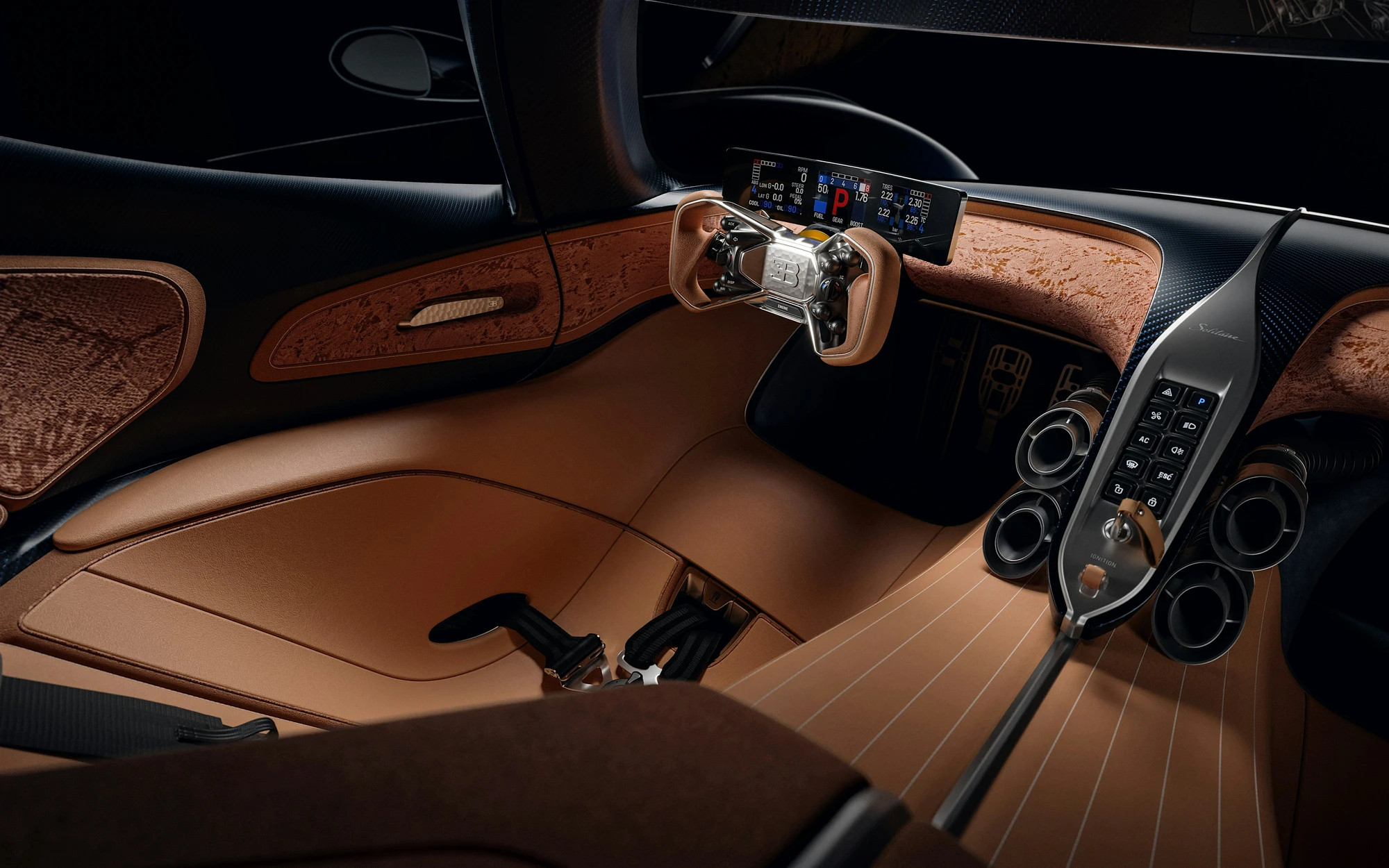
A Destrier was the finest and strongest warhorse a medieval knight could command. It is also the name Bugatti has given its third Solitaire project, a car that shares the posture of a powerful animal poised to pounce, even when standing still.
The one-off commission began with a question. What if the most extreme engineering package the marque has ever created, the foundation of the Bugatti Bolide, was freed from its relentless pursuit of downforce? What form would emerge if the wings, vents, and aerodynamic addenda were stripped away?
The result is a car of pure proportion, standing just one meter tall. It is dramatically lower than any other Bugatti model. The wheels, 20-inch at the front and 21-inch at the rear, appear monumental against a body that has been pared back to its essential volumes. The cabin crouches low between the two front wings, creating an extreme posture normally found only in early design sketches.
One Chassis, Two Expressions
This idea has a precedent in the marque’s history. The Type 57 chassis once formed the basis for both the streamlined Type 57G and 57C “Tank” racers that won Le Mans in 1937 and 1939, and the Type 57SC Atlantic, a car widely held to be among the most beautiful ever built. A race car and an objet d'art from a single foundation.
The Destrier and Bolide continue that tradition. A hand-laser-engraved dedication plate above the windscreen depicts both the Type 57G Tank and the Type 57SC Atlantic, making the connection permanent.
The Destrier’s bodywork introduces new vocabulary. The signature Bugatti C-line, usually an unbroken curve of brightwork, now pauses just before the front wheel well, allowing bare bodywork to show through before it resumes its path. The horseshoe grille is wider than on the Bolide, while at the rear, a blended wing echoes the Chiron Profilée, closing the silhouette with quiet grace.
The car is finished in “Sapphire Celeste,” a multi-layered color created exclusively for its owner. Diamond-inspired sparkle in the paint elevates the car's sculptural form, contrasted by polished aluminum brightwork. It is a quiet echo of history. The celebrated Type 57SC Atlantic chassis 57591, the “Pope” Atlantic, was originally blue before being repainted black.