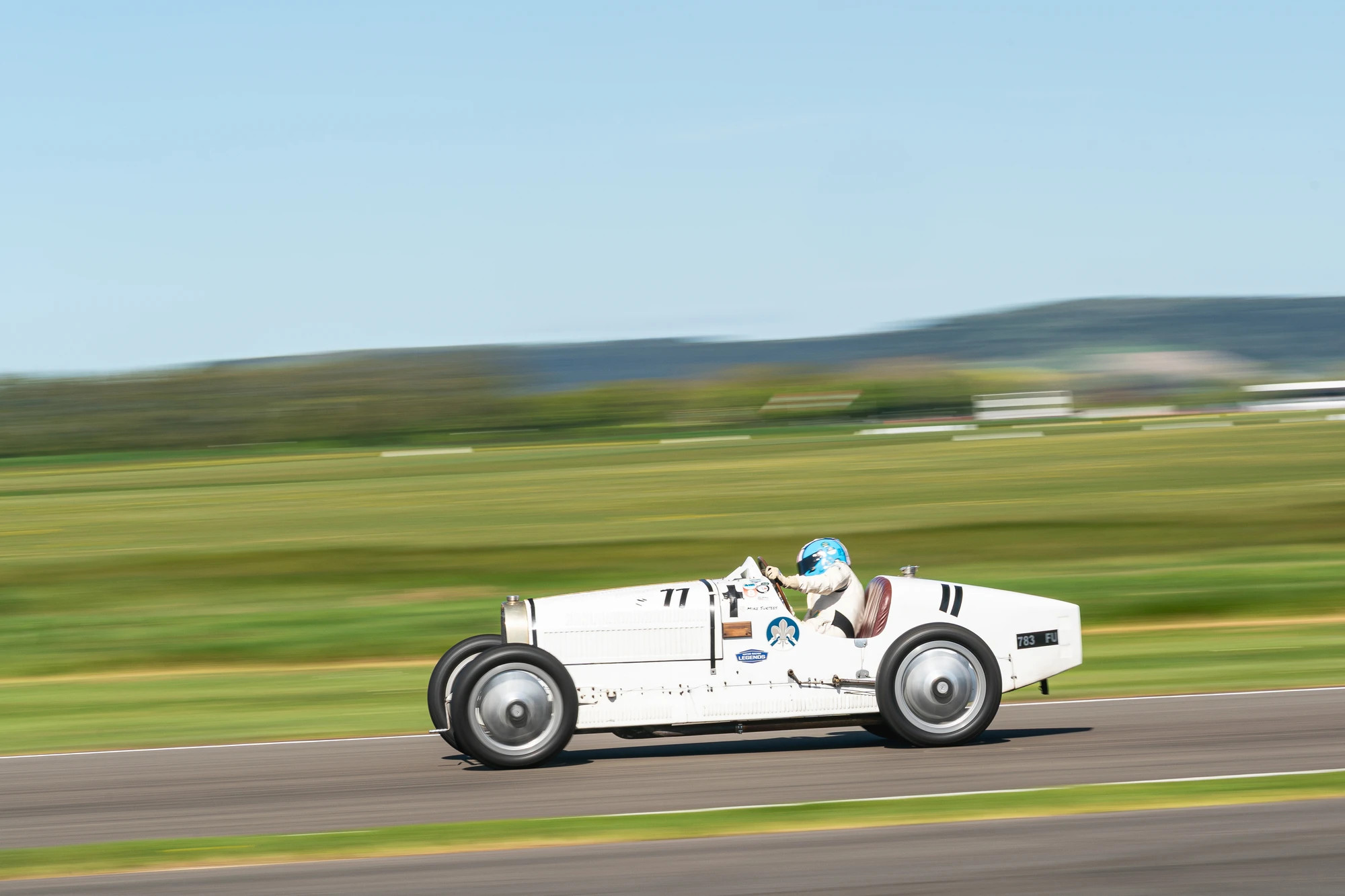
Climbing into the cockpit of a Bugatti Type 35 means your head is fully above the bodywork, exposed to the elements. The air fills with the smell of fuel and oil. Every vibration from the engine and the road travels directly through the seat and the steering wheel into your body. It is a complete sensory immersion, a constant dialogue between the driver, the machine, and the track.
A full century after Ettore Bugatti revealed the car at the 1924 Lyon Grand Prix, this experience remains brutally and beautifully intact. The Type 35 went on to achieve over 2,500 victories, making it the most successful competition car of its time. Yet its real legacy is found not in record books, but on the circuits of Monaco, Le Mans, and Goodwood, where a small community of owners continues to race them as they were always meant to be raced.
Thierry Stapts is one of them. His white Type 35, also a hundred years old, is a regular competitor. He describes the sensation of driving it as somewhere between a racing car and a motorcycle. It is an unfiltered experience, one that demands total focus and rewards it with a connection no modern car can offer.
This is the point. In an age of synthesized engine notes and layers of electronic insulation, the Bugatti asks for something else entirely. It asks for skill, for patience, and for a willingness to engage with a machine on its own terms. To drive it well is to work with its character, not to dominate it. It’s a partnership.
A Demanding Relationship
The relationship between these owners and their cars is measured in decades. Thierry has been driving his for seven years and says he is still improving, still learning its language. There is always more to discover. He affectionately calls the car “grandmother”: old, nimble, and beautiful. “It’s like a part of my family,” he says.
Keeping a century-old Bugatti competitive is a serious undertaking. Parts are scarce and often must be fabricated from scratch by specialists, many of whom are based in the United Kingdom. For Thierry, his mechanic Pascal Dussouchet is the reason the car remains both fast and safe. It is a bond built on immense trust and a shared understanding that these machines deserve to be preserved through use, not just admiration.