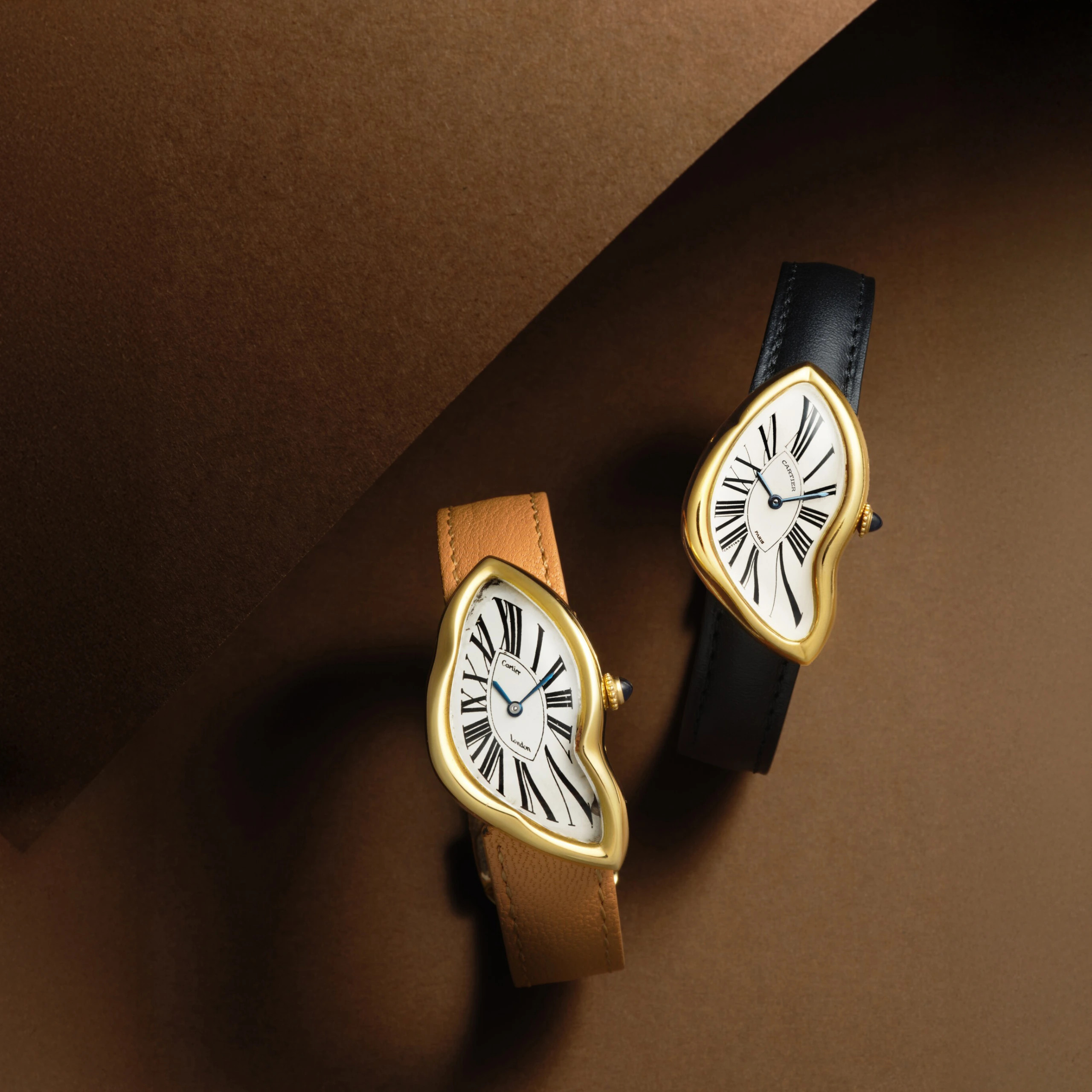
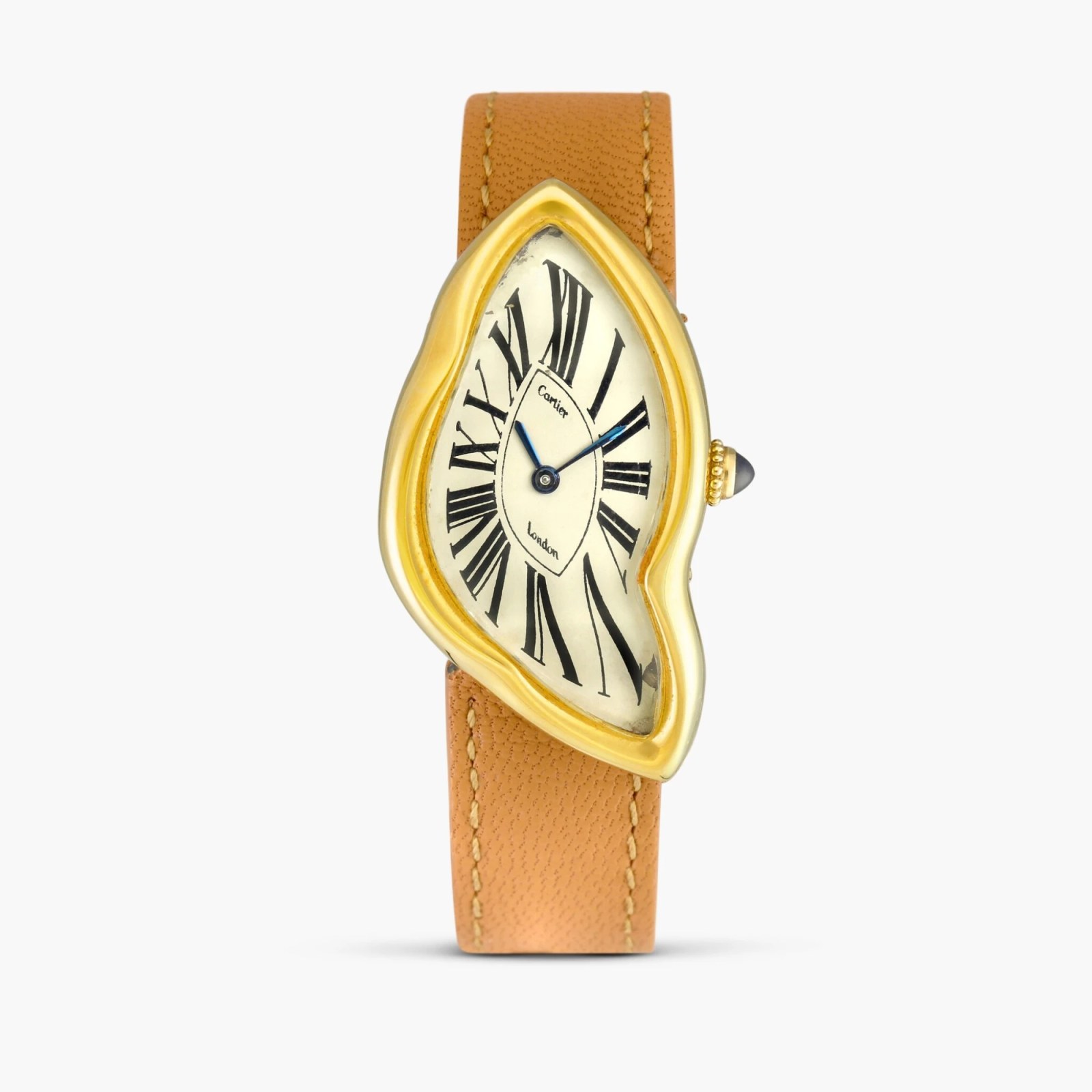
The shape is the first thing that registers. It is a familiar oval, but one that seems to have survived a moment of intense heat or pressure. The Cartier Crash does not look like it was designed. It looks like it happened. The Roman numerals stretch and contort to fit the warped frame. The whole object feels like a beautiful accident. That feeling is part of the point. Recently, one of these watches, a rare London-made example from 1987, sold at Sotheby’s Hong Kong for nearly two million dollars. The price, double its estimate, set a new world record for any Cartier watch at auction. It is a staggering figure for a piece of gold and sapphire that so deliberately rejects conventional ideas of beauty. But the number itself is less interesting than what it signifies. It suggests a deep and growing appetite for objects with a story. For things that are not perfect.
The Crash was born in Cartier’s London boutique during the 1960s, an era when the branch, led by Jean-Jacques Cartier, operated with a distinct creative independence. London was producing designs that were bolder and more eccentric than their Parisian counterparts. The workshop felt more like an artist’s studio. This was not design by committee. It was the result of a specific vision, in a specific place, at a specific time. Legend says the watch was inspired by a client’s damaged Cartier Baignoire, its case melted out of shape in a car accident. The story has never been confirmed. It almost does not matter if it is true. The myth has become part of the object. It gives the watch a narrative soul, something that cannot be replicated or mass-produced. The form itself is a protest against the predictable symmetry of most watchmaking.

This particular record-setting piece is one of only three made in 1987, in yellow gold, bearing the 'Cartier London' signature and powered by the same Jaeger-LeCoultre calibre that ran the original 1967 examples. It is a detail prized by collectors. It carries the ‘Cartier London’ signature, a detail prized by collectors. Its sale is not an isolated event. At the same auction, other unconventionally shaped Cartier watches from the same period also achieved prices many times their estimates. There is a clear pattern here. The market is rewarding character, not just brand recognition.

We are seeing a shift away from the sterile perfection that defined luxury for so long. Hype is becoming tiresome. Flawless, computer-generated designs are starting to feel cold. The Cartier Crash is the antithesis of all that. It has a point of view. It has history. Its value is tied to its strangeness, not its precision. In a world saturated with perfectly polished objects, a little distortion feels honest. It feels human. The demand for the Cartier Crash is not just about collecting a rare watch. It is about buying a piece of artistic defiance. It is a signal that the most compelling ideas are rarely the ones that follow the rules.