
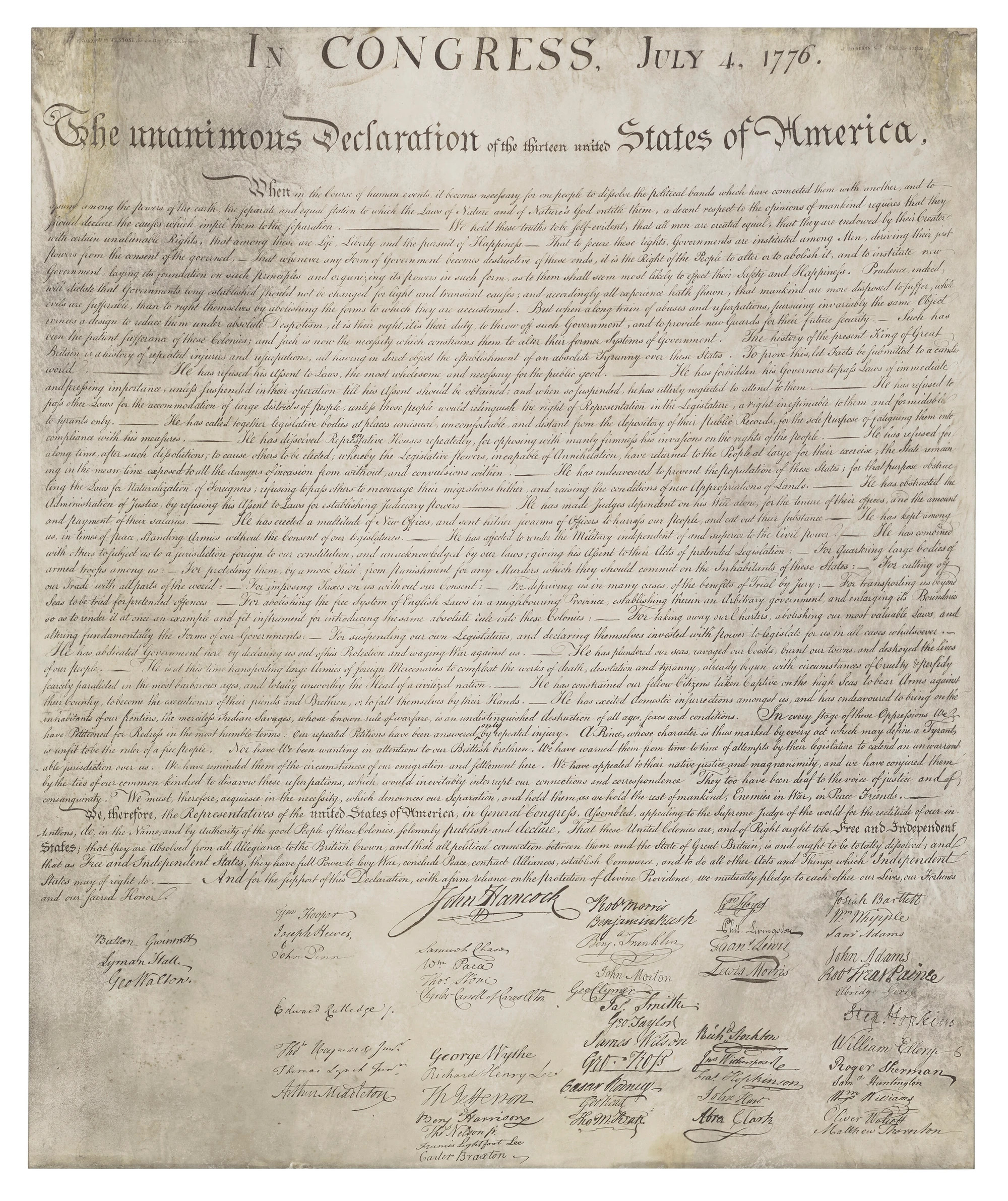
In 1820, forty-four years after it was signed in Philadelphia, the Declaration of Independence was already showing its age. The original manuscript had been treated roughly during the Revolutionary War and its aftermath, and the ink was beginning to fade. This physical decay prompted a project of preservation, led by then Secretary of State John Quincy Adams, the son of signer John Adams.
The country was in a period of renewed patriotism following the War of 1812. This mood produced what printing historian John Bidwell has called “heroic engravings” of the document. Notable examples by John Binns and Benjamin Owen Tyler were more inspirational than accurate, incorporating facsimiles of the signatures but taking artistic liberties with the text. Adams, according to Bidwell, believed the American people deserved a version “untainted by demeaning publicity and arbitrary artistic interventions.”
An Exacting Commission
Adams first approached Benjamin Owen Tyler for the work, but found his proposed fee of $150 too high. He then turned to William J. Stone, an engraver who had worked in the same shop that printed Tyler’s version. Stone’s skill in banknote engraving made him the ideal candidate for a task that demanded absolute precision.
It took Stone three years to complete the copperplate engraving. The exact method he used is still a matter of some debate. While some have suggested a wet-ink transfer process, a close examination by specialist Seth Kaller comparing the original manuscript to Stone’s work suggests tracing was the more likely technique. More than a dozen small differences support this, including a decorative 45-degree line through the capital ‘T’ at the top of the Stone print that does not appear on the original. This level of forensic detail points away from a riskier wet process.
By April 1823, the plate was finished. The State Department authorized a run of 200 copies to be printed on vellum. John Quincy Adams noted in his diary in October 1822 that while the signatures were done, Stone still had “much to labour” on the Declaration itself.