
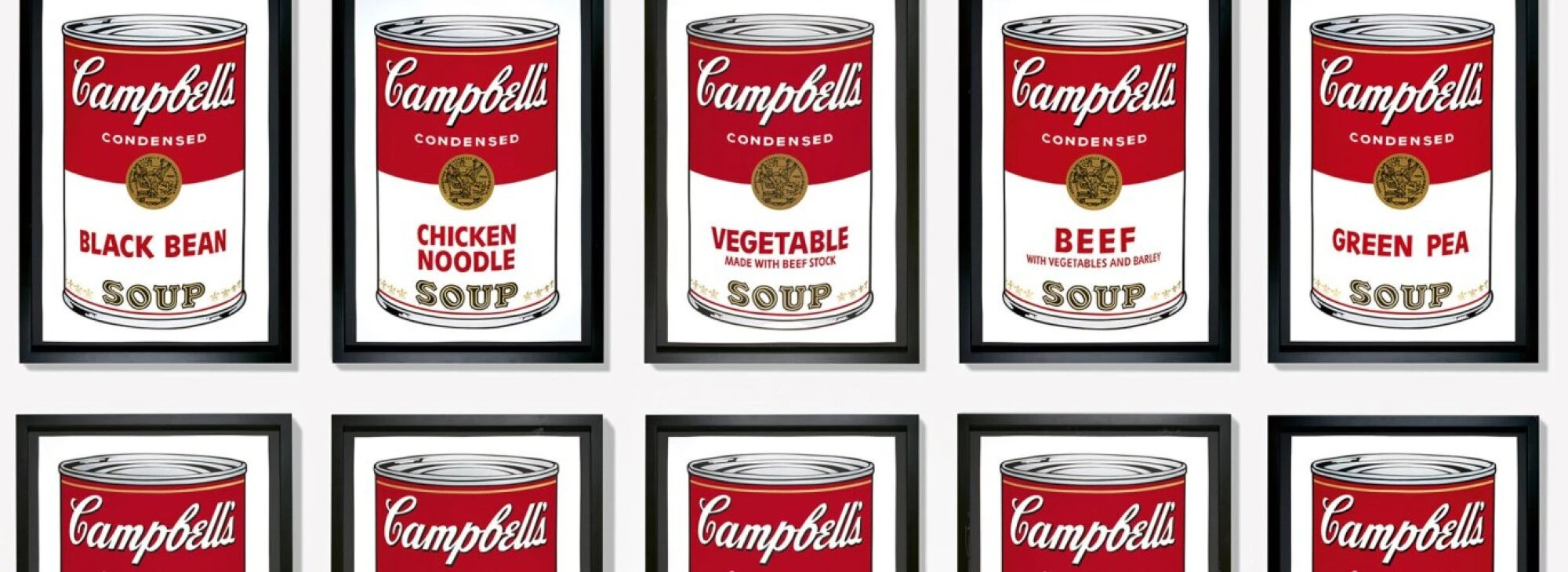
A friend suggested he paint something everybody would recognize, “like Campbell’s Soup.” In 1962, Andy Warhol took the advice. He created a series of 32 canvases, one for each flavor of soup the company offered. The works were hand-painted, with projections of the cans traced onto the canvas, but they were designed to mimic a mechanical process. Each one carried subtle imperfections, a human touch beneath a uniform surface.
The works were first shown at the Ferus Gallery in Los Angeles. The art dealer, Irving Blum, saw something in them that departed from Warhol's earlier comic-strip paintings. He arranged an exhibition, placing the 32 canvases on grocery store shelves along the gallery walls. The public was mostly indifferent, but the art world took notice. A dealer in a nearby gallery even began selling actual cans of soup, advertising them as a cheaper alternative to Warhol's paintings.
The $1,000 Decision
Blum sold a few of the individual canvases, including one to his friend, the actor Dennis Hopper. But he quickly had a change of heart. He recognized the works were not 32 individual paintings, but one single piece. They needed to stay together. He bought back the few he had sold and approached Warhol with an offer.
The deal was for $1,000, paid out in installments over 10 months, for all 32 works. Warhol, who had conceived of them as a set, was delighted. As journalist Sara McCorquodale later wrote, this decision was critical. "This made it different; it made it a statement," she noted in 2015. Blum’s foresight preserved the work’s integrity.
The initial exhibition is now seen as the turning point in Warhol's career. The work captured something about the new America, a culture that embraced consumerism. Before the year was out, Manhattan socialites were attending events in soup can-printed dresses. Years later, after Warhol’s death, Blum sold the complete set to New York's Museum of Modern Art for a price reported to be upwards of $15 million.