
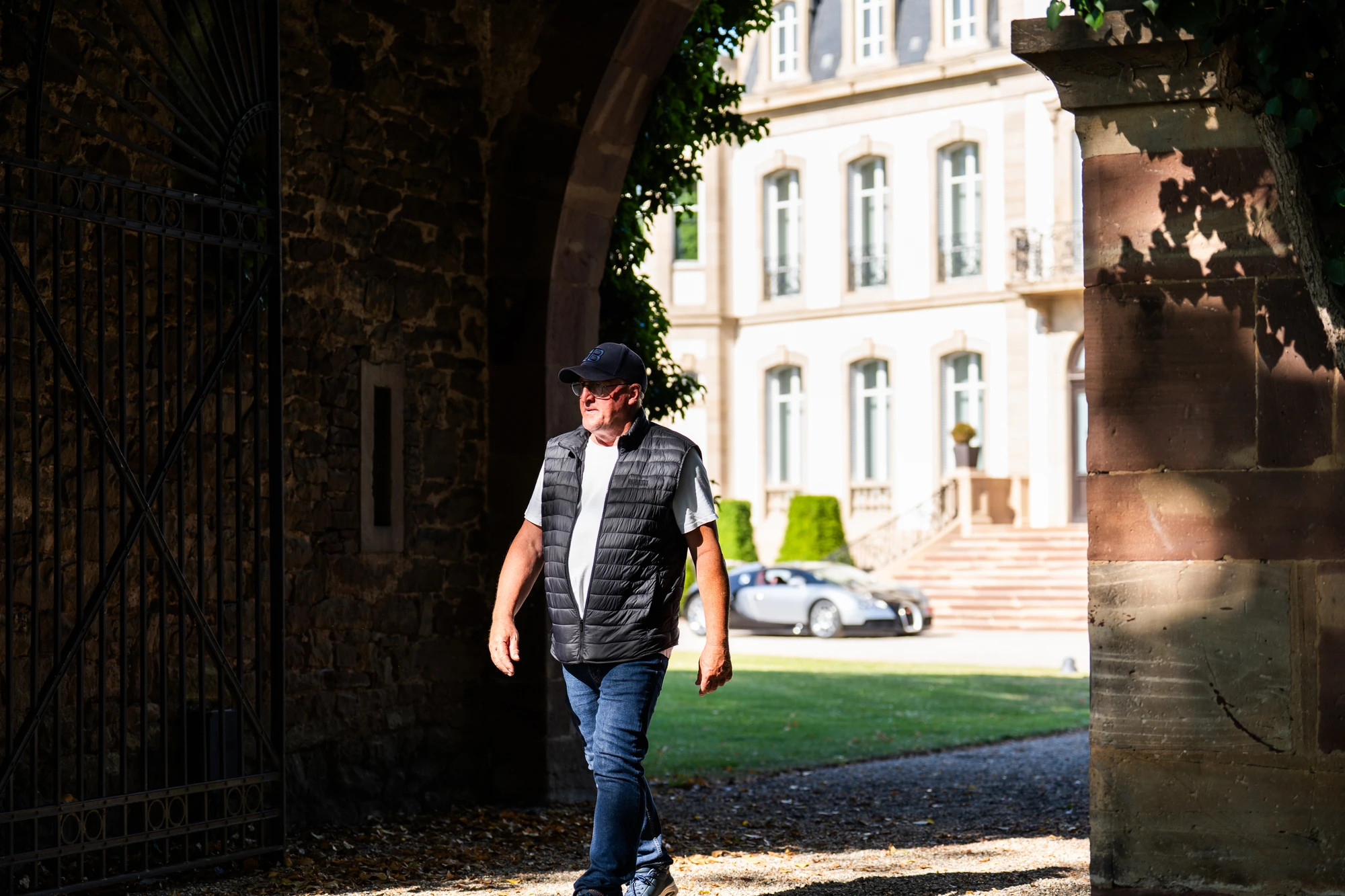
When Bugatti returned to Alsace at the turn of the millennium, it began with a single employee. Patrick Burk, a Facility Manager from nearby Saverne, was the only person on site. He had answered a job advertisement so discreet it mentioned no company name and no location. When he walked through the doors of the unrestored Château, he found a 23-hectare domain of open fields and buildings bearing the marks of time. There was no team. There was only the weight of a legend and the task of building something worthy of it.
Burk lived on the grounds, behind the Château and the Remise Nord, watching over the property seven days a week. He became the company's sole point of contact with the outside world, the human link between a brand being reborn in Molsheim and its parent, the Volkswagen Group, in Wolfsburg. His children grew up there, their family life woven into the fabric of the place. “Bugatti was the priority,” Burk says. “24 hours a day, weekends included. Work never stopped.”
The Foundation Stone
Before the hypercars, there was construction. Before the clients, there were ceremonies to orchestrate. Burk’s role expanded with the needs of the day, from Chief of Construction to Guest Relations. One of his most vivid memories is laying the foundation for the new era. He was tasked with organizing the official ceremony for the Atelier’s first stone, hosting more than 300 guests on what was still an empty field. He handled every detail, acting as event organizer, host, and project coordinator. When his first president, Karl-Heinz Neumann, arrived with local officials, everything was in place. The rebirth was officially in motion.
That period saw the conception of the Veyron under Neumann, a man Burk calls his mentor. The trust between them was direct. As a gesture of recognition for all he had done, Neumann placed the very first miniature model of the Veyron, a unique piece, directly into Burk’s hands. It was a symbol of the personal investment that defined the project. “I sacrificed time with my family, for the brand,” Burk reflects. “But I was willing to do so. I was extremely proud to work for Bugatti.”