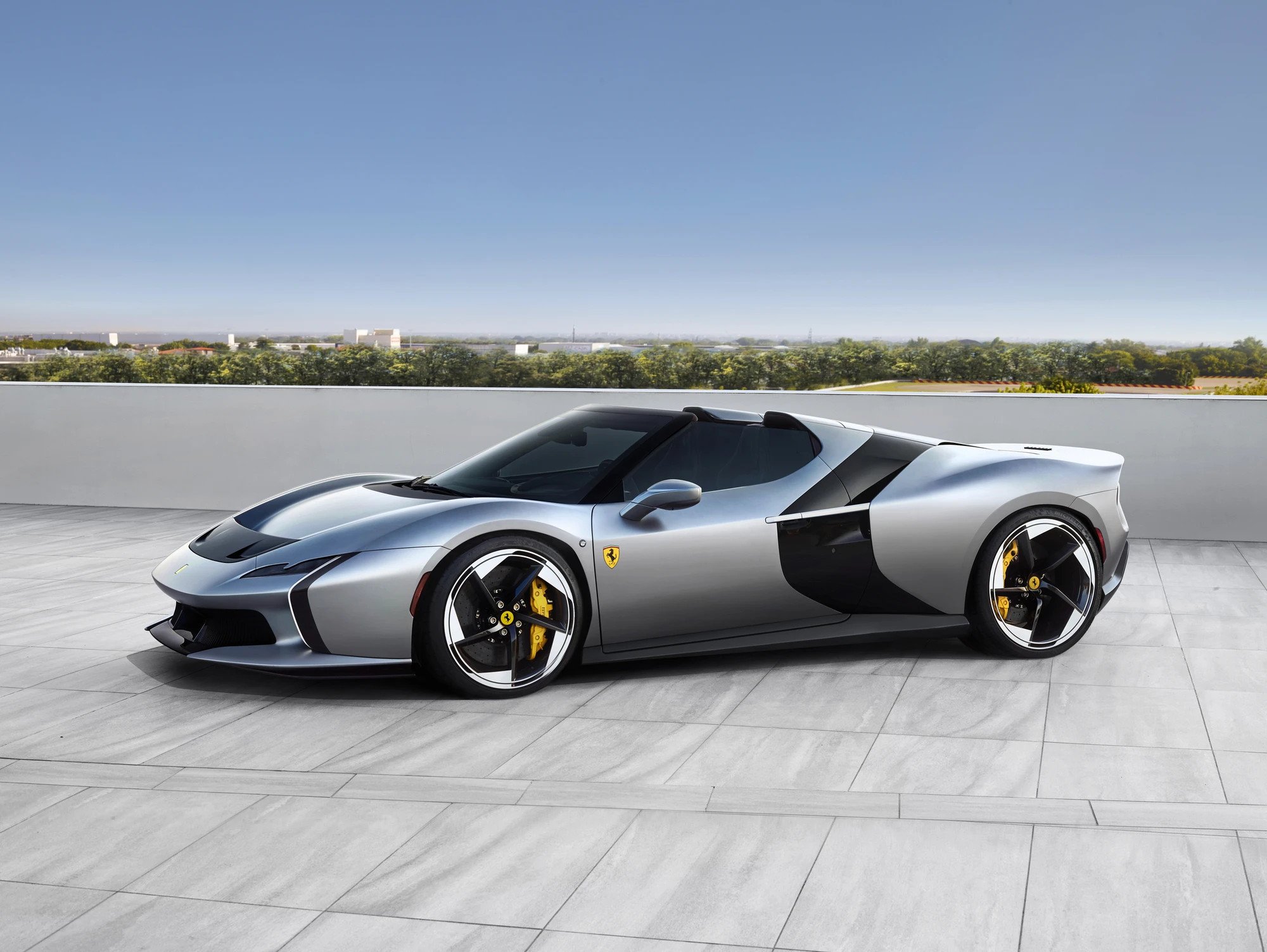
The door handle is milled from a single blade of solid aluminium. It stretches like a bridge between two sides of the bodyshell, a detail you might not immediately recognize for its function. This is the Ferrari HC25, a pure roadster from the One-Off series, unveiled during the Ferrari Racing Days at the Circuit of the Americas in Austin, Texas.
Designed by the Ferrari Design Studio, under the direction of Flavio Manzoni, the HC25 is built for a single client. It belongs to the Special Projects programme, a part of the company that creates unique cars based on a customer's specific vision. The entire process, from the initial idea to the final build, takes around two years, with the client involved in design and verification phases along the way.
An End and a Beginning
The foundation of the HC25 is the F8 Spider. It inherits its chassis, layout, and mid-rear internal combustion V8 powertrain. This makes the HC25 a significant car, as it is derived from the last open-top model from the Prancing Horse to feature the non-hybrid turbo V8 in a mid-rear position. The project serves as a conclusion to the story of that iconic platform.
At the same time, the HC25 looks forward. The muscularity sculpted around its wheels echoes the aesthetic language of the F80, positioning the car as an ideal bridge to the futuristic path Ferrari has taken with its flagship models, the 12Cilindri and F80. The forms are defined by vertical flanks, sharp crests, and clean, geometric lines that harmonize with the car's sensual surface transitions.
A Car of Two Volumes
A strong graphic identity defines the HC25. The car is built around a dual-volume structure, creating an interplay where the front and rear appear as two distinct bodies. These are joined by a wrapping, highly three-dimensional central band finished in glossy black. This element is also functional, incorporating air intakes for the radiators and components for heat extraction from the powertrain.
The main body is finished in matt Moonlight Grey, a color chosen to give solidity and fullness to the forms. From the side, the car gains momentum from an arrow-shaped movement in the black band, which runs from the base of the rear wheels, curves vertically over the door to the sculpted handle, and then sweeps back to merge into the rear screen. The proportions were refined to minimize the visual impact of the glazing and lower the car’s perceived shoulder line.
The lighting units are specific to this car. The front headlamp uses modules never before featured on any Ferrari, achieving a slim lens with a central indentation that mirrors the split design of the rear lights. The Daytime Running Lights adopt a vertical arrangement for the first time, using the leading edge of the front wings to create a distinctive boomerang shape. Inside the cabin, this dialogue continues. Sophisticated grey technical fabric is accented with yellow graphics that recall the boomerang shapes of the DRLs. The same yellow appears on the exterior Ferrari logos and brake calipers.
The wheels feature a five-spoke configuration with a diamond-finished outer rim. A double recessed groove on the outer channel visually enlarges the wheel, while the slender spokes are finished in dark tones to emphasize the diameter. The car is equipped with a suite of performance systems, including eDiff3, F1-Trac, and SSC 6.1.
Read more about cars here.