
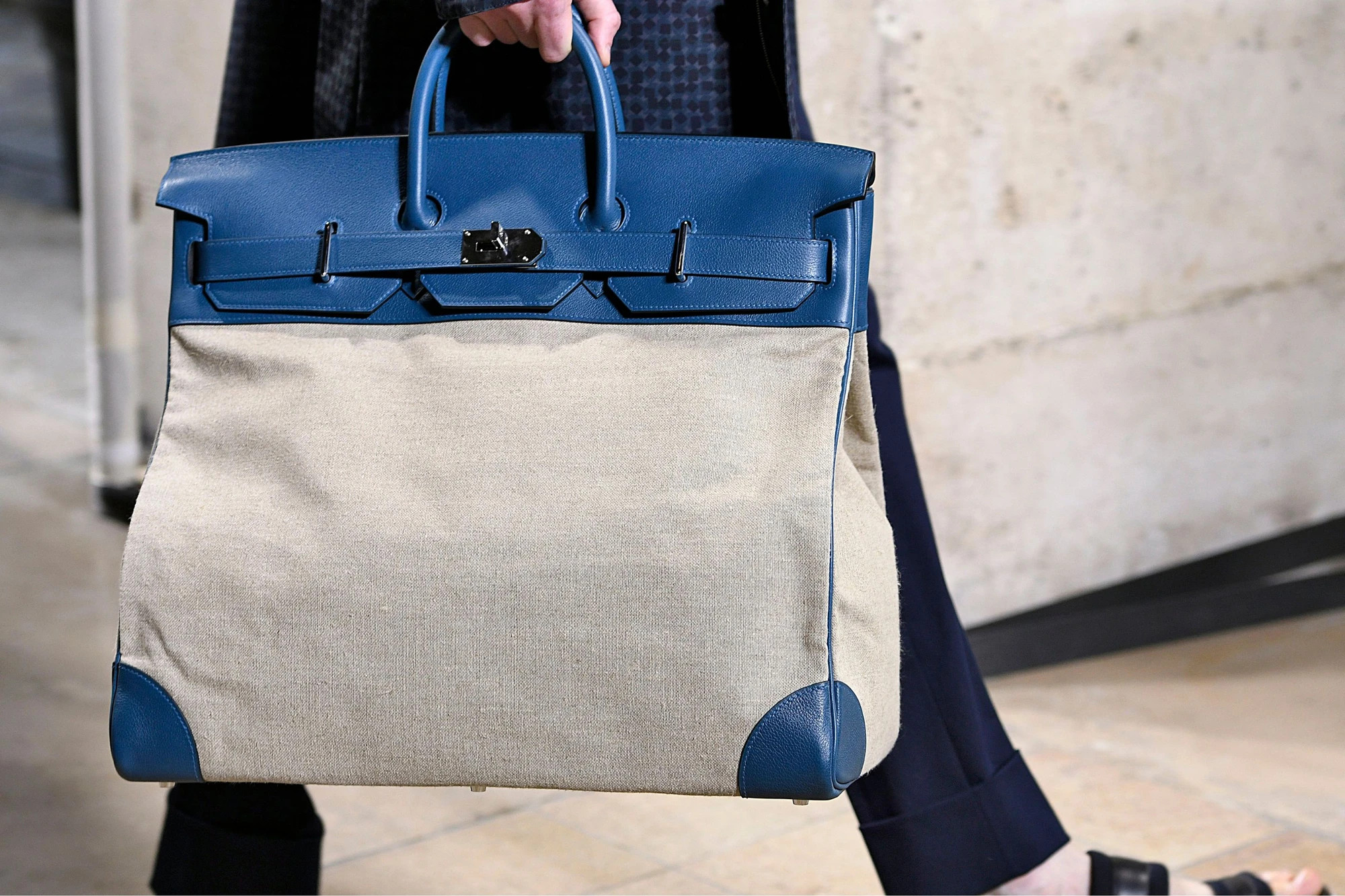
The Hermès Haut à Courroies was first designed in the late nineteenth century to carry riding boots and equipment. Its tall, structured silhouette was a piece of functional leather work, created by a Parisian harness workshop founded in 1837. This history is central to understanding why men's luxury bags have become one of the fastest-growing areas of collecting.
Today, that origin story informs a market where collectors approach bags with the same eye they bring to fine watches or contemporary art. The focus is on craftsmanship, design, and daily function. While briefcases and travel bags remain staples, larger silhouettes like the Hermès Birkin 40 and Kelly 40 are being embraced alongside the foundational HAC.
The secondary market reflects this demand. At Sotheby's, standard leather HACs generally sell for between $15,000 and $20,000. Limited editions command prices from $30,000 to $60,000, while the rarest pristine exotic examples can exceed $100,000. The Birkin 40 in leather follows a similar trajectory, typically selling for $10,000 to $20,000, with exceptional exotic versions realizing over $50,000.
The Enduring Form
The HAC occupies a unique place in the house's history. It served as the direct inspiration for the Birkin, which was introduced in 1984 as a more everyday silhouette. The HAC has remained remarkably true to its original, taller proportions, making it a natural choice for those drawn to a bag with a direct connection to the maison's equestrian roots.
Some of the most sought-after pieces reward regular use. A Naturelle Vache Liegée HAC 40 from 1990, for example, was made from a leather designed to develop a rich patina over years of travel. The subtle marks, softening, and tonal variations become part of its story. Much like a well-worn pair of boots, the bag becomes increasingly individual to its owner over time.