
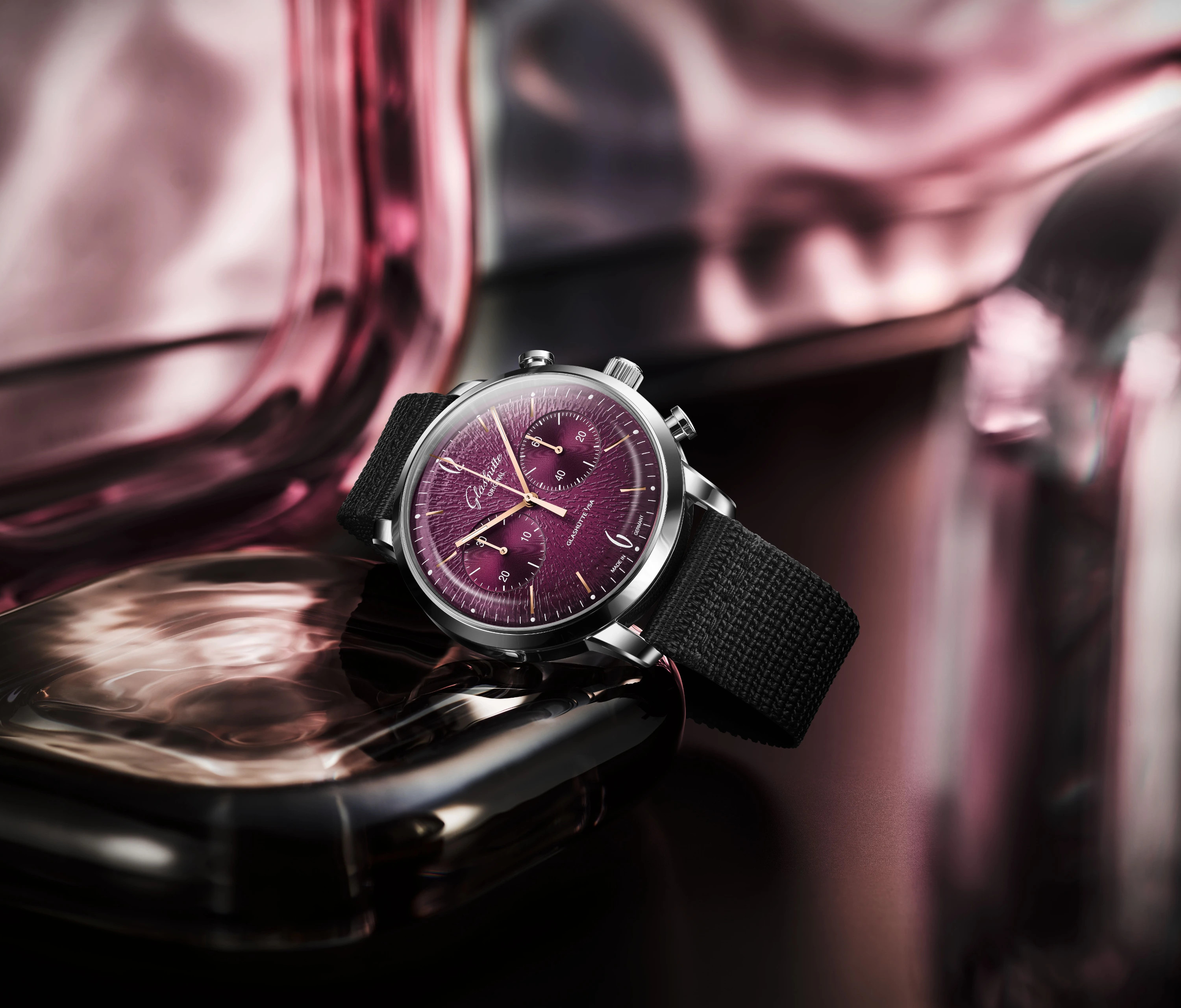
The 2026 Glashütte Original Sixties Chronograph Annual Edition begins with thin strips of bronze. An embossing stamp imparts a refined texture onto the metal base before the dial blank is cut, fitted with tiny bore holes, and milled with fine, parallel grooves that evoke the surface of a vinyl record.
Only after the blank is domed and given a galvanic coat of gold does the colour arrive. A translucent purple lacquer is applied by hand and fired in a kiln. The hour indexes are not applied or printed. They are manually incised into the domed and lacquered surface, a method that brings the warm, shimmering bronze of the base material back to the fore. The entire surface is then sealed with a protective clear lacquer. Numerals and the brand logo are imprinted and kiln-fired in several passes, and a steady hand places luminous dots on the indexes as the finishing touch.
We saw this same dial process up close a few years ago in the stone-grey Annual Edition, where a mesmerising dégradé carried the eye from a lighter centre to a darker edge. It was an unassuming favourite then, and the purple iteration earns the same close attention. This is a dial that has to be seen in person to be understood.
The Case and Calibre
The dial sits inside a polished, 42 mm stainless steel case, 12.4 mm in height with a 48.5 mm lug-to-lug, water-resistant to 3 bar. A domed sapphire crystal, antireflective on both sides, covers the face. The gold-plated hands are curved to follow the shape of the glass and carry partial Super-LumiNova® highlighting. The fluted crown features the brand's Double-G symbol.
Power comes from the automatic Calibre 39-34, beating at 28,800 A/h (4 Hz) with a 40-hour running time. The movement drives the central hour and minute hands, an off-centre small second, and the chronograph functions: a central stop-second and a 30-minute counter at 9 o'clock.