
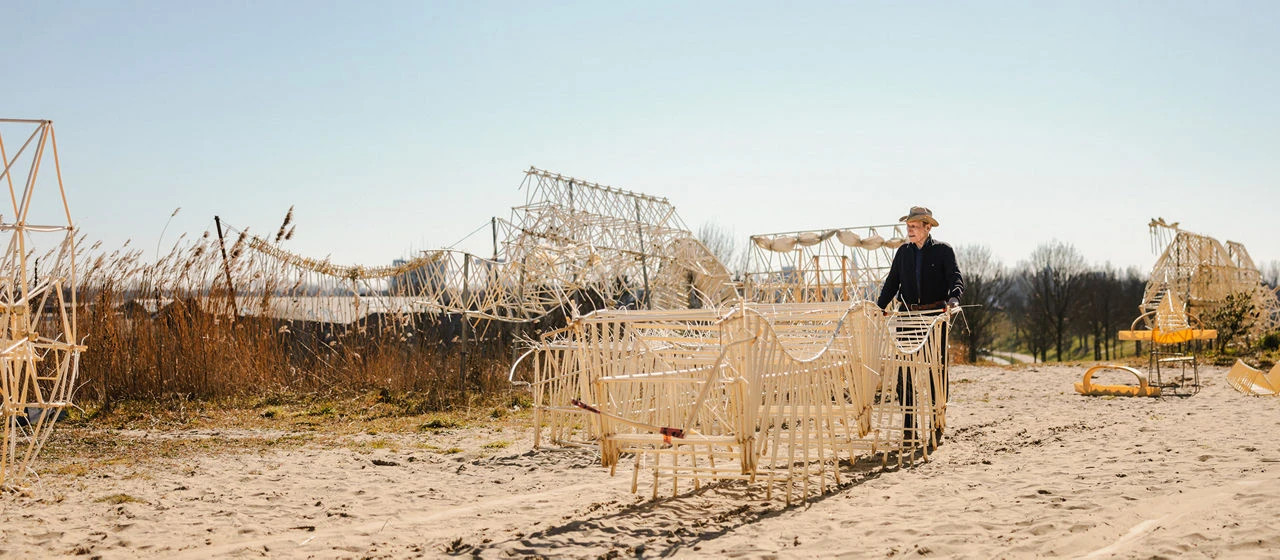
The Mechanical Souls of Theo Jansen’s Strandbeest

    The Mechanical Souls of Theo Jansen’s Strandbeest

    They begin with simple materials. Plastic tubing, cable ties, and recycled water bottles. From these, Dutch artist Theo Jansen has spent nearly 35 years building his "Strandbeest" sculptures. These are not static objects. They are complex structures built with physics and engineering to achieve an uncanny, lifelike locomotion.

    For decades, these creatures roamed the Dutch beaches, powered by wind. Over time, Jansen’s experimentation allowed them to evolve. What began as rudimentary structures, barely able to stand, became fluid beings that could mimic biological movement. They learned to store wind power, change direction upon sensing water, and anchor themselves against oncoming storms.

    A Decade of Collaboration

    The relationship between Jansen and Audemars Piguet Contemporary, the brand’s art programme, started eleven years ago. In 2014, in a collaboration with the Peabody Essex Museum, the Strandbeests were presented on Miami Beach during Art Basel.

    The partnership continued, coinciding with the watchmaker’s 150th anniversary. Audemars Piguet Contemporary supported an exhibition at Plateforme 10 in Lausanne, bringing the work “home” to Switzerland. The show, which ran from July 1 to August 3, 2025, marked a new phase for the sculptures.

    Gallery

    The Fossilised Form

    After more than a decade since their first collaboration, Jansen proposed a new state for his creations: to ‘fossilise’ them. The once mobile sculptures were frozen in time, presented in Lausanne to evoke relics from the Mesozoic age. The exhibition gave a stoic sense of the scale and power the machines once possessed while walking autonomously on the beach.

    Two large-scale sculptures took center stage in the Musée Cantonal des Beaux-Arts Auditorium, alongside sketches and materials that chronicled their complex construction. The poetic magic remained, but the potential for activation now belonged to their past. “They no longer seek the wind to propel them,” Jansen explained, “but instead invite contemplation of their mechanical souls.”

    For the artist, the moment represents a specific point in the creatures’ journey. “This exhibition represents both an end and a beginning,” Jansen stated. “The creatures have completed their evolutionary cycle on earth, yet their story continues through the eyes of those who visit them in the magnificent space of Plateforme 10.”

    Read more about watches here.