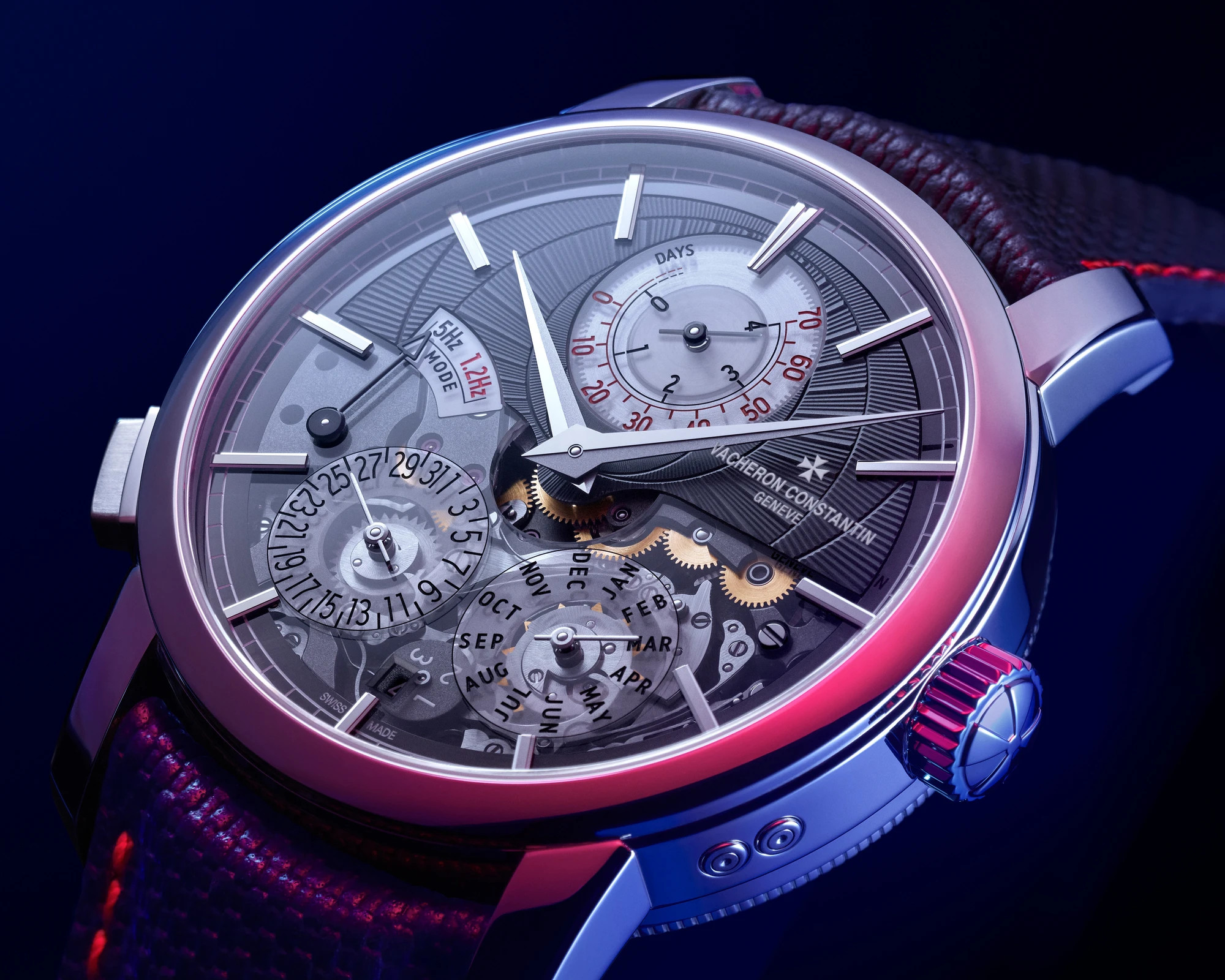
A single push-button set into the platinum case of the Vacheron Constantin Traditionnelle Twin Beat Perpetual Calendar controls the flow of time. The watch, first introduced in 2019, was conceived with the user in mind, tackling the central vulnerability of a noble complication. A perpetual calendar is built to run without intervention until 2100, but only if the movement is kept wound. Letting it stop creates a practical problem that undermines the whole point.
Vacheron Constantin’s solution, the result of four years of research, was a patented dual-frequency system. The hand-wound Calibre 3610 QP is equipped with two independent gear trains. When the watch is on the wrist, it runs in Active mode at a high frequency of 5 Hz, or 36,000 vibrations per hour, ensuring precision with a four-day power reserve. When the watch is set aside, the wearer can press the pusher at 8 o’clock to engage Standby mode.
Active and Standby
In Standby mode, the movement’s second gear train takes over, slowing the oscillation rate to an energy-saving 1.2 Hz, or 8,640 vibrations per hour. This allows the watch to maintain perfect time and calendar tracking while consuming minimal power. A mode indicator hand on the dial confirms the switch, which happens instantly without interrupting the calibre’s energy chain. The original design offered a power reserve of more than two months.
Now, further development has optimized the Calibre 3610 QP. The power reserve in Standby mode has been extended to a full 70 days, a gain of five days. This improvement comes from a new, patented double-gear spring-winding mechanism for the instantaneously jumping perpetual calendar indications. The system requires four times less torque than conventional instant-jump mechanisms, making the date change significantly less demanding on the mainspring.
Anatomy of a Calibre
The 480-component movement, measuring just 6 mm thick, features three separate differentials. One manages the transition between the two gear trains, another channels energy to the 1.2 Hz balance wheel, and a third allows a single hand at 12 o’clock to display the power reserve for both modes on a dual scale. The hairspring for the Standby balance wheel was specially developed for this movement, measuring a minuscule 0.015 mm in thickness.
The watch’s aesthetic is as considered as its mechanics. The 42 mm platinum case is 12.3 mm thick and follows the Traditionnelle collection’s design codes with a rounded shape and fluted caseback. The new openworked dial is split into two sections. An upper plate of 18k gold is finished in a slate-grey hue with a hand-guilloché radiating pattern. The lower sapphire section reveals the sandblasted mainplate, which is treated with a dark NAC galvanic coating.
This two-tone effect continues on the back of the movement, where the anthracite grey of the fixed components contrasts with the golden yellow of the moving parts. The bridges are hand-bevelled and finished with Côtes de Genève. For readability, the day, month, and power reserve counters are laser-etched glass, giving them a frosted look against the darker movement and guilloché dial. The watch is fitted with a textured calfskin strap with a 950 platinum pin buckle.
A Question of Philosophy
According to Christian Selmoni, the Maison's Legacy & Style Director, the original 2019 Twin Beat was a concept watch reflecting the brand’s research into power reserve. He notes that innovation has been a core value since the company’s founding in 1755, inseparable from the aesthetic vision. The Maison has a history of creating workshops for grand complications and pioneering astronomical calendars, including complex Hebrew and Chinese perpetual calendars.
The decision to refine the Twin Beat was a direct response to a real-world issue. “In recent years, as it has become a matter of prime importance to address users' concerns about issues relating to the power reserve of mechanical watches,” Selmoni states, “it was a natural step for us to undertake further development of Calibre 3610 QP.”
Read more about watches here.