
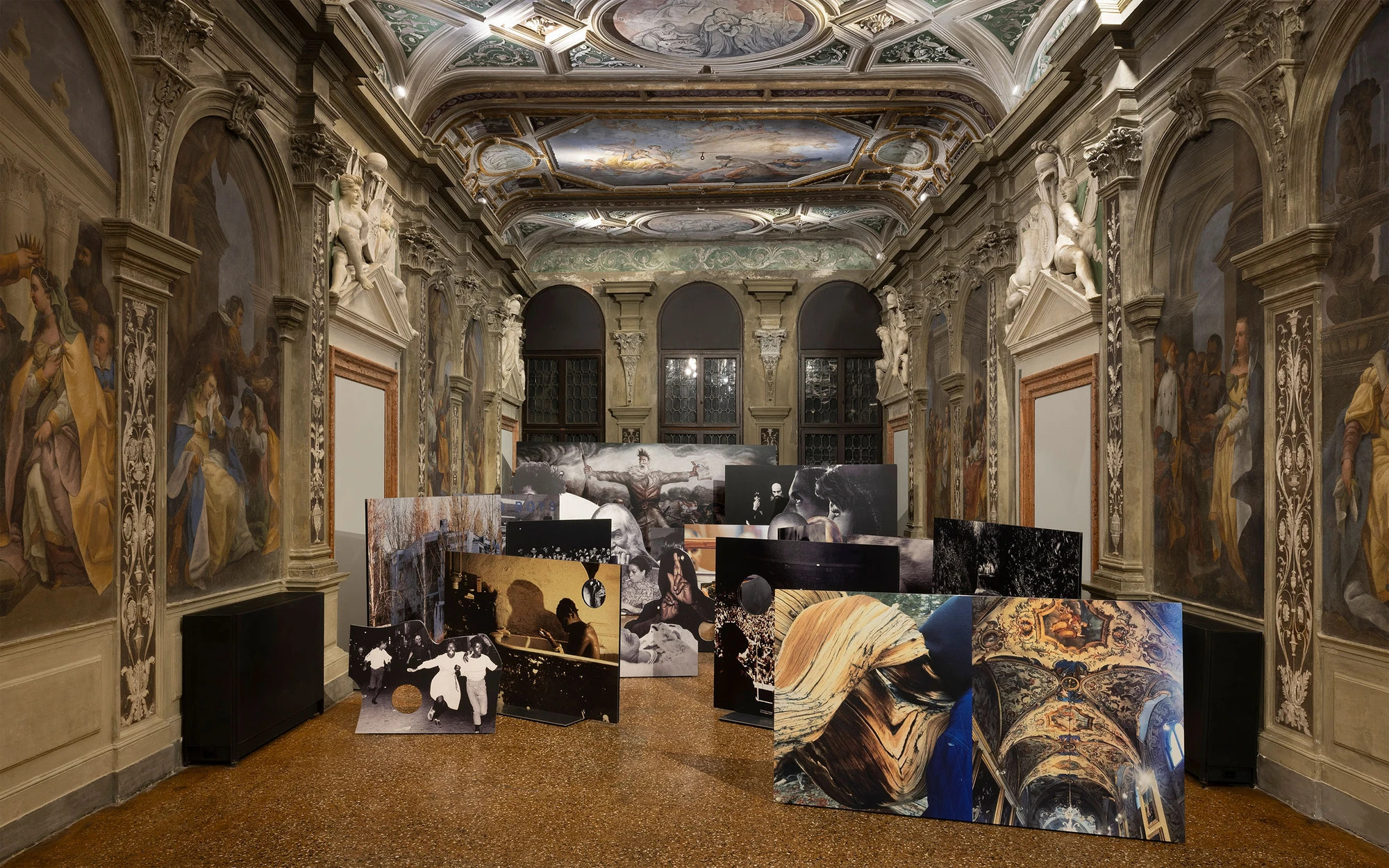
In a small, dark room on the ground floor of the Hotel Metropole, light filters through a narrow window, casting shadows across green damask wallpaper. It was here that Sigmund Freud worked on The Interpretation of Dreams. The artist Bracha L. Ettinger has turned this space into a new kind of territory, where the bathroom is filled with pink seashells and Freud’s theories are opened to a feminist gaze. This is the current state of the 61st Venice Biennale, a place where things are not fixed, and landmarks have a habit of moving.
The main exhibition, titled In Minor Keys, was conceived by the late Koyo Kouoh, who died in May 2025. Her team brought the vision to life, gathering 110 artists and collectives whose work vibrates at a lower frequency, tuned to something primordial. Kouoh wrote in her proposal that she wanted an exhibition sotto voce, or spoken softly. The result, however, is anything but muted. It is a direct examination of history, colonialism, and environmental ruin, all delivered with a sense of poetic justice.
Spread across the Central Pavilion in the Giardini and the old imperial Arsenale, the show’s central pulse is a call to pay attention. It champions artists who have continued to sound alarms in the face of opposition. One of the exhibition's lodestars, the late Senegalese artist Issa Samb, is represented by only a narrow wall of artefacts from his work with the Dakar-based collective Laboratoire Agit’Art. It feels slim for a man who reimagined a pan-African avant-garde through street performance and improvisation.
Alarms and Elegies
Other artists make their presence felt more forcefully. Beverly Buchanan’s makeshift ruins, built from offcuts of cardboard and wood, speak of communities abandoned by the state. Florence Lazar’s film, It’s All Thanks to Bad Weather, considers how Hurricane Dean unearthed the bones of enslaved people on a Martinique sugar plantation. Daniel Lind-Ramos builds carnivalesque sculptures from detritus collected after a storm, and the exhibition closes with an installation by New Orleans artist Dawn DeDeaux, who has grappled with the fallout from Hurricane Katrina since 2005.
Outside the main pavilions, the political temperature is higher. After the jury resigned over the reinstatement of the Russia and Israel pavilions, the Venice Biennale opened with a Pussy Riot protest. Pink flares and chants of ‘Love is Russia’s heart’ drowned out the techno from inside the Russian pavilion. Representing Austria, choreographer Florentina Holzinger uses her own naked body, hanging upside down, to toll a warning bell about rising sea levels while dancers are submerged in water tanks. The South Africa pavilion remains empty, its planned exhibition by Gabrielle Goliath, Elegy, moved to the Chiesa di Sant’Antonin. There, singers sustain a single note for an hour in a memorial to murdered women.