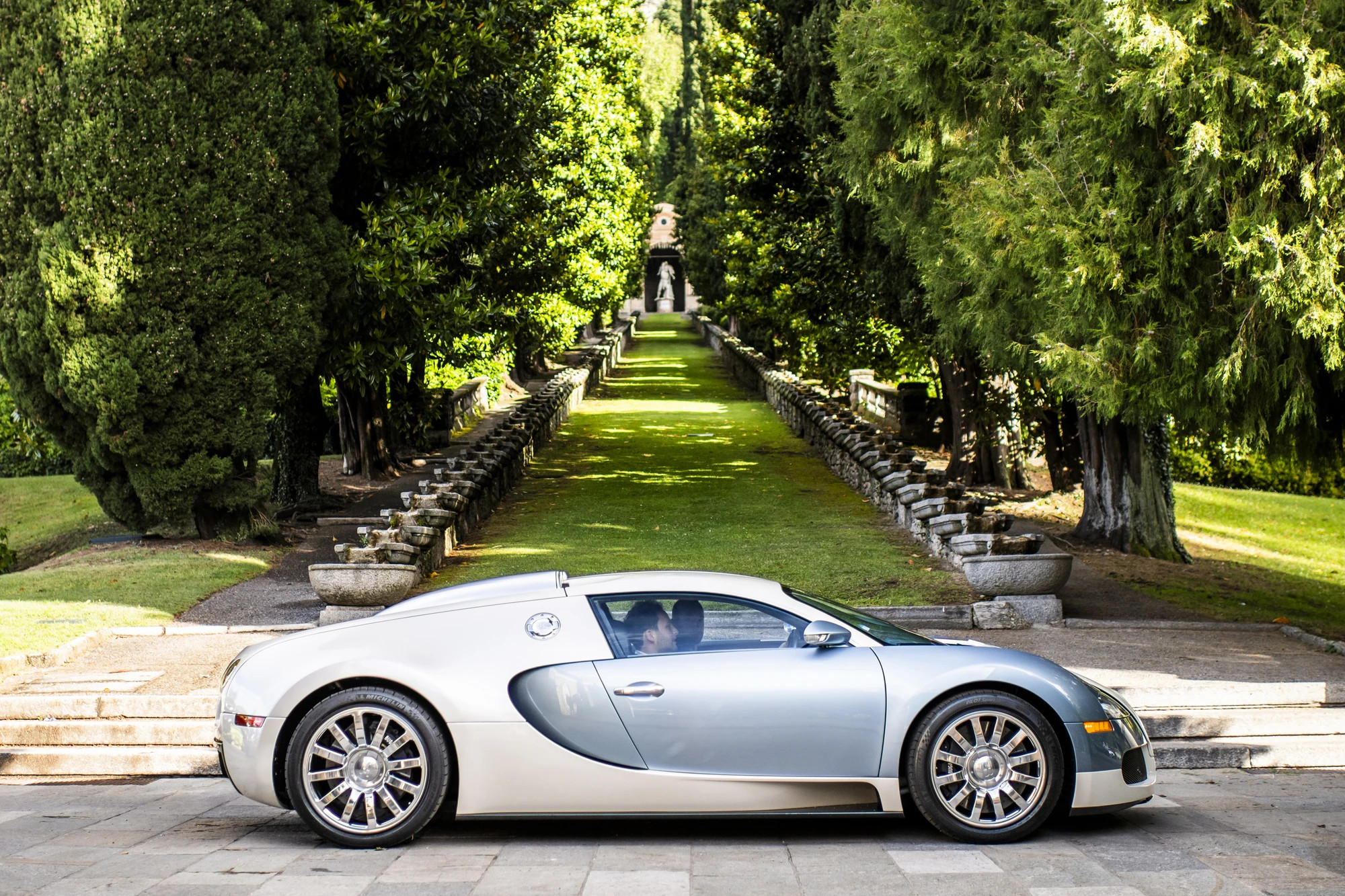
It was sent to the Nevada salt flats to endure searing heat and high-speed endurance tests. The conditions were deliberately unforgiving. For the car, known as Veyron Pre-Series Chassis 5.1, this was its purpose. It was one of just six examples built before Bugatti began customer production, created to guide the Veyron into its final form.
Chassis 5.1 stood at the intersection of an idea and a physical object. The idea belonged to Prof. Dr. Ferdinand Karl Piëch, whose ambition was a 1,001 hp, 400 km/h road car. The object was the machine that had to make that ambition real. It became one of the instruments used to refine a new standard for hypercars.
An Instrument of Creation
Present during the Nevada testing was Dr. Wolfgang Schreiber. He was one of the central figures in bringing the Veyron to series production, having masterminded its 7-speed dual-clutch DSG transmission. The gearbox was an engineering challenge of its own, built to manage the immense force of the W16 engine.
By September 2005, the car had a new identity. Registered in Germany, it was ready to operate beyond development. It traveled to Sicily for the first global dynamic event for the Veyron 16.4, where clients and media encountered the car on track and on open roads. Images from those days show Prof. Dr. Piëch seated inside 5.1, witnessing the realization of his vision.
After 12 months of demanding excursions, its role shifted. It became an ambassador in North America, appearing before select clients from Sun Valley to San Diego. It received new full-silk seats and a monochromatic engine bay. At Pebble Beach, it appeared at the Jet Center, The Quail, and The Lodge, a living record of the Veyron’s evolution.
A Life Lived
In early 2007, the car evolved again. Its engine cover was reconfigured to the final production specification and its interior was finished in deep black. By the end of that year, it had accumulated more than 21,000 km. Records from Bugatti Greenwich noted the realities of a machine that had lived a full development life, charting inspections, recalibrations, and traces of use.
As its operational life concluded in 2008, Chassis 5.1 returned to the Molsheim Atelier for its final transformation. It received authenticated production components in-line with series specification. The transition from an instrument of creation to an object of ownership was complete.
For its new owner, the dedicated team of La Maison Pur Sang has meticulously traced this tale. They gathered the documentation, imagery, and archival material to reveal the car's full character. Its value lies in its story, a living archive of the Veyron’s creation.
That story now has a new chapter on the shores of Lake Como. The car was entered by its owner into the 2026 Concorso d’Eleganza Villa d’Este, taking its place in Class H: ‘The Pace Race: The Supercar Comes of Age.’ It sat within a remarkable Bugatti continuum, represented by an EB110 GT, an unrestored Type 37 from the era of Ettore, and a rare Type 57C ‘Aravis’.
“Every Bugatti tells a story, but Veyron 5.1 carries within it the story of a whole new era for the marque. It was present at moments that shaped the Veyron’s development, its public unveiling and its introduction to customers around the world. Through La Maison Pur Sang, our role is to reveal and preserve that story with the greatest possible care – to certify the car and thus help its owner understand the depth of its significance. Chassis 5.1 therefore stands as a witness to the materialization of a dream – as did all the teams whose talent coalesced to make it a reality.”
Read more about cars here.