
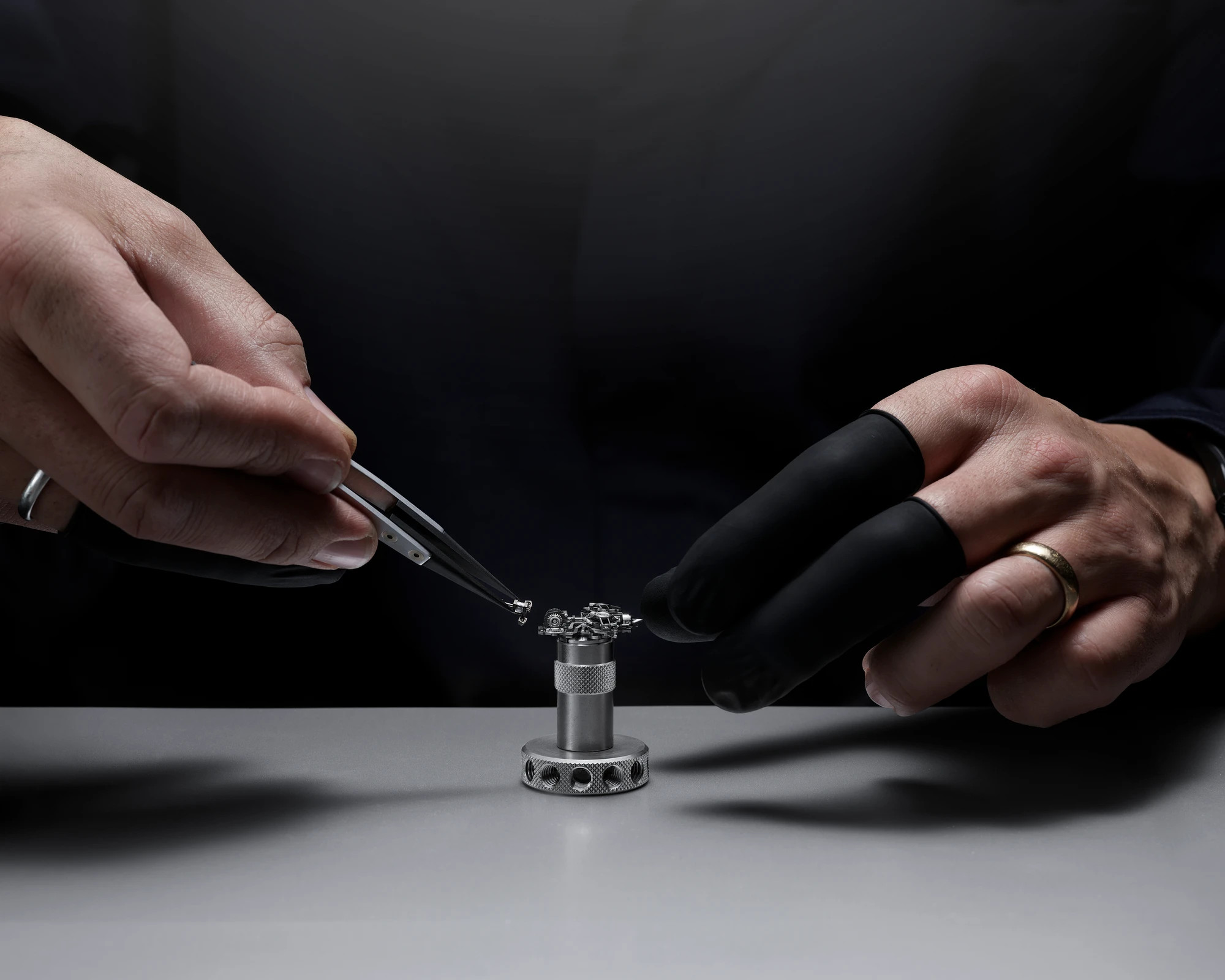
The idea behind the original Ulysse Nardin Freak was to remove everything that was not the mechanism. There was no dial, no hands, and no crown in the traditional sense. The movement itself rotated to indicate the time. It was a watch built around a single, radical thought, launched in 2001 as a defiant answer to the era of quartz. A quarter of a century later, that thought has been pushed to its mechanical limit.
The new [Super] Freak arrives to mark 25 years of the collection and 180 years of the manufacture. It takes the core concept of a watch where the movement tells the time and adds layers of complexity, resulting in what Ulysse Nardin calls the most complicated time-only watch ever created. The name feels appropriate. It is an evolution that is both a tribute to the original and a declaration of technical dominance.
The Architecture of Motion
The entire watch is a kinetic sculpture. The new Caliber UN-252 is an assembly of 511 components, and the brand notes that over 97% of them are in constant motion. The minute indicator is a flying carousel that completes a rotation every hour. Mounted on this carousel are two titanium flying tourbillons, each inclined at 10 degrees and rotating in opposite directions once every 60 seconds.
This structure is then used to introduce a new function to the Freak family, a seconds display. This small addition required its own set of mechanical inventions. Energy is managed by what Ulysse Nardin says is the world’s smallest vertical differential, a 5mm mechanism made of 69 parts that averages the rate of the two tourbillons. That energy is then transmitted to the seconds indicator via a newly patented gimbal system, another miniature marvel at just 4.8mm.