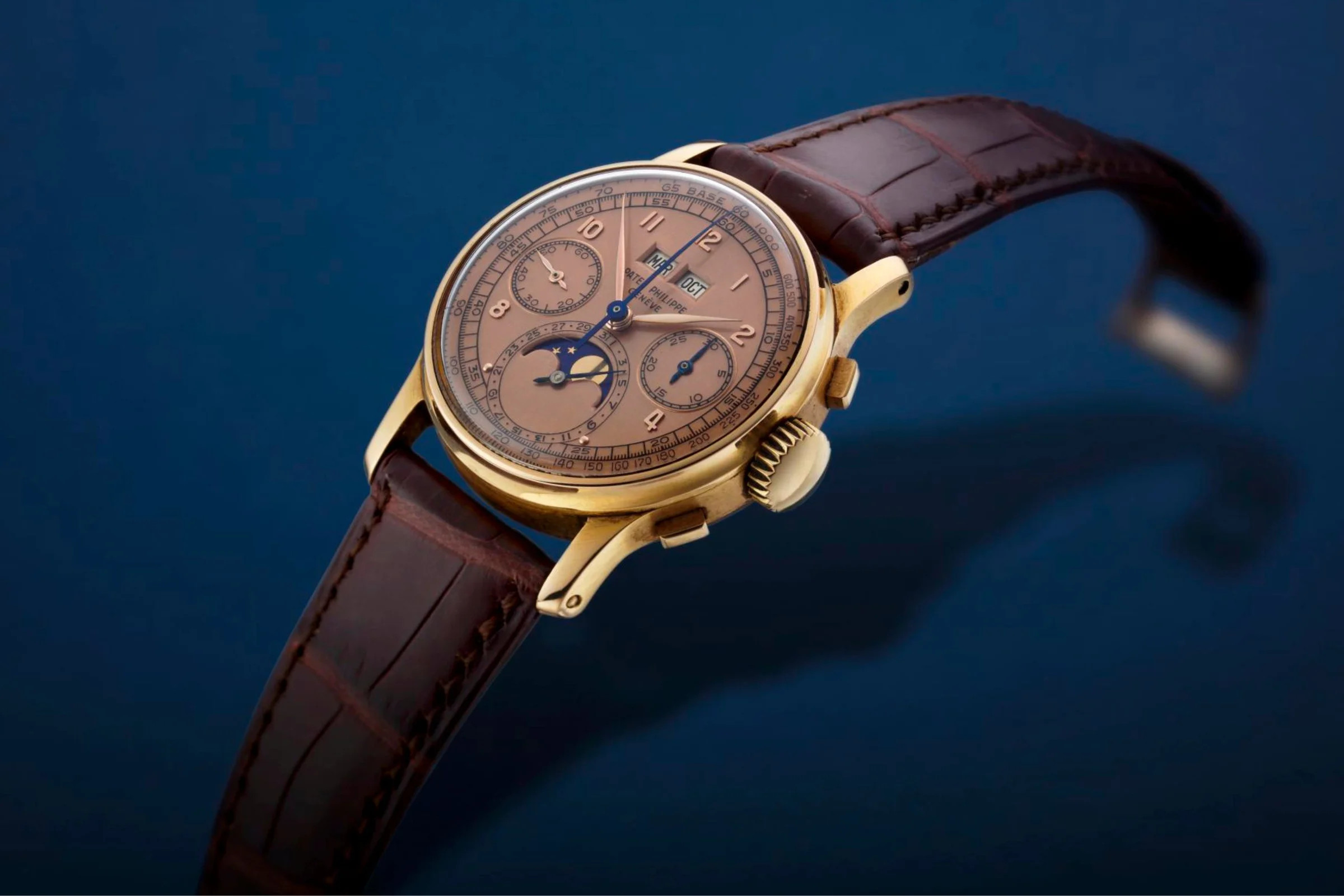
Patek Philippe perpetual calendar chronographs hold an unusual position in the auction room. When an 18-karat pink gold Reference 1518 sold for $9.6M USD in December 2021, the result reflected decades of focused scholarship. Prince Tewfik Adil Toussoun of Egypt acquired that timepiece in 1951, stored it inside a bank vault, and kept its surfaces completely intact. Collectors study these pieces because minute production anomalies transform industrial engineering into singular historical documents.
Production numbers explain the baseline interest. The manufacture built 281 examples of the Reference 1518 between 1941 and 1954, establishing the foundation for all subsequent serially produced complicated wristwatches. Approximately 58 of those pieces used pink gold cases. Only 14 known examples feature a matching pink dial, creating the pink-on-pink configuration that dominates collector discussions.
A second pink-on-pink Reference 1518 from circa 1946 brought $3.9M USD in June 2023. That specific watch carries an elongated maker signature across its dial, a configuration confirmed on just seven known pink-on-pink examples. Subtle variations in factory printing create massive divergence in historical interest.
Patek Reference 2499 and Case Evolution
The Reference 2499 arrived in 1950, introducing a larger 37.5 mm case and distinct design changes across four separate series. Patek produced 349 total examples over three decades of manufacturing. Early First Series pieces retain the rectangular chronograph pushers seen on the older 1518, while later iterations shifted to round pushers.
In November 2018, a First Series Reference 2499 manufactured circa 1952 sold for approximately $3.9M USD. The watch features an engraved caseback dated May 25, 1956, and carries the name of historic London luxury retailer Asprey on the lower dial. Dual signatures document specific retail relationships of the mid-twentieth century.
Retailer partnerships carry equal weight on the Second Series. A pink gold Reference 2499 circa 1957, bearing the Gobbi Milano signature and Italian calendar discs, achieved 60.3M HKD at auction in April 2022. Nine Second Series examples exist in pink gold, and this watch represents the sole known example bearing a retailer name.
The same Gobbi-signed piece appeared at Sotheby's in June 2025, where it realized $4.3M USD. Its original Wenger case retains crisp fluted lugs and well-defined hallmarks, while the Stern Frères dial maintains its raised enamel scales. Physical integrity remains central to how these pieces are evaluated across auction cycles.