
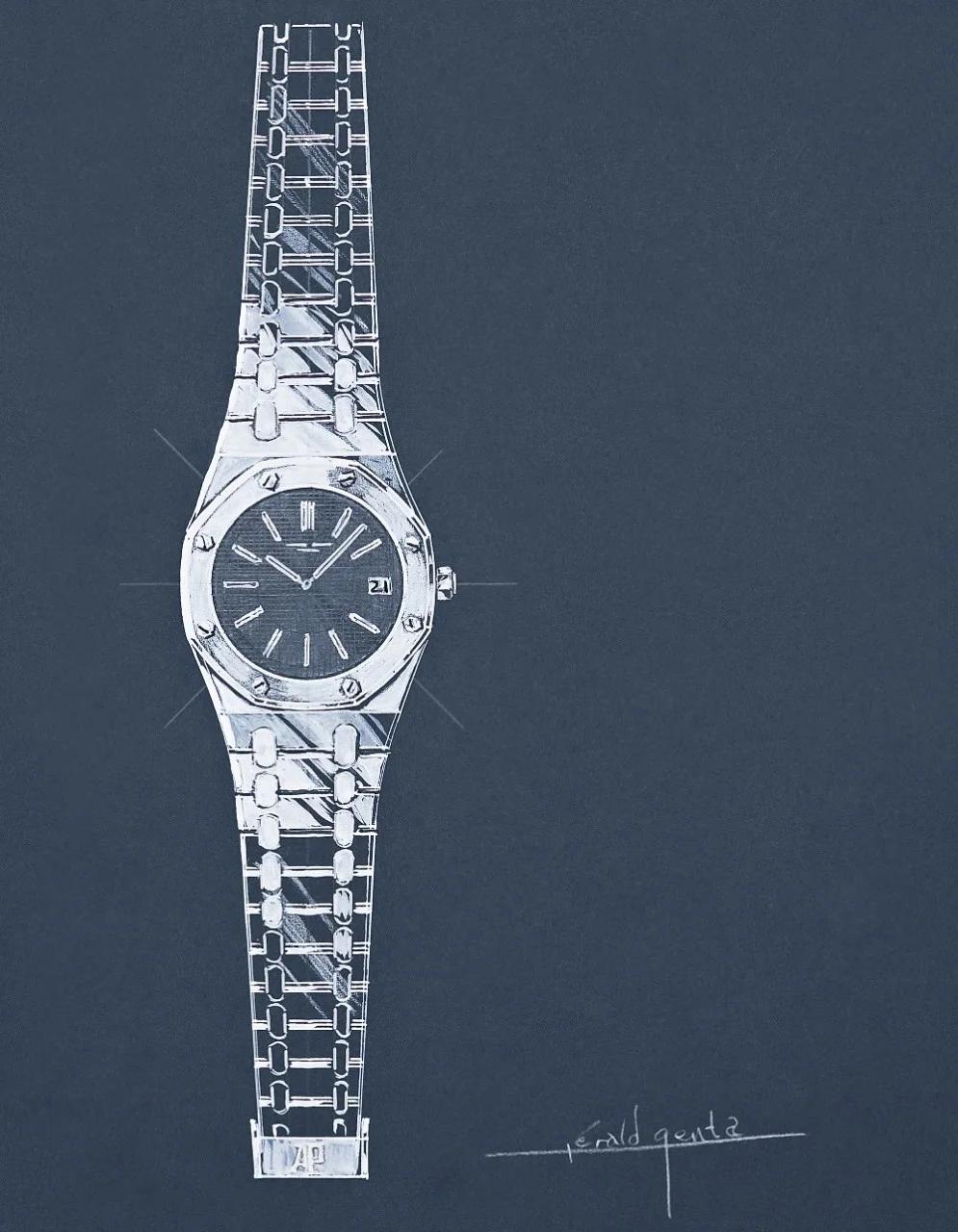
You already know that Gérald Genta drew the Royal Oak and the Nautilus, and that Jörg Hysek answered with the Vacheron Constantin 222. Fewer people know that all three left the starting line on the same movement. Jaeger-LeCoultre built it, called it the 920 and never put it in a watch of its own. Each house gave it a different name, which is why it appears on none of their casebacks.
A problem nobody could crack
Thin and automatic were opposites in the early 1960s. A full rotor sitting on top of a movement adds height, and the houses that cared most about elegance had built their reputations on hand-wound calibres instead. Audemars Piguet's Calibre 2003 of 1953 was one of them, and it became the starting point for what came next.
Getting there took years, and more than one attempt. A 1960 project with Frédéric Piguet never materialised. In 1962 a watchmaker named Mainjot proposed a self-winding system for a movement based on the 2003, but it demanded highly skilled adjustment. LeCoultre handed the work to Fernand Reymond, who died prematurely. Plans carrying the reference 920 date back to 1961, yet the project only truly began in the spring of 1963.
Watchmaker-engineer Maurice Audemars led the project, and his name is on the patent filed on 18 October 1965. On the Audemars Piguet side, technical director Jacques-Louis Audemars wore a prototype on his own wrist from June 1964 to April 1965. Vacheron Constantin took part from 1963 to 1966. Patek Philippe's references appear on the plans by 1965, although its role in the development itself is less documented.
The rotor on rails
What made the 920 work was where it put the weight. Rather than hanging a heavy rotor on a central axis, the 21-carat gold oscillating weight rides on ruby rollers that run along a circular track at its edge, much like a train on its rails. The load moves from the centre to the perimeter, which is what gave the movement its reputation for durability despite its proportions. The rotor winds in both directions, and the seconds hand was left out altogether to save height.
The result measured 2.45 mm thick and 28 mm across, at the time the thinnest self-winding movement with a central rotor. It beat at 19,800 vibrations per hour, ran on 36 jewels and held 40 hours of power. Audemars Piguet delivered its first watches with the movement in March 1967, beginning with Model 5271, and more than 12,000 had been produced over the following decade.
One engine, three names
Jaeger-LeCoultre never used the 920 itself. It supplied the movement as an ébauche, and each house finished, decorated and renamed it. Audemars Piguet called it the 2120, and in 1970 added a date version, the 2121, at 3.05 mm. At Vacheron Constantin it became the 1120 family. Patek Philippe knew it as the 28-255.
When the moment came, the movement was already waiting. The Royal Oak arrived in 1972 on the 2121. The Nautilus followed in 1976 on the 28-255. A year later Vacheron Constantin marked its 222nd anniversary with the 222. All three shared the same quiet signature: a date, and no seconds hand.
That is the part of the story usually skipped. The steel sports watch with an integrated bracelet only reads as luxury when it stays slim, and the 920 is what allowed all three to stay slim. Genta and Hysek drew the silhouettes. The movement made them wearable.
Changing hands
Patek Philippe was the first to move on. By 1981 the Nautilus had switched to an in-house movement, the calibre 335 SC in the reference 3800.
For the other two, the 920 outlived the company that designed it as a supplier. In 1999 Jaeger-LeCoultre informed Audemars Piguet that it would stop producing the ébauche. In 2000 Richemont bought Audemars Piguet's 40 per cent stake in Jaeger-LeCoultre, and by 2002 Audemars Piguet had completed the takeover of production in Le Brassus. A movement born in Le Sentier now carried on a few kilometres down the Vallée de Joux.
The long goodbye
Fifty years after the Royal Oak, Audemars Piguet retired the 2121 from the Jumbo. The reference 16202 arrived in 2022 with the new Calibre 7121, built for the watch's anniversary.
Vacheron Constantin held on longest. At Watches & Wonders in April 2026 it presented the Calibre 2550, seven years in development, in the new Overseas Self-Winding Ultra-Thin. It measures 2.4 mm, a mere 0.05 mm thinner than the movement it succeeds. More telling is how it gets there: with a platinum micro-rotor. The 920's entire idea was to make a full rotor thin enough, and almost sixty years on, its last heir solves the same problem by taking a different road.
Somebody else's masterpiece
Most great movements are remembered for the watches that wear their maker's name. The 920 is remembered for the opposite reason. It powered the Royal Oak, the Nautilus and the 222 at their birth, defined what a luxury sports watch could be, and never once appeared under its own name or in its own maker's catalogue.
The most influential automatic movement of modern watchmaking was always somebody else's.