
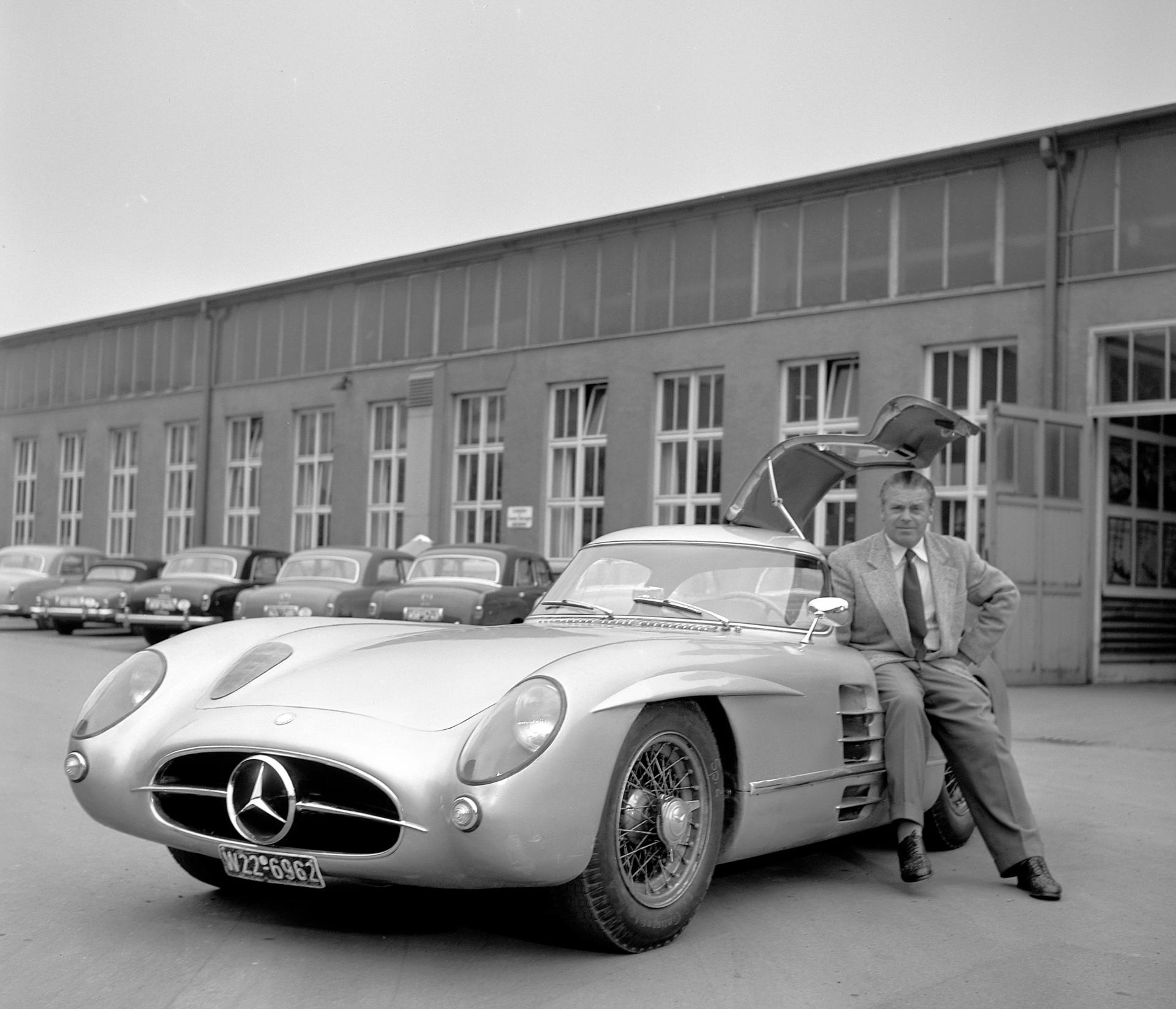
The engineer who could drive
Rudolf Uhlenhaut was born in London in 1906, the son of a German banker and an English mother. He joined Daimler-Benz as a graduate in 1931, and by thirty he was running its racing department.
Most engineers listened to their drivers. Uhlenhaut got in the car. He tested the Silver Arrows himself, flat out, and he was genuinely quick.
Mercedes still tells one story about him, and calls it outrageous itself. Over lunch during testing at the Nürburgring, Juan Manuel Fangio was grumbling about the handling. Uhlenhaut rose from the table, took the car out, and came back faster than the team had managed in the Grand Prix. Fangio, he suggested with a wink, just needed more practice.
One more detail is worth keeping in mind. The man who built some of the fastest cars of his era never owned a car of his own.
Two coupés for Mexico
The 300 SLR was Mercedes' Grand Prix car turned into a sports car, its straight eight enlarged to three litres. In open form it won the 1955 Mille Miglia with Stirling Moss at the wheel, and went on to take that year's World Sportscar Championship.
Uhlenhaut's department gave it a roof. Three chassis were meant to get closed bodywork, drawn by Friedrich Geiger, and two were completed. The doors lifted upwards like the 300 SL road car's, but underneath sat a racing car: three hundred horsepower, when Mercedes' fastest road car made 215, and a top speed close to 180 mph.
The target was the Carrera Panamericana, the road race across Mexico that Mercedes had won one-two in 1952. On highway straights that ran for miles, a closed car would pay off.
The season that ended early
In June 1955, one of the team's 300 SLRs was caught up in the disaster at Le Mans, and Mercedes withdrew its cars from the race. In the aftermath, the Carrera Panamericana was cancelled.
Mercedes still won the championship that autumn, then walked away from motorsport in October. Most people assume Le Mans ended it. The bigger reason was back in Stuttgart: five hundred people were tied up in racing, holding back the production cars, and the board wanted them back.
Neither coupé ever started a race. The first, trimmed in blue, came closest. Uhlenhaut drove it to the Swedish Grand Prix and on to Monza, and it ran practice laps in Northern Ireland and in Sicily, where Moss damaged it before the Targa Florio. The second, trimmed in red, was only finished on 28 December 1955, with nothing left to race.
The commute
So two of the fastest cars in the world had nowhere to go. Uhlenhaut took the blue one as his company car, and the man who never owned a car now drove a racing car to work.
An outsize silencer went on so it could use public roads. Even so, his secretary is said to have reminded him one morning that it was past eleven, with a noon meeting in Munich, two hundred kilometres away. As Mercedes tells it, he got into the coupé and arrived on time.
In 1956 the company lent the blue car to two journalists, Robert Braunschweig of Automobil Revue and Gordon Wilkins, who drove it more than two thousand miles across Europe. Wilkins was clear about one thing in his report: "this car is not for sale, and in this form never will be."
Stuttgart, May 2022
For sixty-seven years Mercedes kept both. Offers came in over the decades, some went a long way up the company, and every one was politely turned down.
Then the board changed its mind. On 5 May 2022, inside the Mercedes-Benz Museum, RM Sotheby's held an auction for a small group of invited collectors. The bidding opened above the price of the Ferrari 250 GTO that had set the auction record in 2018.
The hammer fell at 135 million euros, nearly three times the old auction record. It is still the most valuable car ever sold. The money became the starting capital of the Mercedes-Benz Fund, which gives scholarships to young people working in environmental science and decarbonisation, and the buyer agreed the car would still appear in public on special occasions.
The car that left was the second one, the coupé with the red interior. The blue one, the car Uhlenhaut drove to work, never left the company. It still stands in the museum in Stuttgart.
Built to win in Mexico. He used it for the commute.