
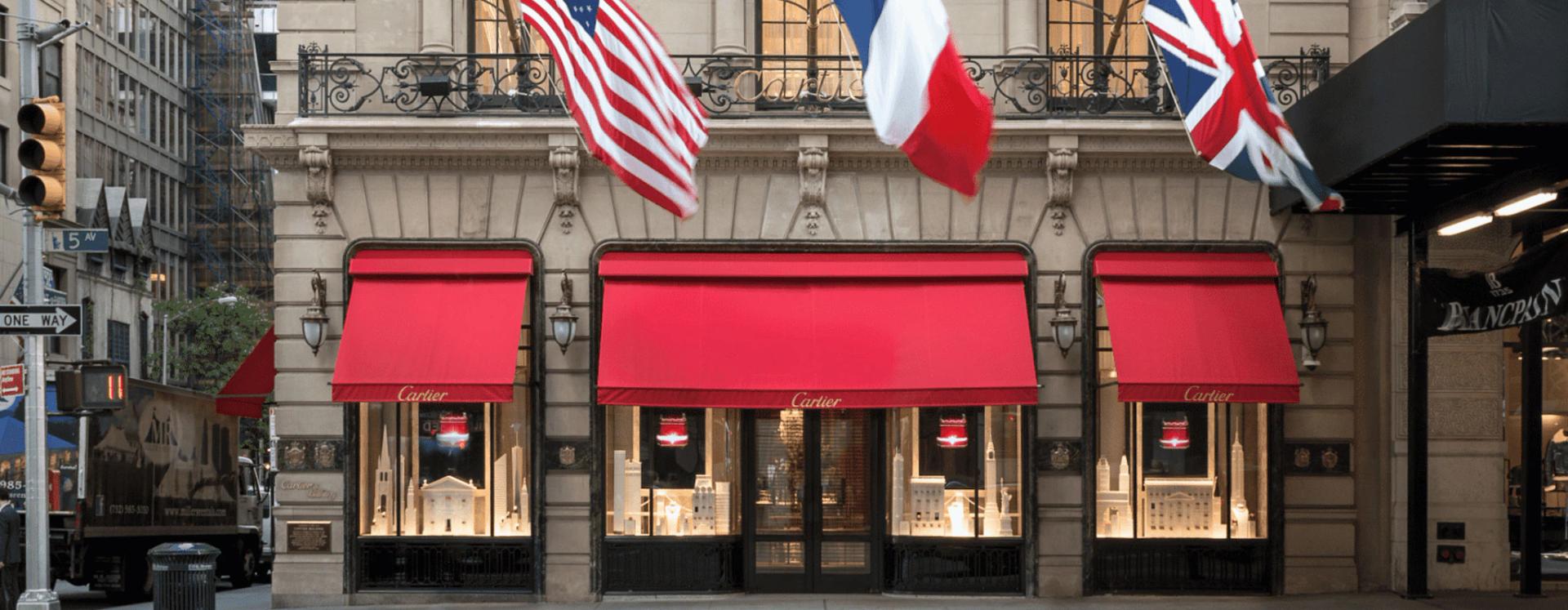
Most founding myths in luxury get better with every retelling. Cartier's New York story barely needs the help, and it comes with an address: 653 Fifth Avenue.
In 1904, Morton Freeman Plant bought a corner plot at Fifth Avenue and 52nd Street from William K. Vanderbilt. Plant was a financier and the son of Henry B. Plant, the railroad and steamship magnate, and the Vanderbilts set one condition on the sale: for twenty five years, the land could not go to a commercial interest. This was Millionaires' Row, and the families on it intended to keep the shops away. On the corner, the architect Robert W. Gibson gave Plant a Neo-Renaissance palazzo in marble and limestone, finished in 1905.
Trade moved north regardless. Stores and hotels crept up the avenue block by block, and in 1915, not even halfway into the term, Vanderbilt conceded the fight and lifted the restriction from the deed. Plant was already looking elsewhere, and moved further up Fifth Avenue to 86th Street.
Cartier, meanwhile, needed a proper New York home. Pierre had opened the branch in 1909 and was selling from a salon on the fourth floor of 712 Fifth Avenue. In that salon, Maisie Plant, Morton's wife, found the piece she wanted: two strands of natural pearls, 128 of them, graduated and matched, with clasps signed Cartier. Assembling a set like that had taken the house years. Its value was put at around a million dollars.
Each side now held what the other wanted. So in 1917 they traded: the pearls and a hundred dollars for the house. Reporting the sale, The New York Times described the Plant residence as one of the barriers holding back the northward movement of trade on Fifth Avenue. The house built to keep commerce out was about to become one of the most famous shops on the street.
To convert it, Cartier brought in the architect William Welles Bosworth, and the facade stayed. Maisie, for her part, sat for the society painter Alphonse Jongers wearing the pearls. Morton died in November 1918, little more than a year after the trade. She kept the strands through two more marriages, ending as Mrs John E. Rovensky.
Then the market moved. Cultured pearls arrived in volume between the wars, and natural pearls never recovered their price. On 23 January 1957, Parke-Bernet sold both strands from Maisie's estate. Together they made 165,000 dollars.
The building went the other way. New York made it a landmark in 1970. In 2001 the corner became Place de Cartier. In 2016, after almost three years of restoration under Thierry Despont, the mansion reopened, and one of its rooms is now the Maisie Plant Salon.
Pierre Cartier gave a woman the necklace she fell for, and she gave him an address. A century later, Cartier is still on the corner, and the woman who made the trade has a room of her own inside it.